

Technical Q&A
Tunable White or Single-Color COB LED Strip: How to Choose
Tunable white or fixed CCT COB LED strip? Compare flexibility, controls, cost and typical applications to specify the right approach for your project.
2026-10-12
COB LED Strip Power Consumption: Watts and Running Costs
How much power does a COB LED strip use? Typical watts per meter, the 12V/24V current math, PSU sizing headroom and what 100 meters cost to run.
2026-10-12
Custom COB LED Strip: MOQ, Lead Time and OEM Options
Planning custom COB LED strips? Understand typical MOQs, OEM options, lead times and the specs you can customize before requesting a quotation.
2026-10-10
COB vs SMD LED Strip: 6 Differences Buyers Should Know
COB or SMD LED strip? Compare construction, light quality, efficiency, durability and price so you can choose the right technology per project.
2026-10-09
COB LED Strip Lifespan: How Long Do They Really Last?
How long do COB LED strips last? What the L70 rating means, which heat and driver factors shorten service life, and how buyers protect it.
2026-10-08
COB LED Strip Price: What Drives Cost and How to Compare
What drives COB LED strip price? See the cost factors behind every quote and how wholesale buyers should compare offers before placing an order.
2026-10-07
12V COB LED Strip vs 24V: How to Choose the Right Voltage
Compare 12V and 24V COB LED strip options: voltage drop, run length, cut precision, drivers and cost, so you can specify the right voltage.
2026-10-06
High CRI COB LED Strip: Why Color Accuracy Matters
Learn what a high CRI COB LED strip is, why CRI 90+ matters in retail and hospitality lighting, and how B2B buyers can specify color-accurate strips.
2026-10-05
COB LED Strip Sample Testing: 7 Checks Before a Bulk Order
Sample testing is the cheapest insurance in LED strip procurement — and the most commonly skipped step. Suppliers send free
2026-09-30
COB LED Strip Lights vs LED Neon Flex: A Buyer’s Comparison
Compare COB LED strip lights and LED neon flex for commercial decoration — light quality, installation, cost, maintenance and when to choose each.
2026-09-29
Flexible COB LED Strip: How to Bend, Cut and Install It Right
Learn how to bend, cut and install flexible COB LED strip correctly — bending radius, soldering, channels and the mistakes that void warranties.
2026-09-28
Specifying COB LED Strip for Architectural Lighting Projects
Specify COB LED strip for architectural lighting with confidence — lumens, IP ratings, controls, sampling and tender documentation checklist.
2026-09-24
RGB COB LED Strip vs SMD RGB: A Buyer’s Comparison Guide
Compare RGB COB LED strip and SMD RGB for retail and hospitality: light quality, color mixing, cost and sourcing tips from GPD engineers.
2026-09-23
Dimmable COB LED Strip Lights: A Guide to Flicker-Free Dimming
Compare TRIAC, 0-10V, DALI and PWM dimming for dimmable COB LED strip lights — and learn how to eliminate flicker in commercial projects.
2026-09-22
Waterproof COB LED Strip Lights: How to Choose the Right IP Rating
Compare IP20, IP65, IP67 and IP68 waterproof COB LED strip lights for outdoor projects — specs, applications and a wholesale sourcing checklist.
2026-09-21
COB LED Strip Lights: A Buyer’s Guide for Commercial & Architectural Projects
Source dotless COB LED strip lights for commercial projects. Compare 12V/24V, waterproof, high-CRI, dimmable and RGB options — plus a wholesale sourcing checklist.
2026-09-19
COB LED Strip Lights: Dotless, Ultra-Smooth Lighting for Premium Decor
If you’re tired of grainy, dotted lighting from traditional LED strips and craving a high-end, uniform glow for your space,
2026-09-16
24V LED Strip Lights: Stable, High-Brightness Lighting for Long Runs
When upgrading your home or commercial lighting, voltage stability is key to smooth, flicker-free illumination. While 12V LED strips work for short-distance decoration, 24V LED strip lights are the premium choice for longer lighting runs, brighter output, and more stable performance. Ideal for large room renovations, cabinet lighting, outdoor decor, and commercial displays, they deliver consistent lighting quality that standard low-voltage strips cannot match.
2026-09-07
Why LED Strip Lights Won't Turn On: Troubleshooting
There can be many possible reasons why LED strip lights won't turn on. Here are some common ones: ESD damage: LED is an electrostatic-sensitive component. If static protection is inadequate during production, the LED chip may be burned out by static electricity. Strengthening ESD protection—such as requiring staff to wear anti-static gloves and wrist straps as regulated, and ensuring tools and instruments are properly grounded—can prevent this problem. High-temperature damage: LEDs do not tolerate high temperatures well. If the soldering temperature and
2024-02-13
What Is an LED?
LED is the abbreviation of Light Emitting Diode. It is a solid-state lighting technology that emits light when electrons and holes recombine and release energy. LEDs are widely used in modern society, such as in lighting, flat-panel displays, and medical devices. The core of an LED is essentially a PN junction. When a forward voltage is applied, electrons diffuse from the N region to the P region, and holes move from the P region to the N region, where they recombine with the
2024-02-13
Downloads
Follow Us
Official Account: Douyin:
2026-04-06
Why LED Strip Lights Won't Turn On: Troubleshooting
There can be many possible reasons why LED strip lights won't turn on. Here are some common ones:
ESD damage: LED is an electrostatic-sensitive component. If static protection is inadequate during production, the LED chip may be burned out by static electricity. Strengthening ESD protection—such as requiring staff to wear anti-static gloves and wrist straps as regulated, and ensuring tools and instruments are properly grounded—can prevent this problem.
High-temperature damage: LEDs do not tolerate high temperatures well. If the soldering temperature and time are not properly controlled during production and repair, the LED chip may be damaged by excessive or sustained high temperature. Proper temperature control for reflow and soldering irons, using temperature-controlled irons, can effectively prevent the iron's high heat from burning out the LED chip.
Moisture explosion under high temperature: If an LED package is exposed to air for a long time, it absorbs moisture. Without a dehumidification process before use, during reflow soldering the moisture inside the package expands from the high temperature and long cycle, causing the LED package to crack and indirectly leading to overheating and damage of the LED chip.
Inadequate packaging protection: If the LED strip's packaging protection is insufficient, the beads may be damaged by impact during transport.
Welding quality issues: Cold solder joints on the LED strip can cause the solder to fall off during transport vibration, leaving the strip dark. In addition, insufficient solder volume, poor solder quality, brittle or detached joints can also cause the strip not to light up.
Installation problems: Bending the LED strip at too sharp an angle during installation can separate the solder joints from the copper foil and cause failure to light. Over-compressing the product during installation can damage the chip or cause joint deformation and detachment. The LED strip must not be twisted during installation, otherwise the solder joints may detach and the strip won't light.
Voltage or current issues: Long-term operation causing overheating, or voltage problems burning out the LEDs; excessive current or voltage puncturing the resistor and severely damaging it, so the entire strip goes dark.
Identifying the specific fault cause and repairing it may require professionals using specialized tools and equipment for testing. If you encounter an LED strip that won't light up, we recommend contacting a professional technician for inspection and repair.
What Is an LED?
LED is the abbreviation of Light Emitting Diode. It is a solid-state lighting technology that emits light when electrons and holes recombine and release energy. LEDs are widely used in modern society, such as in lighting, flat-panel displays, and medical devices. The core of an LED is essentially a PN junction. When a forward voltage is applied, electrons diffuse from the N region to the P region, and holes move from the P region to the N region. Within a few microns near the PN junction, electrons recombine with the holes in the N region and the electrons in the P region, producing spontaneously radiated fluorescence. The energy states of electrons and holes differ across semiconductor materials. The amount of energy released when they recombine varies—more energy released yields a shorter wavelength (bluer light), while less energy yields a longer wavelength (redder light). The color of light emitted by an LED (i.e., its wavelength) is determined by the material of the chip.
In the LED display industry, "LED" specifically refers to LEDs that emit visible light. The smallest light-emitting pixel of an LED display has the same meaning as the "pixel" in an ordinary computer monitor. An LED display is composed of several display pixels; the structurally independent minimum unit that forms an LED display is the LED display module. With its unique advantages, LED displays are widely used in various settings such as billboards, stadiums, stage backdrops, and traffic signals.
Compared with traditional lighting technology, LEDs offer many advantages: high efficiency and energy saving, environmental friendliness, long lifespan, and small size. Therefore, LED applications in lighting are expanding—not only for general illumination but also for special lighting fields such as plant growth lights, automotive lighting, and landscape lighting. With continuous technological progress and falling costs, the prospects for LED applications will be even broader.
Follow Us
Official Account:
Douyin:


24V LED Strip Lights: Stable, High-Brightness Lighting for Long Runs
When upgrading your home or commercial lighting, voltage stability is key to smooth, flicker-free illumination. While 12V LED strips work for short-distance decoration, 24V LED strip lights are the premium choice for longer lighting runs, brighter output, and more stable performance. Ideal for large room renovations, cabinet lighting, outdoor decor, and commercial displays, they deliver consistent lighting quality that standard low-voltage strips cannot match.
The most significant advantage of 24V LED strip lights is their superior voltage stability. Longer LED strips often suffer from voltage drop, causing dimmer lights and uneven color at the tail end. Thanks to higher operating voltage, 24V strips effectively reduce voltage loss over long distances. Even when installed in full-length layouts for ceilings, corridors, and large cabinets, they maintain uniform brightness from start to finish, with no dark segments or inconsistent glow.
Built for higher brightness and better load capacity, 24V LED strips offer stronger and more concentrated illumination. They provide brighter, clearer light while remaining flicker-free and eye-friendly, perfect for functional task lighting as well as aesthetic ambient lighting. Whether you need bright under-cabinet lighting for food preparation, soft continuous glow for bedroom ambiance, or vivid accent lighting for store displays, these strips perform steadily and reliably.
Safety and durability make 24V strips a cost-effective long-term investment. As safe low-voltage lighting, they produce extremely low heat after long hours of operation, avoiding overheating risks. The stable circuit structure greatly reduces light decay, burnout, and short-circuit issues. With a longer service life and consistent performance, they require minimal maintenance, helping you save frequent replacement costs.
Flexible and user-friendly installation fits both residential and commercial scenarios. Ultra-thin and highly bendable, 24V LED strips can adapt to curved surfaces, corners, and narrow gaps. The self-adhesive backing allows quick, drill-free installation on walls, ceilings, cabinets, and staircases. You can freely cut the strips at designated marks to customize lengths for your exact space needs, making them perfect for DIY lighting projects.
Versatile in application, 24V LED strip lights suit nearly all indoor and mild outdoor lighting needs. They are widely used for living room ceiling contour lighting, kitchen under-cabinet lighting, bedroom background lighting, long corridor decoration, shop window displays, and studio ambient lighting. Many models support RGB color changing, dimmable brightness, and smart control, allowing you to switch modes freely for daily use, festivals, and parties.
If you are looking for stable, long-lasting, and high-brightness LED strips for large or long-distance lighting layouts, our 24V LED strip lights are the ideal solution. Enjoy uniform illumination, reliable safety, and flexible DIY design to upgrade your space with professional-quality lighting.
Tunable White or Single-Color COB LED Strip: How to Choose
Most quotations default to a single fixed color temperature, and for good reason — it is simple, stable and cheap to control. But an increasing share of project inquiries now ask for something more flexible: a tunable white COB LED strip that shifts between warm and cool white on demand. Whether that flexibility is worth specifying depends on how the space will actually be used, and on the control and cost implications that come with it. Here is how buyers and specifiers can decide between the two approaches.
How a Tunable White COB LED Strip Works
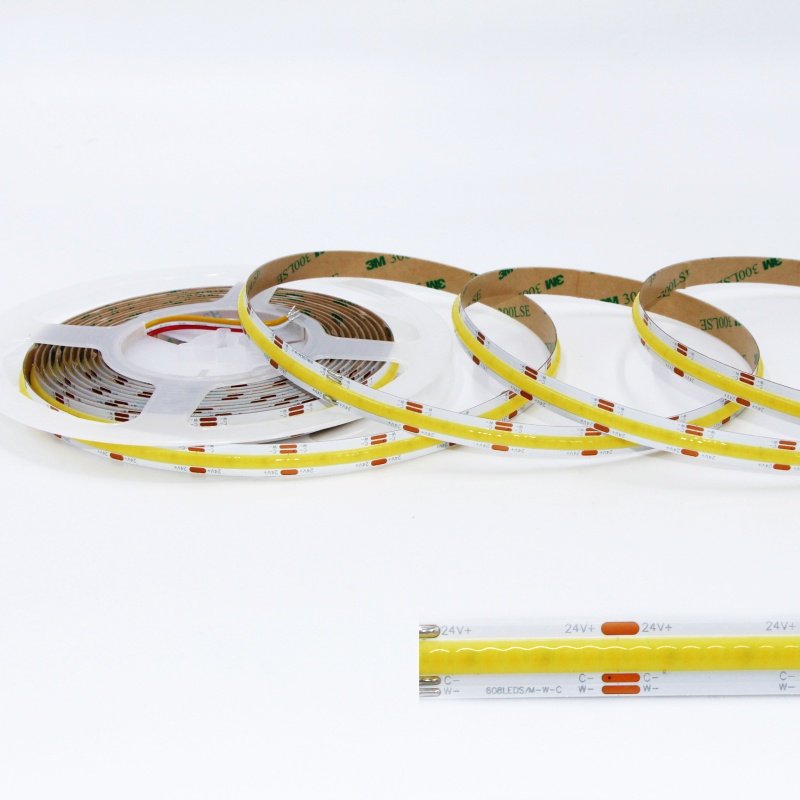
A tunable white strip carries two sets of LED dies — one warm, one cool — under the same continuous phosphor film. A dual-channel controller drives each set independently, and the mixed ratio sets the output anywhere across the range, typically 2700 K to 6500 K. This is why ratings like “7 W + 7 W” appear on datasheets: two channels, each with its own load. Our 10 mm 608 LED/m dual-channel strip is built exactly this way. The construction matters for sourcing, because a tunable white COB LED strip needs a two-channel controller and a power budget that accounts for both channels, not a standard single-circuit driver.
Where Single-Color COB Strip Is Still the Right Answer
Fixed CCT remains the correct specification for the majority of installations. When the brand standard is settled — 3000 K hospitality, 4000 K office, 5000 K retail — a single-color strip delivers it with simpler drivers, ordinary dim-to-warm-free controls and no commissioning beyond standard aiming and dimming. It is also the budget-friendly route: fewer channels, smaller power supplies and no interface to program. For cove lighting, concealed shelf lines and most fit-outs where the architectural concept already fixes the color temperature, single-color COB strip is the efficient, low-risk choice.
Where Tunable White Earns Its Premium
- Wellness and daylight schemes: offices and healthcare spaces that follow daylight rhythms shift from cool morning light to warm evening light automatically.
- Multipurpose hospitality: a restaurant floor that runs bright and neutral at breakfast and warm and intimate at dinner — one installation, two moods.
- Showrooms and exhibitions: merchandising and exhibit layouts change; tunable white adapts without re-lamping.
- Unfinished spaces: when furniture, finishes or brand standards are not final, tunability removes the risk of specifying the wrong CCT on day one.
Tunable White vs Single Color at a Glance
| Factor | Tunable white | Single color |
|---|---|---|
| CCT flexibility | Full range, on demand | One fixed value |
| Control gear | Dual-channel controller | Switch or standard dim |
| Drivers and wiring | Two channels, higher total load | Single circuit |
| Commissioning | Mix curves and scenes to set | Minimal |
| Typical cost | Higher | Lower |
Specifying Checklist for Tunable White Projects
- Confirm the control protocol first — dedicated CCT controllers, DALI, 0-10V dual-channel or RF/app systems — and match the strip’s channel wiring to it.
- Size the power for both channels: a “7 W + 7 W” strip draws up to 14 W per meter at full white, so the usual power consumption math applies twice.
- Ask for channel-to-channel consistency data; the warm and cool dies should blend without a visible crossover band at mid-range mixes.
- Sample the actual mixes on site — 2700 K, 4000 K and 6500 K scenes tell the client more than a datasheet.
- Document the scenes and handover settings, and file the spec alongside the rest of the buyer’s checklist.
Frequently Asked Questions
Can a tunable white COB LED strip be locked to one fixed CCT?
Yes — the controller simply holds a fixed mix ratio, or the installer drives one channel. It works, but if the color temperature will genuinely never change, a single-color strip delivers the same result at a lower cost with simpler controls.
Does tunable white COB LED strip cost more to run?
At any given moment the strip draws roughly the power of whichever channel mix is active, so everyday running cost is comparable to a single-color strip of similar density. The system’s maximum load is higher because both channels can run together, which affects driver sizing rather than the energy bill.
Which spaces benefit most from tunable white?
Multipurpose and wellness-driven spaces: hotel ballrooms that host breakfast and evening events, meeting rooms that switch between presentation and collaboration, offices following daylight rhythms, and showrooms that restyle regularly. Single-purpose spaces with a fixed brand CCT rarely justify the premium.
Compare Both Options on Your Project
Undecided between the two? Browse our COB LED strip lights range for single-color and dual-channel options, or contact the GPD team with your application — we will quote both approaches with controller recommendations, samples and photometric data so the decision is made on real light.
COB LED Strip Power Consumption: Watts and Running Costs
Wattage is the specification buyers ask about last and need first. COB LED strip power consumption decides the driver size, the cable gauge, how many feed points a run requires and — over the years — a visible slice of the client’s energy bill. Yet it is also the number most often skimmed over in quotations. This guide walks through typical wattage ranges, the voltage math behind them, how to size the power system with headroom, and what a real installation costs to run.
How Many Watts Does a COB LED Strip Use?
Rated power per meter scales with density and board width. Typical figures run from around 8 W/m for slim, standard-density COB strip up to 15–20 W/m for high-output architectural grades, with a few specialty lines above that. Real examples from our range show the spread:
| Strip | Density | Rated power | 5 m load at full output |
|---|---|---|---|
| 8 mm 320 LED/m | 320 LED/m | 8 W/m | 40 W |
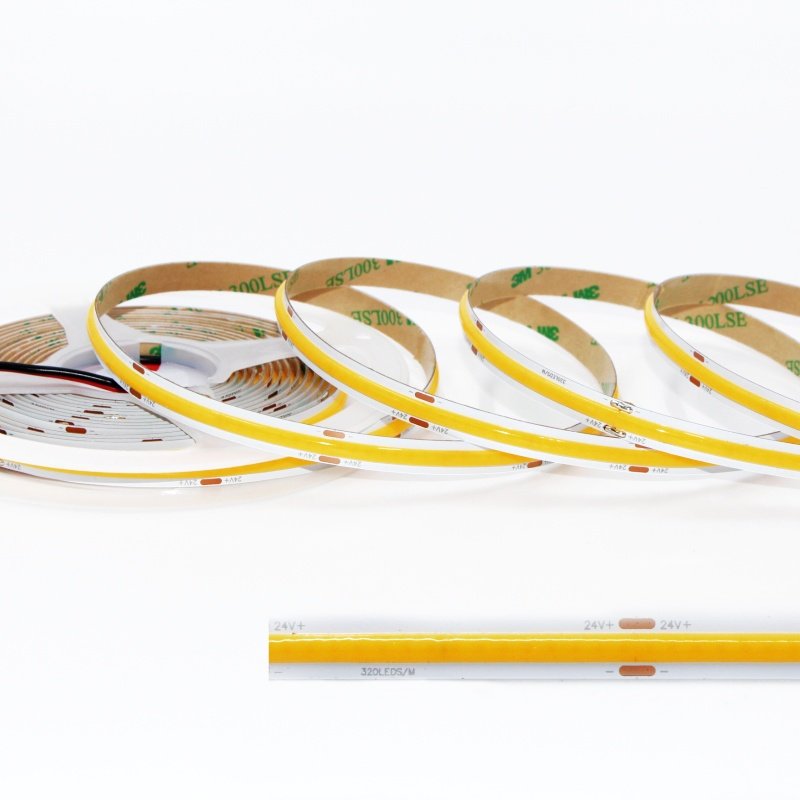
| 10 mm 480 LED/m | 480 LED/m | 14.5 W/m | 72.5 W |
| 10 mm 608 dual-channel | 608 LED/m | 7 W + 7 W | 70 W |
| 12 mm 600 LED/m | 600 LED/m | 24 W/m | 120 W |
| 30 mm 1600 LED/m | 1600 LED/m | 40 W/m | 200 W |
Always read the rated figure from the datasheet rather than estimating from appearance — density and board width together determine the load.
The Current Math: Why Voltage Matters
Power is voltage times current, so the same wattage draws very different current at 12V and 24V. A 60-watt run pulls 5 amps at 12V but only 2.5 amps at 24V — and current is what sizes your cable, drives voltage drop and limits feed length. This is why long runs favor 24V systems, why shorter, denser runs often stay at 12V, and why the electrical side of a COB vs SMD decision starts with the same calculation. Our 12V vs 24V comparison covers the trade-offs in full.
Sizing Drivers and Cabling with Headroom
The starting point is simple: total the COB LED strip power consumption of every feed at full output, then work outward from there. Three rules keep an installation safe and stable. First, sum the load per feed — every run between power injection points, not just the total meterage. Second, size each constant-voltage driver at least 20% above that load; drivers running at their ceiling run hot and age fast, a point our COB LED strip buyer’s guide stresses alongside voltage and density matching. Third, choose cable gauge for the current it carries: low-voltage systems lose power in thin cable quickly, and an undersized feed shows up as dim tails long before it trips anything.
What COB LED Strip Power Consumption Costs to Run
Running cost is straightforward arithmetic: kilowatt-hours equal total watts multiplied by operating hours, divided by 1,000. Take a retail application with 150 meters of 14.5 W/m strip running ten hours a day: 2,175 watts for ten hours is roughly 21.75 kWh per day, about 650 kWh per month — on the order of $100 a month at a $0.15 per kWh tariff. At that scale, specifying an efficient grade instead of an overdriven one pays for itself across a multi-year lease, and dimming trims the figure further: on a standard constant-voltage PWM system, energy draw falls roughly in proportion to output, which also softens the light for evening trade.
Frequently Asked Questions
How many watts per meter does a COB LED strip use?
Most commercial COB strips fall between 8 and 20 W per meter depending on density, board width and target output. Ultra-narrow and standard-density strips sit at the lower end, while wide high-output architectural grades reach or exceed the top of the range. The datasheet is the authoritative figure.
Can I power a COB LED strip directly from the wall socket?
No. Standard COB strips run on 12V or 24V direct current and need a constant-voltage LED driver between mains and the strip. Connecting one directly to mains supply will destroy it immediately; high-voltage mains-operated strips are a separate product family with their own protections.
Does dimming reduce COB LED strip power consumption?
Yes. On a standard constant-voltage PWM dimming system, power draw falls approximately in proportion to the dimming level, so a space dimmed to 40% output uses roughly 40% of the energy. Dimming to scene also reduces heat in the strip, which supports longer service life.
Size the Power System for Your Project
Planning loads for an upcoming installation? Browse our COB LED strip lights with full electrical specifications, or contact the GPD team with your run lengths and operating schedule — we will calculate the total COB LED strip power consumption, size drivers, cabling and injection points, and quote the complete power plan.
Custom COB LED Strip: MOQ, Lead Time and OEM Options
Catalog specifications rarely survive first contact with a real project. A retail fit-out needs 4.7-meter runs pre-terminated with connectors; a furniture line wants an ultra-narrow board in a specific bin; a hotel group needs its own CCT and packaging. This is where a custom COB LED strip program earns its keep — and where buyers should understand what factories can actually customize, how minimum order quantities work, and what lead time to plan for before a purchase order goes out.
What Can Be Customized on a COB LED Strip
COB construction is highly configurable at the factory level, and most established manufacturers offer a wider range than their catalogs suggest:
- Cut lengths and termination: strips supplied in project-specific lengths with connectors, wire tails or leads pre-soldered, ready for installation.
- Electrical specification: 12V or 24V systems, wattage per meter and density from standard bins up to very high output.
- Color and rendering: CCT from warm 1800–2700K through 6500K, CRI 80/90/95 options and tuned bins for brand consistency.
- Board geometry: PCB width from ultra-narrow 3–5 mm up to wide 30 mm boards for high-output lines.
- Ingress protection: IP20 through IP65–IP67 via silicone tube or potting processes.
- OEM finishing: private-label reels and cartons, custom label data and project-specific packaging.
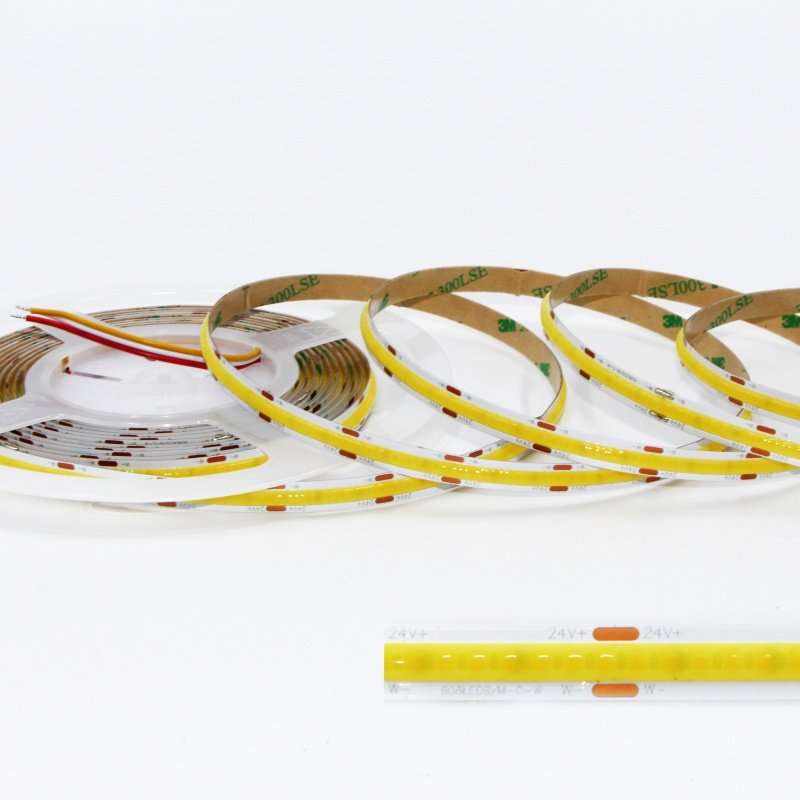
A case in point is our 5mm 608 LED/m 24V COB strip — an ultra-narrow, high-density format that exists precisely because a standard catalog could not cover every joinery and display application.
MOQ: Why It Exists and What to Expect
Buyers regularly ask what MOQ a custom COB LED strip carries, and the honest answer is that it is set by preparation cost, not by policy. A factory that sets up solder lines, procures chips in matched bin lots and configures QC jigs for a specific build carries nearly the same preparation cost for 50 meters as for 5,000. In practice, standard catalog specifications usually ship at low or no MOQ, while deeper customization — a bespoke CCT, an unusual board width or private-label packaging — raises the threshold. The useful move is to ask for tiered pricing: many suppliers will support a pilot batch against a higher unit price, then step the price down at agreed volumes. Remember that MOQ also interacts with cost, as covered in our price and cost-factor guide — a volume commitment is one of the levers that genuinely moves the number.
Lead Time: What Drives It and How to Plan
Lead time depends on how far the request sits from stock. Configured versions of catalog items — cut, terminated and packed — typically ship within days. A build that requires non-stock chips, a custom phosphor batch or IP processing adds production and curing time, and every custom order should include incoming QC and aging tests before shipment, which is non-negotiable time well spent. Seasonal factors matter too: capacity around major Chinese holidays tightens weeks in advance, so buyers with first-quarter projects should place specifications early. The safest schedule reserves a sampling stage before the bulk run — the specs that arrive on real reels are the ones worth checking, as our lifespan guide notes on aging data.
Customization at a Glance
| Custom item | Typical flexibility | Confirm in writing |
|---|---|---|
| Cut length and connectors | High | Cutting pitch, connector type, wire gauge |
| CCT, CRI and density | High | Photometric test report |
| IP rating | Medium | Tube or potting process, curing time |
| PCB width and color | Medium | Board width in mm |
| Private label and packaging | Varies | Volume threshold, artwork format |
Questions to Ask Before Placing a Custom Order
- Put the full specification of your custom COB LED strip in writing — density, wattage, CCT, CRI, IP, cut pitch — and have the supplier countersign the datasheet, not just the quotation.
- Request samples of the actual custom configuration, not a catalog look-alike, and age-test them under project conditions.
- Confirm the aging and QC process the batch will pass before it ships.
- Agree labeling, reel and carton packaging requirements, and a spare-quantity percentage for site damage.
- Fix Incoterms and the lead-time commitment in the purchase order; the COB LED strip buyer’s guide covers the commercial checklist end to end.
Frequently Asked Questions
What MOQ should I expect for a custom COB LED strip?
It varies by factory and by how deep the customization goes. Standard specifications configured from stock are often available at minimal quantities, while bespoke bins, widths or packaging set a higher floor. Ask for tiered pricing so you can see the cost at pilot, mid and full volumes before committing.
Can custom lengths arrive pre-cut with connectors installed?
Yes — pre-cutting and connector assembly is one of the most common custom requests. Confirm the cutting pitch, connector brand and wire gauge in writing, because pre-terminated strip that arrives matching the joinery drawings saves significant site labor.
How does customization affect lead time?
Stock-based configurations ship in days; fully custom builds add production plus QC and aging time, and capacity tightens around major holidays. Build a sampling stage into the schedule and confirm both dates in writing with the purchase order.
Discuss Your Custom COB LED Strip Project
Have drawings or a specification ready? Browse our standard COB LED strip lights for a starting point, or contact the GPD team with your requirements — MOQ, OEM options, lead time and samples quoted clearly, with engineer support throughout the project.
COB vs SMD LED Strip: 6 Differences Buyers Should Know
Most product catalogs today split LED strip lines into two families: COB and SMD. Buyers comparing samples often ask which technology is “better,” but the honest answer is that they solve different problems — and the wrong choice usually shows up as visible dots, extra diffuser cost, or a quote that is harder to justify. This guide breaks down the real differences between COB and SMD LED strip construction, light quality, durability and price, so wholesale buyers and project specifiers can match the technology to each application instead of guessing.
Construction: One Continuous Surface vs. Discrete Points
The names describe the physics. An SMD (surface-mounted device) strip carries packaged LED components soldered onto the board at fixed intervals — every 10 to 30 millimeters typically — so the light leaves the strip in distinct points. A COB (chip-on-board) strip mounts bare LED dies directly onto the PCB beneath a single continuous phosphor film, so the entire strip becomes one uniform light-emitting line with no visible spacing.
That construction difference drives nearly everything else: how the light looks on a surface, whether a diffuser is mandatory, how heat spreads, and even how many solder joints exist to fail. When you compare any COB vs SMD LED strip datasheet side by side, start from this point and the rest of the numbers fall into context.
Light Quality: Where COB Pulls Ahead
Because COB emits from a continuous surface, it produces the dotless effect that premium retail, hospitality and mirror applications demand. On polished tile, marble or glass, SMD points reflect as distinct hot spots unless the strip sits behind a thick diffuser — an extra accessory, an extra cost, and extra installation depth. COB also reduces direct glare for close-range viewing, since the emitting surface is larger and the light is spread evenly along the run. SMD strips remain perfectly serviceable where the light source is hidden or the viewer is far away; up close, the difference is immediately visible.
Efficiency, Heat and Durability
Contrary to a common assumption, efficiency is not a decisive winner: quality COB and SMD strips both operate in the same general efficacy range, and the real spread comes from chip grade and driver quality rather than the package type. Two structural points do favor COB. Heat generated by the dies spreads across the whole board instead of concentrating at each package, and a COB strip contains far fewer solder joints — statistically among the more common failure points on any strip. Heat management still dominates longevity for both technologies, as our COB LED strip lifespan guide explains in detail.
Price and Sourcing Considerations
COB vs SMD LED strip pricing differs mainly in process cost. COB strips generally carry a modest premium: the phosphor coating process and higher chip density cost more to produce, which is one of the price factors buyers should recognize in quotes. SMD strips are a mature commodity with an enormous supplier base, which simplifies replacement sourcing and keeps unit prices low. The fair comparison is therefore per project, not per reel: in a visible application, COB’s higher price is often offset by deleted diffusers, faster installation and fewer aesthetic complaints.
COB vs SMD at a Glance
| Factor | COB LED strip | SMD LED strip |
|---|---|---|
| Light appearance | One continuous line, dotless | Distinct points at intervals |
| Diffuser requirement | Optional | Needed to hide dots |
| Glare and hot spots | Lower | Higher at close range |
| Solder failure points | Fewer | More |
| Typical price level | Higher | Lower |
Which Should You Choose?
Every COB vs SMD LED strip decision comes down to visibility and budget. Choose COB when the strip is visible or the surface is reflective: retail displays, hospitality ceilings, mirrors, glass cabinetry and architectural reveals. Choose SMD where the source is concealed and budget leads the decision — deep coves, backlighting panels and utility runs. Many mixed projects use both, which is perfectly sound engineering. Whichever you pick, the technology matters less than the basics behind it: chip binning, copper weight and driver quality decide how the strip actually performs, as our lifespan guide and buyer’s checklist make clear.
Frequently Asked Questions
Is a COB vs SMD LED strip comparison about brightness?
Not really. Efficacy ranges overlap, so neither technology is inherently brighter. COB looks smoother and more even because its light is continuous, while SMD concentrates output at points. Compare lumens per meter and lumens per watt on the datasheet instead of judging by appearance alone.
Can COB replace SMD in an existing installation?
Usually yes, mechanically: both mount with 3M tape or channels and run on the same constant-voltage drivers. Verify the voltage, cut-length intervals and total wattage so the existing power budget still holds before swapping reels.
Which technology handles dimming better?
Both dim well on a matched constant-voltage system. Smoothness depends far more on the driver and control brand than on COB versus SMD construction, so put dimming performance in the specification rather than assuming one package type wins.
Test COB and SMD Side by Side
Still deciding for a specific project? Browse our full COB LED strip lights range to review construction options, or contact the GPD team for samples of both technologies, photometric data and a quotation. Seeing the two side by side on your own surface settles the question faster than any datasheet.
COB LED Strip Lifespan: How Long Do They Really Last?
Product listings love the number 50,000 hours, and procurement teams are right to ask what sits behind it. The honest answer is that COB LED strip lifespan is not a fixed figure — it is a rated behavior under defined conditions, and the installation decides how much of it you actually get. For wholesalers and project buyers, that distinction matters commercially: service life drives maintenance cycles, warranty exposure and the total cost a client signs up for. This guide explains what the rating means, what shortens a strip’s working life, and how to specify so the installed result matches the datasheet.
What the Rated Hours on a COB LED Strip Actually Mean
When a datasheet states 50,000 hours, it normally refers to L70 — the point at which a test sample has faded to 70% of its initial light output — often with a B50 figure, meaning half of the units are expected to reach that point by then. Two things follow. First, the strip does not die at the rated hour; it simply gets dimmer, and color shift usually appears before the lumen loss becomes obvious. Second, the rating is measured under controlled conditions: a stable ambient temperature and a clean, matched power source that a cramped ceiling void rarely provides.
Hours also convert into years only through the operating schedule:
| Daily operating time | 50,000 hours equals |
|---|---|
| 8 hours/day (office) | ≈ 17 years |
| 10 hours/day (retail) | ≈ 13.7 years |
| 12 hours/day (hotel, supermarket) | ≈ 11.4 years |
| 24 hours/day (emergency, signage) | ≈ 5.7 years |
What Shortens a COB LED Strip Lifespan in Real Installations
Heat is the dominant factor. LED chips age faster as junction temperature rises, and a widely used rule of thumb holds that sustained operation well above the specified temperature roughly halves expected life for every additional 10°C. In practice, the usual culprits are:
- Enclosed fixtures without heat sinking: sealing a strip inside a tight plastic profile traps heat; aluminum channels exist precisely to pull it away. Profiles, spacing and derating are the cheapest lifespan insurance available.
- Running at maximum wattage in restricted spaces: a strip driven at its full rating inside a narrow cove runs far hotter than the same strip on an open shelf.
- Poor-quality or oversized drivers: excessive output ripple stresses the strip, and an underrated or unstable power supply delivers the kind of electrical abuse that shortens COB LED strip lifespan before any visible symptom appears.
- Moisture and contamination: the wrong IP class for the environment lets humidity and dust attack the phosphor layer and solder joints — match the IP rating to the actual zone.
- Ignoring color shift: many strips become unacceptable to the client while still technically working, so “life” ends at the point the light no longer matches, not when it goes dark.
How Buyers Protect Service Life Before Ordering
Most of a strip’s real-world COB LED strip lifespan is decided at the ordering stage, before a single reel ships. Four checks make the biggest difference:
- Ask what the rated hours are based on — chip-level aging data and a finished-strip aging report are worth more than a big number.
- Specify aluminum profiles or heat-dissipating mounting for enclosed and high-wattage runs, and avoid driving strips at their absolute maximum in confined spaces.
- Use quality constant-voltage drivers with low ripple; driver quality is repeatedly implicated in early failures, as our flicker-free dimming guide explains.
- Treat an unusually low quote as a lifespan risk: strips that cut corners on phosphor and binning fade faster, a link we covered in our price and cost-factor guide.
- Read the warranty the way an auditor would — duration, what is covered, and whether the supplier backs it with test data.
Frequently Asked Questions
Do COB LED strips really last 50,000 hours?
They can, under the rating conditions: moderate ambient temperature, a matched driver and sane loading. In a hot, sealed housing driven at full power, expect notably less. The rated figure is best read as a ceiling that good engineering lets you approach.
Does switching them on and off frequently shorten the COB LED strip lifespan?
LEDs tolerate switching cycles far better than older lamp technologies, so normal daily use is not a concern. Frequent switching stresses the driver more than the strip, which is another reason driver quality belongs in the specification.
What warranty should I ask a supplier for?
Two to three years is common for quality constant-voltage strip, five years from confident manufacturers. More important than the length is the wording: does it cover lumen maintenance and color shift, not just complete failure, and can the supplier produce the aging data behind it? Suppliers confident in their test reports rarely hesitate to share them.
Plan an Installation Built to Last
Sourcing strip for a long-service project? Browse our COB LED strip lights range with full datasheets, or contact the GPD team for aging data, warranty terms and a quotation tailored to your installation conditions. Our engineers respond within one business day.
COB LED Strip Price: What Drives Cost and How to Compare
Ask three suppliers for a quotation on the same COB LED strip and you will often receive three very different numbers. That spread is not automatically a red flag — COB LED strip price reflects a stack of engineering decisions that never show up in a product photo. For wholesale buyers and project purchasers, understanding those cost drivers is the fastest way to compare offers fairly, avoid overpaying for marketing claims, and stop underpaying for the specifications a project actually needs.
What Actually Drives the Price of a COB LED Strip
Two strips that look identical in a listing can differ in cost by 30–50% because of choices made before the first unit is assembled:
- Chip grade and binning: tightly binned chips with consistent color and luminous flux cost more per reel, and that discipline is what keeps one wall matching the next.
- Density (LEDs per meter): a 480 LED/m strip uses far more die and assembly time than a 320 LED/m one — this is usually the single largest line item.
- CRI level: moving from CRI 80 to a high CRI COB LED strip at 90 or 95 requires better phosphor and stricter testing, which is priced in.
- PCB width and copper weight: wider boards and 2 oz copper dissipate heat better and extend lifetime, at a higher material cost.
- IP rating: silicone tube or potting processes add real labor and materials for IP65–IP67 versions.
- Compliance: UL, CE, UKCA and RoHS testing is amortized into the price of certified product.
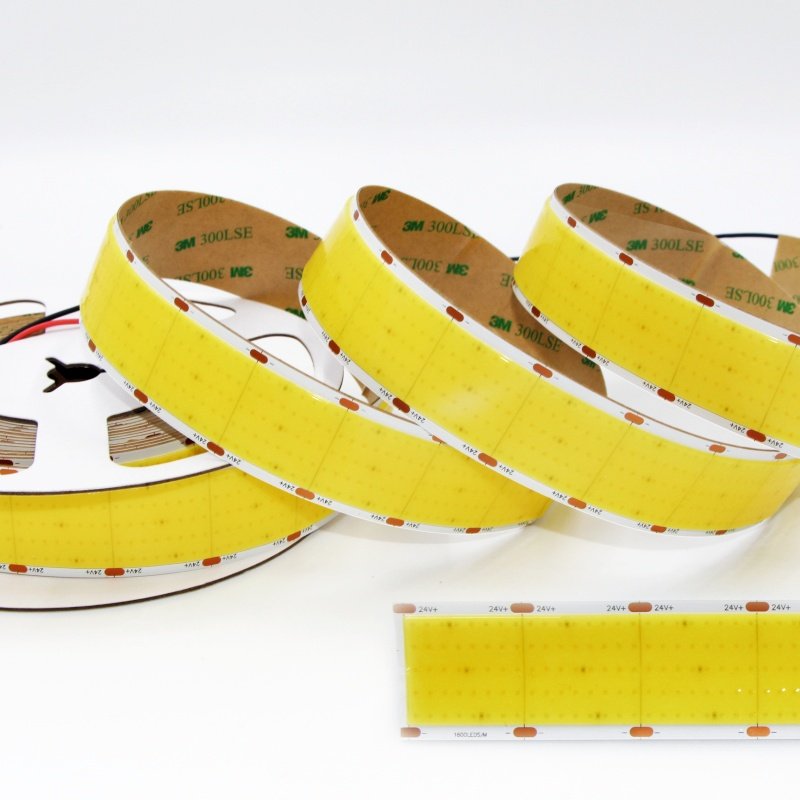
COB LED Strip Price vs. Total Project Cost
For commercial work, the sticker number is the wrong metric. A strip that fails early, shifts color, or flickers on the specified dimmer turns a saving of a few cents per meter into relabor, site revisits and warranty claims. Professional buyers therefore compare cost per meter over the rated lifetime, including the driver and accessories each option requires. A practical example: on a 10,000-meter retail rollout, replacing a failed batch after six months costs far more in freight, labor and site disruption than the per-meter saving ever delivered, so the quote that looks 15% higher with documented binning data and a three-year warranty is frequently the cheaper line item. Voltage plays into this as well: the 12V versus 24V decision changes driver count and re-feed intervals, which is why our 12V vs 24V comparison belongs in any cost review.
Where the Money Goes: Price Drivers at a Glance
| Cost driver | Price impact | What to verify |
|---|---|---|
| Chip grade and binning | High | Bin data, Ra/R9 test report |
| Density (LEDs per meter) | High | Datasheet and segment count |
| CRI level | Medium–High | CRI 90+/95+ photometric report |
| PCB width and copper | Medium | Board width in mm, copper weight |
| IP rating | Medium | Tube or potting process detail |
| Certifications | Medium | Valid UL/CE/UKCA/RoHS certificates |
How to Compare Quotes Fairly: A Buyer’s Checklist
- Normalize the specification first. A quote for 480 LED/m at CRI 90 is not comparable to one for 384 LED/m at CRI 80 — put every supplier on the same baseline before judging the COB LED strip price.
- Ask what is included: integrating sphere test reports, binning tolerance in SDCM, warranty length and replacement terms all carry cost and value.
- Watch the wattage game. Confirm real power draw with photometric data instead of trusting a headline number; an understated wattage makes a quote look artificially cheap.
- Compare landed cost: MOQ, lead time and Incoterms (EXW, FOB or DDP) change what actually reaches your warehouse.
- Weigh only the certifications your market requires, and ask for certificate copies with the offer.
- Shortlist two or three suppliers and request samples against the same specification before committing to the bulk order — our COB LED strip buyer’s guide covers the full selection framework.
Frequently Asked Questions
Why do quotes for the “same” COB LED strip differ so much?
Because the specification sheet rarely captures chip binning, copper weight or warranty terms. Two suppliers can both write “COB, 480 LED/m, CRI 90” and still be quoting different products. Ask each supplier to itemize these details and the price gap usually explains itself.
Is the cheapest COB LED strip price ever a good deal?
Occasionally — for short decorative runs with no color-matching requirements. For retail, hospitality or architectural work, an unusually low quote is a signal to check the test data first, because relabor and replacement quickly erase the saving.
Does ordering more reduce the COB LED strip price?
Generally yes. Larger orders let a factory buy chips in better bin lots and spread setup costs, so unit pricing improves with quantity. Order against the project plus a maintenance stock, though, rather than chasing a volume discount with inventory you cannot use.
Get an Itemized COB LED Strip Quotation
Comparing offers for an upcoming project? Browse our full range of COB LED strip lights to benchmark specifications, or contact the GPD team for an itemized quotation with test reports, binning data and warranty terms. Our engineers respond within one business day.
12V COB LED Strip vs 24V: How to Choose the Right Voltage
In retail, hospitality and display projects, an LED strip can have the right color temperature and still make merchandise look dull. The missing factor is color rendering. For wholesalers, contractors and lighting designers, specifying the correct voltage matters just as much — and the first decision is often 12V versus 24V. Both a 12V COB LED strip and its 24V counterpart are widely stocked, and on a product page they can look almost identical. The practical differences show up in the field: brightness that fades along a long run, cutting points that are too coarse for a display shelf, or a driver inventory that does not match the project. This guide compares the two options so you can specify with confidence.
Why Voltage Drop Hits a 12V COB LED Strip Sooner
Voltage drop is a matter of simple physics. For the same wattage, a 12V strip draws twice the current of a 24V strip, and because copper traces in the PCB have resistance, that current turns into a gradual voltage loss along the strip. The visible symptom is a brightness and color gradient: the start of the run looks correct while the far end looks dimmer and slightly warmer.
As a working rule of thumb, a single feed on a 12V strip is typically kept to around 5 meters, while a 24V strip can often reach about 10 meters before a re-feed or amplifier is needed. Exact figures depend on strip wattage and PCB design, so treat the datasheet as the final authority. If a design needs a long, unbroken run from one driver, this single factor usually settles the 12V versus 24V question on its own.
Where a 12V COB LED Strip Is the Better Choice
Twelve volts is not a legacy option — it is the practical pick in several common scenarios:
- Short, dense runs: cabinet lighting, shelf strips, display cases and furniture pieces rarely exceed a few meters per feed, so voltage drop is not a concern.
- Mobile and off-grid power: vehicles, boats, RVs and solar systems run on 12V batteries, so a 12V COB LED strip connects directly without a converter stage that adds cost and failure points.
- Fine cutting intervals: 12V strips are built from shorter chip groups, so their cut points are usually closer together than 24V equivalents. For joinery and retail fit-outs where every segment must land precisely, this saves trimming waste.
- Existing 12V infrastructure: if a client’s site or product line already uses 12V drivers, staying at 12V keeps spares and replacements simple.
A good example of the format is our ultra-narrow 3mm 400 LED/m 12V COB strip, a 7 W model designed for tight channels and precision display work.
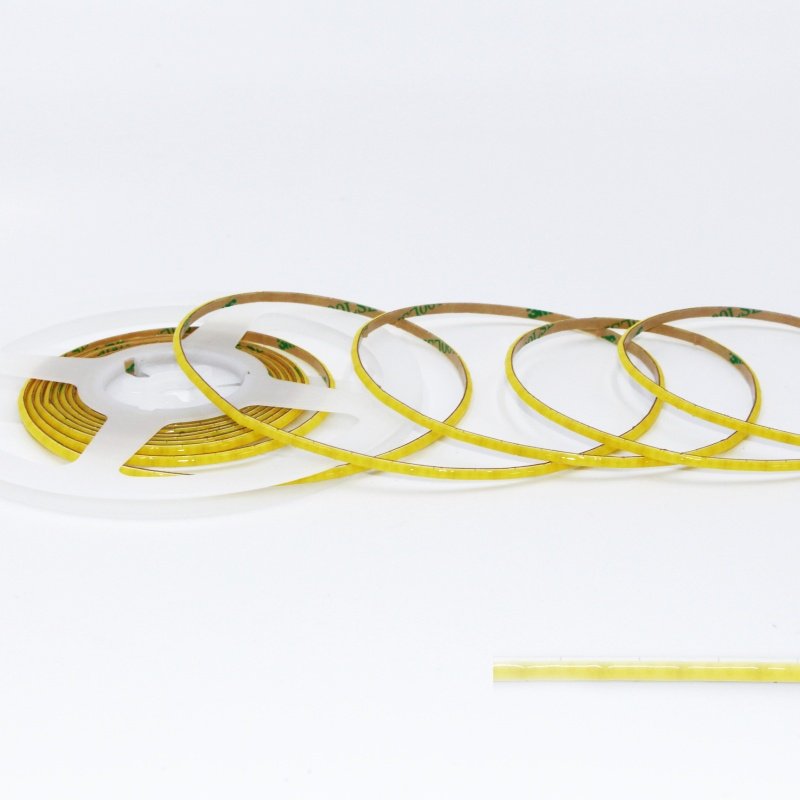
12V vs 24V at a Glance
| Factor | 12V COB LED strip | 24V COB LED strip |
|---|---|---|
| Current at 60 W | 5 A | 2.5 A |
| Typical run per feed | About 5 m | About 10 m |
| Voltage drop sensitivity | Higher | Lower |
| Cut length granularity | Finer (shorter chip groups) | Coarser |
| Typical applications | Cabinetry, displays, vehicles, marine | Coves, facades, long architectural runs |
For longer architectural runs, 24V’s lower current means less loss in the strip and marginally better efficiency at the same wattage. Our earlier guide to 24V LED strip lights for long runs covers that side of the comparison in detail.
How to Specify the Right Voltage
- Measure the longest single feed in the design, not the total strip length — re-feeding every 5–10 m changes what the voltage can be.
- Check the cut points against the installation: divide the available length by the cut interval and confirm the segments still land where the joinery needs them.
- Standardize where possible. Wholesalers carrying one voltage family in each wattage class hold less stock and simplify warranty handling.
- Confirm dimming compatibility: both voltages dim smoothly when paired with a matched constant-voltage driver, as covered in our COB LED strip buyer’s guide.
- Match the driver to the strip voltage and at least 20% above the total load in watts.
Frequently Asked Questions
Can I connect a 12V COB LED strip to a 24V power supply?
No. Overdriving a strip at double its rated voltage will burn out the LEDs almost immediately. Match the supply voltage to the strip exactly; if only a 24V driver is available, use a step-down converter or switch to a 24V-rated strip.
Is a 12V COB LED strip less efficient than 24V?
At the same wattage, the 12V version loses slightly more power as heat in the strip’s own traces because it carries double the current. Over short runs the difference is negligible in practice; over 10-meter feeds it becomes one more reason to move to 24V or to re-feed the run.
Can 12V and 24V strips share one driver?
Not directly. Each voltage family needs its own constant-voltage output sized to the connected load. If a project mixes both, plan the driver schedule around that from the start rather than discovering it on site.
Get a Quote for 12V and 24V COB LED Strips
Unsure which voltage fits your next project? Browse our full range of COB LED strip lights in 12V and 24V, or contact the GPD team for samples, test reports and a quotation. Our engineers will help you match voltage, density and driver within one business day.
High CRI COB LED Strip: Why Color Accuracy Matters
In retail, hospitality and display projects, an LED strip can have the right color temperature and still make merchandise look dull. The missing factor is color rendering. For wholesalers, contractors and lighting designers, specifying a high CRI COB LED strip is one of the simplest ways to raise the perceived quality of a space without changing the lighting layout or the budget. This guide explains what CRI means, where it matters most, and how to specify it with confidence in your next tender or OEM order.
What Does CRI Mean in COB LED Strip Lighting?
Color Rendering Index (CRI, also written as Ra) measures how faithfully a light source reveals object colors compared with a reference illuminant, on a scale that typically runs from 0 to 100. Conventional SMD strips and many entry-level COB LED strip lights fall between CRI 70 and 80. That is acceptable for coves and signage, but colors look noticeably flat wherever skin tones, wood, textiles or fresh food are involved.
A high CRI COB LED strip is engineered to reach CRI 90 or above. Professional buyers should also check R9, the score for saturated red, because a strip can average 90 overall yet still render reds, warm woods and baked goods poorly. Reliable manufacturers publish full photometric test reports rather than a single headline number, so always ask for the data behind the label.
Where High CRI Makes a Visible Difference
Color-critical environments are easy to identify: anywhere people look closely at products, faces or finishes, color rendering belongs on the schedule next to lumen output and CCT. Typical examples include:
- Retail: accurate color keeps garments, cosmetics and furniture consistent between window display, shelf and fitting room, which protects brand standards and reduces “looks different at home” returns.
- Hospitality: warm, high-CRI light flatters skin tones, materials and artwork — the detail guests notice but rarely name.
- Food and grocery: fresh produce and meat under low-CRI light look gray and unappetizing, which directly affects sales.
- Galleries, museums and showrooms: faithful color is a specification requirement, not a preference.
Why COB Construction Suits Color-Critical Work
COB (chip-on-board) packages many LED dies directly onto the circuit board under a uniform phosphor layer, so the strip emits one continuous line of light instead of separate dots. Even illumination keeps color perception consistent along the run and removes the micro-shadows that dotted strips cast on shelves and textured surfaces. High-density models such as our 12mm 600 LED/m 24V COB strip also simplify the design: no heavy diffuser is needed just to hide LED dots, so light reaches the eye with minimal distortion.
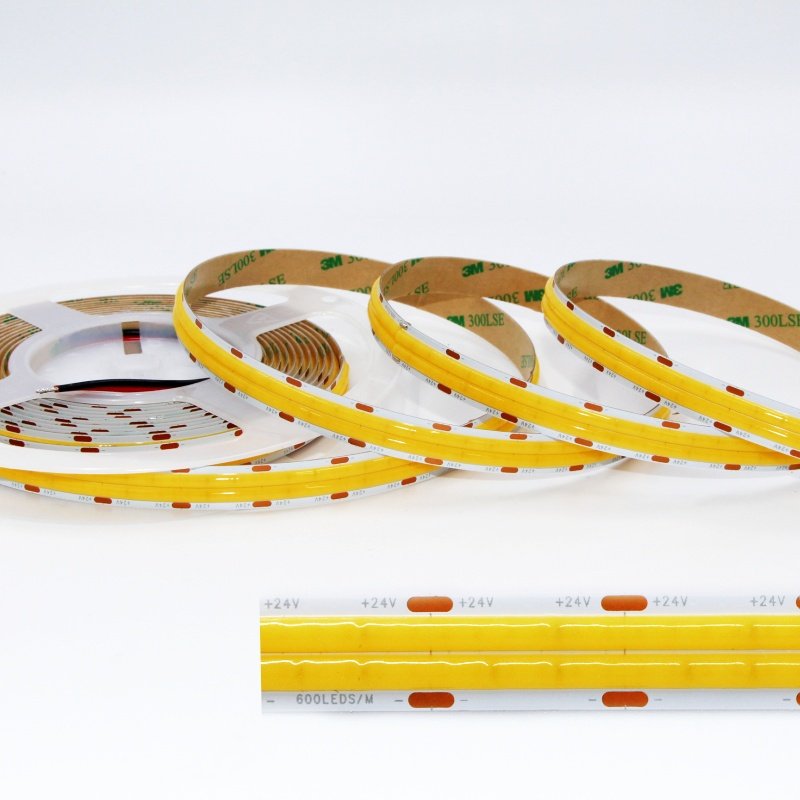
How to Specify a High CRI COB LED Strip
Use this quick reference when preparing a lighting schedule:
| Application | Recommended CRI | Typical CCT |
|---|---|---|
| Retail and showrooms | CRI 90+ (R9 > 50) | 3000–4000 K |
| Hospitality and restaurants | CRI 90+ | 2200–3000 K |
| Grocery and food display | CRI 90+ | 3000–4000 K |
| Galleries and museums | CRI 95+ | 2700–3500 K |
| Coves and general architectural lighting | CRI 80–90 | Per design |
- Ask for an integrating sphere test report (Ra, R9 or TM-30 data) instead of a datasheet claim.
- Check binning: strips within a 2–3 SDCM tolerance keep multiple reels looking the same on one ceiling.
- Confirm dimming compatibility. Quality high CRI COB LED strips hold color while dimming smoothly when paired with a matched driver — see our flicker-free dimming guide for details.
- For wholesale and OEM orders, require the same CRI bin across repeated production batches; consistency over time matters as much as the number on the first sample.
For voltage, density and driver matching in more depth, our COB LED strip buyer’s guide walks through the full selection process.
Frequently Asked Questions
Is CRI 90+ necessary for every project?
No. Cove lighting, backlighting and signage usually look fine at CRI 80–90, and the cost difference adds up on long runs. Reserve a high CRI COB LED strip for areas where people and products are seen at close range: sales floors, dining areas, fitting rooms and display cases.
Does a high CRI COB LED strip cost more?
There is normally a modest premium over standard-CRI equivalents, mainly from tighter chip binning and quality control. Most buyers treat it as insurance, because color-critical areas are exactly where rework and client complaints are most expensive.
Can high CRI COB strips dim without shifting color?
Yes, when they are paired with a compatible dimmable driver and control system. The degree of color shift during dimming depends on LED binning and driver quality, so ask suppliers for dimming test data before placing a bulk order. For large projects, request the test with the exact driver model written into the lighting schedule.
Request Samples and CRI Test Reports
Planning a retail, hospitality or display project? Contact the GPD team for samples, photometric test reports and a quotation, or browse our full COB LED strip range to compare specifications. Our engineers respond within one business day.
COB LED Strip Sample Testing: 7 Checks Before a Bulk Order
Sample testing is the cheapest insurance in LED strip procurement — and the most commonly skipped step. Suppliers send free samples happily, yet many buyers ship a bulk order based on a quick glance at one meter taped to a wall. That shortcut is how flicker complaints, color mismatches and dead-on-arrival sections end up on a job site. Before your first bulk order of COB LED strip lights, run these seven checks on real samples.
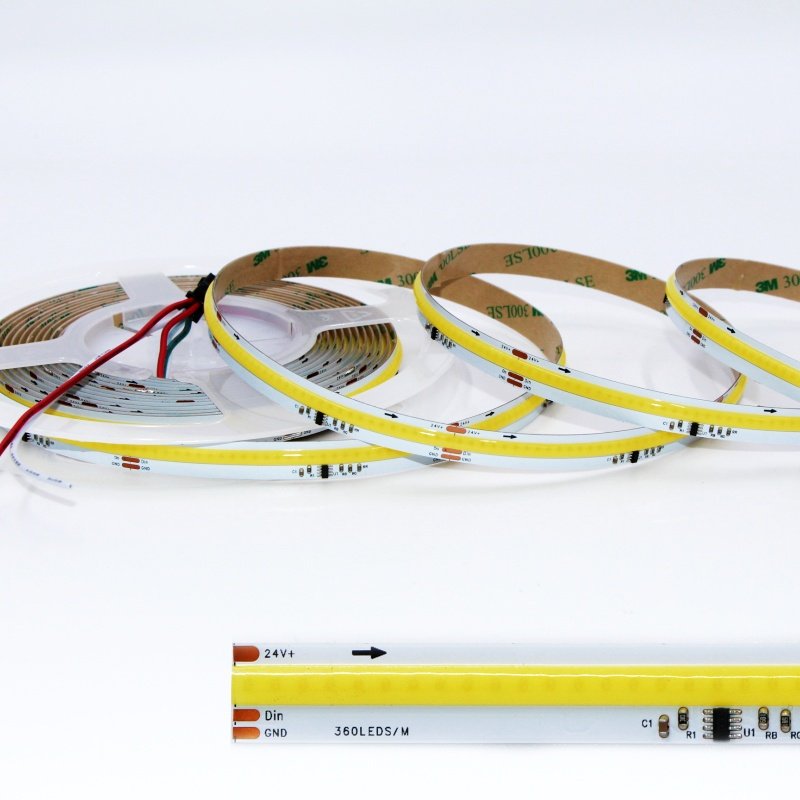
Check 1–2: Photometry and Color
Power one meter through a dimmer and measure against the datasheet. Output should land within about 10% of the claimed lumens per meter, and CCT should read within tolerance (3000K is not 3000K if it measures 2700K). Then line up three to five samples from the same reel: the color must be visually identical. This is where SDCM ≤ 3 binning either proves itself or fails — a strip that passes alone but mismatches its own batch will fail on a large ceiling.
Check 3–4: Dimming and Electrical Behavior
Connect the sample to the exact driver and controller your project will use. Dim from 100% down to the minimum and film it in slow motion: the result should be smooth, with no strobing, pop-on or dropout at low levels. Also verify polarity marking, connector orientation and that the strip survives a power cycle without resetting color settings. Our flicker-free dimming guide lists the compatibility points that matter most.
Check 5: Aging and IP Verification
Run the sample for 72 hours continuously before approving anything. Early failures — a dark segment, adhesive lifting, driver trips — almost always appear within the first two days. For any IP65 or higher product, repeat the aging test with the strip wet: a waterproof COB LED strip must prove its sealing under water, not just on paper. Our IP rating guide explains what each level should survive.
Check 6–7: Mechanical Build and Documentation
• Mechanical: bend a sacrifice sample along its length and across the chip line, cut it at a marked point, and solder a joint — the PCB should tolerate normal installation handling without lifting pads or cracking
• Adhesion: peel-test the 3M tape on your real mounting surface
• Documentation: collect the datasheet, IES/LDT photometric files, CE/RoHS/UKCA certificates and the written warranty terms before the purchase order, not after
The full parameter framework behind these checks is covered in our COB LED strip lights buyer’s guide.
Turn Test Results Into Negotiation Leverage
Documented sample results are not just quality control — they are commercial leverage. With test records in hand, buyers can negotiate batch-consistency clauses, defect-rate thresholds, replacement terms and lead-time penalties into the contract. Suppliers who resist written commitments after passing your tests are telling you something. Those who welcome them are suppliers worth scaling with.
Frequently Asked Questions
How many samples are enough for testing?
At least three to five meters, ideally from two production batches, so batch consistency is visible before you commit to volume.
Who pays for sample shipping?
Most factories provide free samples with the buyer covering freight; many credit the freight back on the first bulk order — confirm both in writing.
Can I skip aging tests on repeat orders?
Reduce, not skip. A 24-hour spot check on each new batch catches process drift without adding meaningful lead time.
Get Tested Samples Before You Commit
Browse the COB LED light strip series and request sample sets with full test documentation — our engineers support your testing protocol and reply within one business day.
Request a Quote | Contact Our Sales Team
COB LED Strip Lights vs LED Neon Flex: A Buyer’s Comparison
Two products dominate modern decorative and commercial lighting quotes: COB LED strip lights and LED neon flex. Both promise a seamless line of color, yet they behave very differently on site — in shaping, brightness, maintenance and cost. Choosing the wrong one usually means rework. This comparison gives wholesalers, contractors and fit-out teams a clear decision framework, based on what we see across hundreds of projects each year.
Two Technologies, Two Different Jobs
COB LED strip lights place densely packed LED chips under a phosphor layer on an exposed flexible PCB, producing a continuous, dotless line of light straight from the strip. LED neon flex is a strip — COB or SMD — enclosed in a thick, extruded silicone jacket that diffuses the light into a rounded, neon-sign look with 180° or 360° emission.
So the real question is not “which product is better” but “where does each belong”: exposed architectural lines versus graphic, sign-style elements.
Side-by-Side Comparison
| Factor | COB LED Strip Lights | LED Neon Flex |
|---|---|---|
| Light appearance | Flat, continuous light line from the board | Round, glowing tube look |
| Shaping | Bends on-plane; cut points every 25–50 mm | Extremely flexible in 3D; minimum bending radius ~10 cm; cut every 5–10 cm |
| Brightness control | Wider efficacy range, easier to dim smoothly | Softer, more diffused output |
| Heat management | Needs aluminum channel above ~10 W/m | Silicone jacket insulates; derate in hot climates |
| Service & repair | Easy to inspect, cut and rejoin | Whole section replacement is common |
| Indicative cost | Lower per meter | Higher (jacket + shaping labor) |
Where COB LED Strip Lights Win
Specify COB strip lights when the light must integrate with the architecture: ceiling coves, wall washers, cabinet and shelf lighting, handrails, backlit panels and any concealed channel. They run at higher efficacy, dim smoothly, can be re-cut and serviced on site, and their dotless line reads as premium at close range. For a full parameter walkthrough, our COB LED strip lights buyer’s guide covers voltage, CRI and waterproofing.
Where LED Neon Flex Makes Sense
Neon flex wins when the product itself is the visual feature: outdoor signage, storefront outlines, 3D graphic letters, landscape curves and facade patterns that need a rounded, self-standing tube visible from all angles. Its sealed silicone jacket also simplifies IP67/IP68 outdoor use — though for wet zones, verify the sealing standard exactly as you would for strips, following our waterproof COB LED strip IP rating guide.
The Hybrid Option: COB Neon Flex
Many projects now specify a hybrid: a COB light source inside a neon-flex silicone jacket. This combines the dotless, high-CRI output of COB with the rounded look and outdoor robustness of neon flex — at a price between the two. Ask suppliers for both versions’ samples; under real dimming and at real viewing distances, the difference is easy to see.
Frequently Asked Questions
Is COB neon flex the same as COB LED strip lights?
No. COB neon flex wraps a COB light source in a diffusing silicone tube; standard COB strip lights expose the light line directly. Same core technology, different form and application.
Which one lasts longer outdoors?
Quality versions of both are rated for years outdoors; longevity depends more on silicone UV stability and sealing quality than on the product category.
Can COB strip lights form letters and shapes like neon flex?
Only gentle on-plane curves. True graphic shapes need neon flex or pre-bent modules.
Get Both Options From One Supplier
Browse our COB LED light strip series or ask for COB neon flex alternatives — send us your drawings and we will recommend the right product with samples within one business day.
Flexible COB LED Strip: How to Bend, Cut and Install It Right
COB LED strips are engineered to survive years inside coves and profiles — yet a surprising share of failures trace back to the first hour on site: a bend over a live chip line, a scratch across the phosphor layer, a cut made in the wrong place. The good news is that every one of these mistakes is avoidable. This guide explains how to handle a flexible COB LED strip correctly through bending, cutting, joining and mounting, so the product delivers its full dotless performance for its entire rated life.
Bending: Two Rules That Prevent Most Failures
A flexible COB LED strip bends freely along its length — in and out of curves, around columns, across wavy ceilings — because the copper circuit runs parallel to the chips. The danger is vertical bending, folding the strip up or down across the chip line, which stresses every solder joint and can crack the phosphor layer.
- On-plane bends (left/right): any shape is fine; keep the curve gentle and fix the strip with clips every 20–30 cm
- Cross-bends (up/down): keep a minimum bending diameter of about 60 mm, and never bend repeatedly at the same point
- 90-degree corners: cut and reconnect with soldered joints or L-shaped connectors — do not fold the strip
Cutting and Rejoining Without Damage
COB strips can be cut anywhere along the marked cutting units (typically every 25 or 50 mm), but the rejoining discipline decides whether the joint lasts as long as the strip:
- Cut with sharp scissors exactly on the marked line, never through the middle of a unit
- Solder to the exposed pads within 3 seconds at 320–380°C — prolonged heat lifts the pads
- Prefer silicone-sealed snap connectors for field joins; soldering remains the benchmark for permanent concealed joints
- On IP65 or higher strips, reseal every cut end with the original end caps and adhesive, or the rating is void
Planning the layout before cutting is the cheapest insurance: measure the run, mark the cut points, and only then take the strip off its reel. Our waterproof COB LED strip IP rating guide covers the resealing details for outdoor runs.
Mounting: Adhesive, Channels and Heat
The factory 3M tape bonds well to clean, flat, dust-free surfaces — wipe the mounting line with isopropyl alcohol first and press the strip along its full length. For any installation above roughly 10 W/m, inside closed profiles, or in hot environments, mount the strip into an aluminum channel: the profile acts as a heat sink, protecting the phosphor layer and extending lifetime well beyond the 50,000-hour rating. Avoid embedding strips directly into foam or wood, which trap heat and prevent even a flexible COB LED strip from dissipating properly.
Four Mistakes That Void the Warranty
- Folding across the chip line to force a corner instead of cutting and joining
- Scratching the phosphor layer with metal tools — it creates permanent dark marks
- Powering the strip while it is still coiled on the reel, which traps heat in seconds
- Reversed polarity connections that damage the first segment when power is applied
Every one of these is visible in an inspection, which is why they are excluded from warranty coverage. For the electrical side — voltage drop, feed spacing and driver sizing — our 24V LED strip lights guide and the COB LED strip lights buyer’s guide cover the full picture.
Frequently Asked Questions
Can a flexible COB LED strip make a 90-degree turn?
Not by folding. Cut the strip at the marked point and join two segments with an L-shaped connector or a soldered bridge — the joint is stronger and invisible inside a channel.
Why did my strip darken at one spot?
Almost always a vertical bend over the chip line or a scratch across the phosphor layer at that point. Both are installation damage, not product defects.
How tight can I bend it around a column?
On-plane bends can follow any column shape. Keep a gentle curve, secure with clips, and avoid stretching the strip while fixing it.
Need Installation Support for Your Project?
Browse the COB LED light strip series and request our installation manual, bending test videos and free samples — our engineers support your site team within one business day.
Specifying COB LED Strip for Architectural Lighting Projects
Architectural lighting lives and dies by its details. A cove that shows dots, a facade run that fades at the far end, or a color mismatch between two batches can undo an otherwise excellent building design — and the contractor carries the blame. That is why COB LED strip for architectural lighting has become the default specification for coves, wall washers, niches and facade accents. This checklist walks project teams through the specification decisions that must be locked before a tender goes out.
Start from the Lighting Effect, Then Work Backwards
Every architectural application implies a set of strip parameters. Lock the effect first, and the specification writes itself:
- Ceiling coves and wall washers: high uniformity, 180° beam, typically 8–12 W/m
- Niches, shelves and handrails: compact 8–10 mm boards, close-range viewing, dotless output essential
- Facade outlines and reveals: weatherproof construction, stable color at distance
- Backlit translucent panels: even diffusion, moderate efficacy, consistent color across the panel
Because the emitting line is continuous, a quality COB LED strip for architectural lighting forgives tight mounting depths that would expose SMD dots — a detail that regularly decides material approvals.
Specifications That Belong in Your Tender Documents
| Parameter | Typical Architectural Spec | Why It Matters |
|---|---|---|
| Voltage | 24V | Stable brightness on long runs, fewer feed points |
| Efficacy | ≥ 90 lm/W | Meets energy codes without overcounting fixtures |
| Color rendering | CRI ≥ 90, SDCM ≤ 3 | Materials render true; batches match visually |
| Ingress protection | IP20 indoor / IP65–IP67 exterior | Match to the exposure, avoid overpaying |
| Dimming | Flicker-free, DALI / 0-10V compatible | Integrates with building control scenes |
| Lifetime | 50,000 h to L70, 5-year warranty | Protects the contractor’s liability period |
Pinning these six lines in the tender removes the ambiguity that low bidders exploit — “equivalent” strips rarely match on binning, copper weight or silicone quality. Our COB LED strip lights buyer’s guide expands on each parameter.
Sampling and Mock-Ups: The Step That Prevents Rework
Never approve an architectural strip from a datasheet alone. The professional sequence is:
- Box mock-up: one meter of the strip in a replica of the actual cove or profile, dimmed through its full range
- On-site test: check the real mounting surface, temperature and control system together
- Photometric files: request IES/LDT data so the designer can run DIALux or Relux on the actual geometry
Sites with weather exposure add one more gate: verify the sealing standard with our waterproof COB LED strip IP rating guide, and where scenes and brightness levels matter, confirm control behavior using the flicker-free dimming guide.
Lead Times, Batches and Project Risk
Architectural schedules rarely forgive delays. Three procurement habits reduce risk: confirm OEM strip lengths and connector positions against the shop drawings before production; require same-batch delivery for visible areas so SDCM consistency holds across the whole level; and place the strip order before the ceiling close date, not after — COB production queues lengthen in peak season. A supplier accustomed to architectural projects will commit these terms in writing.
Frequently Asked Questions
What length can one power feed cover on a 24V COB strip?
Typically up to 10 meters per feed with stable color and brightness; beyond that, inject power or specify amplifier joints to avoid end-of-run fade.
Do architects need a diffuser profile with COB strips?
Not for visual quality — the line is already dotless. Profiles are still used for mechanical protection, heat sinking and precise aiming.
How is color consistency across batches guaranteed?
By single-bin LED sourcing and an SDCM ≤ 3 specification, confirmed with batch photos taken under identical camera settings before shipment.
Ready to Specify COB LED Strip for Your Next Project?
Explore the COB LED light strip series and request IES files, box mock-up samples and project references — our engineering team supports tender documentation within one business day.
RGB COB LED Strip vs SMD RGB: A Buyer’s Comparison Guide
Walk into any flagship retail store or hotel lounge and you will see color-changing cove lighting everywhere — but look closely and you will notice two very different levels of quality. Some installations show a smooth ribbon of color; others reveal a dotted line of individual LEDs. The difference usually comes down to one decision: RGB COB LED strip versus conventional SMD RGB. This comparison breaks down how each technology works, where each one wins, and what wholesale buyers should check before ordering.
How RGB COB Differs from SMD RGB at the Chip Level
Traditional SMD RGB strips mount discrete LED packages — each containing red, green and blue diodes — at fixed intervals along the board. Every package is a visible point of light, so unshielded installations show dotted lines and individual color halos on nearby surfaces.
An RGB COB LED strip takes a chip-on-board approach: red, green and blue chips are distributed densely along the PCB and sealed under a single phosphor-silicone layer. The three colors blend before the light leaves the strip, producing one continuous, dotless line of mixed color — the same seamless look that made dotless COB LED strip products popular in white-light applications.
Side-by-Side Comparison for Buying Decisions
| Factor | RGB COB LED Strip | SMD RGB Strip |
|---|---|---|
| Light appearance | Continuous color line, no visible dots | Distinct LED points, dotted reflections |
| Color on surfaces | Smooth, even wash at any distance | Color hotspots close to the surface |
| Diffuser requirement | Optional — looks clean bare | Aluminum profile + diffuser strongly recommended |
| Unit cost | Higher | Lower |
| Best viewing distance | Close-range and mirror-polished surfaces | Hidden coves at greater distances |
| Controller compatibility | Standard RGB controllers and decoders | Standard RGB controllers |
Neither technology is “better” in absolute terms — they solve different problems at different price points, which is exactly why distributors often stock both.
Where Each Type Wins in Real Projects
Choose an RGB COB LED strip when the light line is visible to the end customer: retail shelving, hotel headboards, bar counters, mirror surrounds and glass-edge accents. On glossy or reflective materials, SMD dots double themselves and instantly cheapen the look, while COB keeps the color field continuous even at close range.
SMD RGB remains a sensible choice for concealed coves mounted high above eye level, outdoor outlines where the strip is far from viewers, and budget-driven decorative projects where the diffuser hides the dots anyway. Many contractors combine both — COB where people get close, SMD where they cannot.
Sourcing Checklist Before You Place the Order
- Color mixing test: ask for a slow-motion video of purple, cyan and warm white transitions — cheap COB strips show color separation at close range
- Voltage and run length: for runs beyond five meters, specify a 24V COB LED strip to keep color and brightness stable end to end
- Controller matching: confirm the strip works with your RGB controller ecosystem and test the full color cycle on samples
- IP rating: IP20 for dry interiors, silicone-coated versions for damp or outdoor zones — our waterproof COB LED strip IP rating guide explains the differences
- Certifications and samples: CE, RoHS and UKCA as standard, with sample panels tested under real installation conditions
For a broader view of specifications before you decide, our COB LED strip lights buyer’s guide covers voltage, CRI and waterproofing in one place.
Frequently Asked Questions
Is an RGB COB LED strip worth the higher price?
For any installation where the strip is visible — retail displays, hospitality features, illuminated mirrors — yes. The dotless color line is a visible quality upgrade that supports premium positioning. For fully concealed coves, SMD RGB delivers adequate results at lower cost.
Can RGB COB strips show pure red, green or blue?
Yes. Each color channel is individually addressable, so saturated single colors, mixed pastels and dynamic scenes all render correctly — with far smoother transitions than dotted SMD lines.
Do RGB COB strips need special controllers?
No. Standard RGB controllers and decoders work as usual; only the strip construction differs. Confirm the voltage (12V or 24V) and channel wiring with your supplier before ordering.
Ready to Source RGB COB LED Strip Lights?
Explore the complete COB LED light strip series and request free samples of both RGB COB and SMD RGB — seeing the two side by side ends the debate instantly. Our engineers reply within one business day.
Dimmable COB LED Strip Lights: A Guide to Flicker-Free Dimming
Few things trigger customer complaints faster than strip lights that buzz, strobe on camera, or refuse to dim smoothly. Most of these problems come not from the LED strip itself but from a mismatch between the strip and its dimming system. This guide explains how a dimmable COB LED strip actually works, compares the four mainstream dimming methods, and gives wholesalers and contractors a practical checklist to guarantee flicker-free results on every project.
How Dimming Works on a COB LED Strip
A COB LED strip runs on constant voltage — typically 12V or 24V — so dimming is achieved by controlling the power delivered by the driver, not by the strip. There are two principles at play:
- Analog (CCR) dimming continuously reduces the current, producing perfectly smooth light with zero electromagnetic interference — ideal for camera-sensitive spaces such as studios.
- PWM dimming switches the power on and off thousands of times per second. At high enough frequencies the eye perceives perfectly stable, dimmed light. PWM is the standard for color-changing and CCT-adjustable strips because the color mix stays consistent at every brightness level.
Because the light-emitting line of a COB strip is continuous, dimming transitions look exceptionally smooth — there are no individual dots to emphasize any stepping in the dimming curve.
Four Dimming Methods Compared
| Method | Best For | Watch Out For |
|---|---|---|
| TRIAC (phase-cut, wall dimmer) | Retrofit rooms with existing wall dimmers | Requires a TRIAC-compatible driver; cheap pairs cause buzzing and pop-on |
| 0/1-10V analog | Offices, hotels, commercial ceilings | Needs a control wire from driver to wall panel |
| DALI | Large projects needing addressable control and scene memory | Higher driver cost; needs commissioning |
| PWM (RF remote / app / DMX) | Coves, retail displays, RGB and CCT strips | Controller quality defines flicker performance |
For most commercial cove and shelf lighting, a quality PWM controller paired with a constant-voltage driver delivers the best balance of cost and performance. Where the project must integrate with building management systems, specify a dimmable COB LED strip with DALI- or 0-10V-compatible drivers instead.
Why Strips Flicker — and How to Prevent It
Flicker has three usual sources, and all of them are preventable at the specification stage:
- Low PWM frequency. Controllers dimming below roughly 500 Hz produce visible strobing, especially in the peripheral vision. Demand controllers operating at 1 kHz or higher — or analog dimming — for workspaces and anywhere cameras are used.
- Undersized or poorly regulated drivers. A driver running above 80% of its rated load heats up and its output destabilizes. Size drivers at 20% headroom.
- Mixing incompatible components. A premium dimmable COB LED strip on a bargain-basement TRIAC dimmer will still misbehave. Always test the exact strip–driver–dimmer combination as a set.
Voltage choice matters too: on long runs, a 24V COB LED strip holds stable brightness while dimming, whereas 12V systems show end-of-run dimming sooner. Our guide to 24V LED strip lights for long runs covers this in depth.
Pre-Order Compatibility Checklist for B2B Buyers
Before confirming a bulk order, verify with your supplier:
- Flicker test data — request a video of the exact strip dimming from 100% to 5%, filmed in slow motion
- Dimming curve — logarithmic curves feel natural to the eye; linear curves make low levels jump
- Minimum brightness level — quality COB strips dim smoothly to 5% or below without dropout
- Driver matching list — the supplier should publish tested strip–driver pairings
- Certifications — CE, RoHS and UKCA as standard; UL-recognized components for North American projects
Not sure how dimming fits into a full specification? Start with our COB LED strip lights buyer’s guide, then lock in the control system.
Frequently Asked Questions
Can I dim a COB LED strip with a regular wall dimmer?
Only if the power supply is a TRIAC-dimmable constant-voltage driver rated for the strip’s load. The wall dimmer controls the driver, not the strip directly — pairing quality components is essential.
What PWM frequency avoids camera flicker?
For venues filmed for TV or social media, specify PWM above 3 kHz or analog (CCR) dimming. Both eliminate banding on camera.
Do all colors dim evenly on RGB COB strips?
Yes — PWM dimming adjusts the duty cycle of each color channel proportionally, so the mixed color stays consistent from 100% down to low levels.
Ready to Source Dimmable COB LED Strip Lights?
Browse the full COB LED light strip series, then ask our engineers for flicker test videos, dimming curves and driver matching lists — we reply within one business day with free samples and OEM options.
Waterproof COB LED Strip Lights: How to Choose the Right IP Rating
Outdoor and damp-location projects are where LED strips fail most often — and the cause is almost never the LEDs themselves, but water ingress. For wholesalers, contractors and lighting designers, recommending the right waterproof COB LED strip light for each environment is the fastest way to cut warranty claims and win repeat orders. This guide explains what IP ratings actually measure, which rating fits each installation scenario, and what to verify before placing a bulk order.
What IP Ratings Really Mean for COB LED Strip Lights
The IP (Ingress Protection) code is defined by IEC 60529: the first digit rates protection against solids, the second against water. In the LED strip market you will mainly meet four levels:
- IP20 — no water protection. Bare PCB. Ideal for indoor coves, cabinets, show shelves and dry ceilings.
- IP65 — splash-proof. The PCB is sealed under a silicone coating. It handles humidity, condensation and splashes, but must not be immersed.
- IP67 — short-term immersion. A silicone sleeve with potted ends survives up to 30 minutes at 1 meter depth.
- IP68 — continuous immersion. Fully potted construction for permanent underwater or in-ground installation.
A professional-grade waterproof COB LED strip light keeps the seamless, dotless output that COB technology is known for even after encapsulation. A low-cost silicone layer that yellows within months is the single most common quality failure in this category — and the easiest one to screen out at the sampling stage.
Matching the IP Rating to the Installation Environment
| Application | Recommended Rating | Why |
|---|---|---|
| Kitchen under-cabinet, bedroom cove, retail shelf | IP20 | Dry indoor air, lowest cost |
| Bathroom (outside shower zone), covered balcony, eaves | IP65 | Humidity, condensation and splashes |
| Garden beds, facade outlines, handrails, signage | IP67 | Rain exposure and temporary pooling water |
| Pools, fountains, in-ground paving channels | IP68 | Permanent immersion or buried installation |
Over-specifying wastes your client’s budget; under-specifying turns into warranty claims on your books. When a project sits between two levels — for example an open pergola in a rainy region — step up one rating rather than gambling on the lower one.
Power Planning: Why 24V Wins Outdoors
Outdoor runs are long — facades, rooflines and garden paths routinely stretch past 10 meters. Voltage drop shows up first at the far end of the run, so a 24V COB LED strip is the default for exterior projects: lower current keeps brightness and color stable along the full length and reduces the number of power feed points. Every feed point on a waterproof installation is a potential sealing point, so fewer feeds directly means fewer failure risks. Reserve the 12V COB LED strip for short signage and cabinet applications where a 12V supply already exists. For a deeper comparison, see our guide to 24V LED strip lights for long runs.
What B2B Buyers Should Verify Before Ordering
IP labels alone do not guarantee field performance. Before confirming a bulk order of any waterproof COB LED strip light, request:
- UV-aging report for the silicone — confirms the jacket will not yellow or crack under sunlight
- Sealing process details — potted end caps plus adhesive-lined heat shrink, not glue-only ends
- Salt-spray test (48h or 96h) for coastal and seaside projects
- 72-hour wet test on samples before mass production — simple and decisive
- Certifications — CE, RoHS and UKCA as standard; UL/ETL wet-location listing for North America
- OEM flexibility — custom IP level, pre-installed connectors and cable tails to your length spec
Not sure how waterproofing fits into the bigger picture? Start with our COB LED strip lights buyer’s guide, then narrow down to the protection level.
Frequently Asked Questions
Can an IP67 COB LED strip stay underwater permanently?
No. IP67 only covers short-term immersion. Permanent underwater or in-ground use requires a fully potted IP68 waterproof COB LED strip light.
Does waterproofing reduce brightness?
Quality encapsulation costs less than 5% of lumen output. Cheap resin, however, yellows within months and visibly dims the strip — always check the silicone’s UV-aging data.
Can waterproof COB strips still be cut and reconnected?
Yes, at the marked cut points, but every cut end must be resealed with a potted end cap or adhesive heat-shrink sleeve to restore the original IP rating.
Ready to Source Waterproof COB LED Strip Lights?
Browse the full COB LED light strip series, then ask our engineers for waterproof test reports and free samples — we reply within one business day with specs, IP options and project references.
COB LED Strip Lights: A Buyer’s Guide for Commercial & Architectural Projects
COB (chip-on-board) technology has become the new standard for premium linear lighting. Unlike conventional SMD strips that show individual light points, COB LED strip lights produce a seamless, dotless line of light — a difference your end customers will notice immediately. This guide walks wholesalers, contractors, and lighting designers through the key specifications to evaluate before placing a bulk order.
What Is a Dotless COB LED Strip?
A dotless COB LED strip mounts bare LED chips directly onto the flexible PCB and seals them under a uniform phosphor layer. Hundreds of emitting points per meter merge into one continuous line of light, eliminating the hotspots and dotted shadows typical of SMD strips — even without a diffuser cover.
For B2B buyers, this translates into three measurable advantages:
- Wider beam angle (180°) for smoother wall washing and cove lighting
- Better heat dissipation, extending lifespan to 50,000+ hours
- Higher luminous efficacy, typically 90–160 lm/W, lowering energy costs in large installations
12V vs. 24V COB LED Strip: Which Voltage Fits Your Project?
Voltage determines how far you can run a strip before brightness fades at the far end.
A 24V COB LED strip is the default choice for commercial projects. Lower current means minimal voltage drop, stable color consistency along runs of up to 10 meters, and less energy loss — a real cost saving across hundreds of meters of cove lighting in a hotel or office tower. For a deeper comparison, see our guide to 24V LED strip lights for long runs.
A 12V COB LED strip still makes sense for retail display cabinets, signage, marine and vehicle retrofits, or anywhere the existing drivers are already 12V.
Rule of thumb: runs longer than 5 meters or high-density applications → 24V; small or retrofit installations → 12V.
Waterproof COB LED Strip Lights: Choosing the Right IP Rating
Match the IP rating to the installation environment — overpaying for protection you don’t need is as costly as under-specifying it:
| Rating | Construction | Typical Applications |
|---|---|---|
| IP20 | Bare PCB | Indoor coves, cabinets, dry ceilings |
| IP65 | Silicone coating | Bathrooms, kitchens, covered outdoor areas |
| IP67/IP68 | Silicone tube + potting | Facades, pools, in-ground channels |
For any outdoor waterproof COB LED strip light, also verify UV-stable silicone (anti-yellowing) and an operating range of at least −20°C to +45°C.
High CRI COB LED Strip: When Color Accuracy Sells the Project
In retail showrooms, hotel lobbies, galleries and garment stores, distorted color rendering directly hurts sales. A high CRI COB LED strip with CRI ≥ 90 (R9 > 50) renders merchandise, wood, skin tones and artwork faithfully. For studios and photography spaces, specify CRI ≥ 95 with TLCI ≥ 95. New to this metric? Start with our explainer on what CRI means for COB LED strips.
One trade-off to plan for: higher CRI versions typically output 5–10% fewer lumens — confirm photometric data before finalizing layouts.
Dimmable and RGB COB Options for Dynamic Spaces
A dimmable COB LED strip compatible with TRIAC, 0/1-10V, DALI or PWM drivers — paired with flicker-free power supplies — is now a baseline requirement for hotels, restaurants and offices.
For feature walls and entertainment venues, an RGB COB LED strip delivers smooth, continuous color transitions with no visible dots — a clear upgrade over dotted SMD RGB. Where circadian lighting is required, CCT-adjustable versions cover 2700K–6500K on one strip.
Flexible COB LED Strip for Architectural Lighting
From ceiling coves and backlit panels to handrails, shelving and building facades, flexible COB LED strip products bend around curves with a minimum bending diameter of roughly 30–60 mm and cut points every 25–50 mm for precise fits.
For any COB LED strip for architectural lighting tender, request IES/LDT photometric files so your design team can run DIALux or Relux simulations before installation — a professional supplier will provide them on request. You can also review the specs of our 10 mm 360° 24V COB model as a reference.
Wholesale Sourcing Checklist for COB LED Strip Lights
Before signing with a manufacturer, verify:
- Certifications: CE, RoHS, UKCA; UL/ETL for North America
- PCB quality: 2 oz copper, 8–10 mm width for heat spreading
- Color consistency: single-bin LEDs, SDCM ≤ 3 across batches
- Adhesive: genuine 3M tape rated for the surface temperature
- Warranty: 3–5 years, with responsive technical support
- OEM/ODM capability: custom lengths, voltage, CRI, IP rating, private-label packaging; clear MOQ and lead-time commitments
Frequently Asked Questions
Do COB LED strips still need aluminum profiles?
Not for appearance — the light is already dotless. Profiles are still recommended as a heat sink for high-power runs or fully enclosed installations.
Can COB LED strips be cut and reconnected?
Yes, at marked cut points (typically every 25–50 mm) with solder pads provided. For IP65+ versions, ends must be resealed with silicone glue or waterproof connectors.
What is the real difference between COB and SMD strip lights?
COB produces a continuous light line with higher efficacy and a wider beam; SMD shows individual dots but costs less and suits point-effect decorative uses.
How long do COB LED strip lights last?
Rated 50,000 hours to L70 when properly heat-managed — roughly 11 years at 12 hours of daily operation.
Ready to Source COB LED Strip Lights at Factory Prices?
Browse the full COB LED light strip series, then get our catalog, photometric data and free samples — our engineers reply within one business day with specs, OEM options and project references.
COB LED Strip Lights: Dotless, Ultra-Smooth Lighting for Premium Decor
If you’re tired of grainy, dotted lighting from traditional LED strips and craving a high-end, uniform glow for your space, COB LED strip lights are the perfect upgrade. Chip-on-Board (COB) technology has revolutionized decorative ambient lighting, delivering seamless, dot-free illumination that ordinary SMD strips simply cannot match. Ideal for modern home decor, commercial displays, and refined accent lighting, they bring a premium, professional touch to any interior space.
The biggest highlight of COB LED strip lights is their flawless dotless lighting effect. Unlike conventional LED strips with visible individual lamp beads that create uneven spotty light, COB strips pack densely arranged chips into a flexible board. This innovative design produces a continuous, ultra-smooth light beam with no dark gaps or flickering. The soft, uniform glow perfectly fits minimalist, luxurious, and modern decoration styles, eliminating the cheap grainy look of traditional decorative lights.
Superior light quality and eye protection make COB strips stand out for daily use. Boasting a high color rendering index (CRI), these lights restore the true color of furniture, walls, and decorations, making room tones more natural and layered. The soft, diffused light causes no glare or eye strain, making them perfect for long-hour scenarios such as desk lighting, bedroom ambient lighting, and study room auxiliary lighting. Whether for family daily use or studio shooting lighting, they deliver stunning visual effects.
Flexibility and practicability are fully upgraded as well. Ultra-thin and highly bendable, COB LED strips can be freely twisted and folded to fit curved corners, ceiling grooves, cabinet gaps, and narrow edge spaces. They support free cutting at fixed intervals, allowing you to customize the length to suit your space perfectly. Equipped with strong self-adhesive backing, they require no drilling or complex wiring, enabling easy DIY installation for renters and decoration enthusiasts.
Durability and energy efficiency are core advantages of COB lighting technology. With integrated chip packaging design, these strips feature better heat dissipation, stable performance, and a longer service life. They effectively avoid light decay and burnout issues common in ordinary light strips. Meanwhile, low-power consumption design greatly reduces daily electricity costs, achieving both energy saving and long-term cost savings.
Versatile in application, COB LED strip lights fit diverse scenarios. Use them for bedroom headboard ambient lighting, living room ceiling border lighting, under-cabinet kitchen lighting, and staircase contour lighting. They are also widely used for boutique display lighting, office accent lighting, and content creation background lighting, meeting both household and commercial high-end lighting needs.
For those pursuing refined space aesthetics and high-quality lighting, COB LED strip lights are a must-have upgrade. Replace rough dotted lighting with seamless, premium glow and easily elevate your space to a whole new stylish level.