
Company News
LED Strip CCT Guide: Choosing 2700K vs 3000K vs 4000K
LED strip CCT explained: 2700K vs 3000K vs 4000K by space and application, the warm-cool trade-offs, and how to specify CCT per room with confidence.
2026-11-28
LED Strip for Gyms and Fitness Studios: Lighting That Works
LED strip for gyms and fitness studios: zone lighting by training area, color for energy and recovery, durability in humid spaces, and control scenes.
2026-11-27
LED Strip for Signage and Channel Letters: Fabricator Guide
LED strip for signage and channel letters: module vs strip formats, brightness by viewing distance, IP and UV for outdoor signs, and fabrication details.
2026-11-26
LED Strip for Garden and Landscape Lighting: A Buyer Guide
LED strip for garden and landscape lighting: IP ratings by exposure, low-voltage planning, mounting that survives outdoors, and CCT for planting schemes.
2026-11-25
LED Strip for Outdoor Facades: Weatherproof Linear Lighting
LED strip for outdoor facades: IP ratings by exposure, thermal cycling, mounting that survives weather, and the specification details facades demand.
2026-11-24
LED Strip Installation Mistakes to Avoid: A Field Guide
The LED strip installation mistakes that cause most field failures — sizing, voltage drop, terminations, sealing, and dimming — and how to avoid them.
2026-11-23
LED Strip for Hospital and Healthcare Lighting: Buyer Guide
LED strip for hospital and healthcare lighting: hygienic IP-rated designs, flicker control, UV-free illumination, and the compliance details projects need.
2026-11-21
LED Strip Fire Safety: What Buyers Should Verify
LED strip fire safety for importers and contractors: materials and flammability ratings, driver protection, installation practices, and documentation.
2026-11-20
LED Strip for Museums and Galleries: Lighting Requirements
LED strip lighting for museums and galleries: high CRI at close range, UV-free and low-heat requirements, conservation limits, and control flexibility.
2026-11-19
LED Strip Integration in Acoustic Ceiling and Baffle Systems
Integrating LED strip into acoustic ceilings and baffles: fixture-acoustic combos, mounting and wiring details, and the specification points that matter.
2026-11-17
LED Strip for Office Workspaces: Linear and Task Lighting
LED strip office workspace lighting: suspended linear lines, indirect ceiling wash, task integration, and the wellbeing and control details offices need.
2026-11-16
LED Strip for Bars and Restaurants: Backbar to Dining Guide
LED strip for bars and restaurants: backbar shelf lighting, dining coves and perimeter lines, CCT for food and faces, and the details venues demand.
2026-11-13
LED Strip Hotel and Hospitality Lighting: Application Guide
LED strip hotel and hospitality lighting applications: guest rooms, coves, mirrors, backbars, and the specification details hospitality projects demand.
2026-11-11
LED Strip vs LED Neon Flex: How to Choose for Your Project
LED strip vs LED neon flex compared: light quality, installation, waterproofing, flexibility, cost, and the project cases where each is the better choice.
2026-11-10
LED Strip Staircase and Handrail Lighting: A Design Guide
Staircase and handrail LED strip lighting done right: density by view angle, brightness and glare control, safety compliance, and installation details.
2026-11-08
LED Strip Bathroom and Mirror Lighting: A Buyer Guide
LED strip bathroom and mirror lighting done right: IP ratings by zone, CCT and CRI for mirrors, dimming, and the installation details wet rooms demand.
2026-11-07
LED Strip for Furniture and Joinery: Integrated Lighting
An integrated lighting guide for furniture and joinery: density and profile choice by application, power and control planning, and installation details.
2026-11-06
LED Strip Warranty: What Buyers Should Verify Before Ordering
What an LED strip warranty actually covers — duration, scope, exclusions — and the questions importers should ask before trusting the warranty page.
2026-11-05
Under Cabinet LED Strip Lighting: A Kitchen Task Light Guide
Under cabinet LED strip lighting done right: mounting position, brightness, CCT, dimming, drivers, and the installation details kitchen projects need.
2026-11-04
LED Strip Shelving and Display Lighting for Retail Projects
LED strip shelving and display lighting for retail: density by shelf height, color by merchandise, control, and the installation notes that matter.
2026-11-03
LED Strip Cove Lighting: Specification and Installation Guide
A cove lighting specification guide for LED strip: profile choice, density, distance to ceiling, CCT, and installation details that decide results.
2026-11-02
How to Cut and Connect LED Strip Lights Correctly
How to cut and connect LED strip lights correctly: cut points, soldering versus clips, sealing after cutting, and the tests before closing the profile.
2026-10-31
LED Strip Connectors: Avoiding the Most Common Failures
Connectors cause many strip light field failures. The common types, where they fail, and the specification and QC practices that prevent callback issues.
2026-10-30
How to Choose LED Strip Aluminum Profiles for Your Project
How to choose LED strip aluminum profiles: heat sinking, diffusion options, mounting styles, and the specification details that affect performance.
2026-10-28
LED Strip Power Supplies: How to Size Drivers Correctly
How to size LED strip power supplies: wattage per meter, run length, headroom, voltage matching — and the installation mistakes to avoid.
2026-10-27
LED Strip Flicker: Specifying Flicker-Free Lighting
Why LED strips flicker — PWM drivers, dimming, cameras — and how to specify flicker-free lighting for hospitality, retail and video work.
2026-10-26
LED Strip Voltage Drop: Planning Power Injection for Long Runs
Why LED strip voltage drop dims long runs, how 24V and power injection solve it, and the planning rules contractors and importers should apply.
2026-10-24
Commercial LED Strip Lighting Industry Report: Key Takeaways
A commercial LED strip lighting industry report summary for importers: demand segments, product shifts, pricing direction, and what to watch next cycle.
2026-10-23
LED Strip Regulatory Compliance Update: What Has Changed
An LED strip regulatory compliance update for importers: CE and UKCA documentation, RoHS, NRTL listing, ecodesign direction, and what to re-confirm now.
2026-10-22
High CRI LED Strip Commercial Project Trend: Buyer Notes
High CRI LED strip demand keeps growing in commercial projects. What drives the trend, how CRI data is specified, and what importers should stock.
2026-10-21
Smart Addressable LED Strip Industry Outlook for Importers
A smart addressable LED strip industry outlook for importers: demand drivers, control protocols, product directions, and what to stock for 2026 programs.
2026-10-20
LED Strip Raw Material Price Trend: What Buyers Should Know
An LED strip raw material price trend overview for importers: chips, FPC, copper and phosphor costs, freight, and how to plan purchases and pricing.
2026-10-19
LED Strip Sustainability and ESG Lighting: Buyer Guide
Sustainability and ESG are reshaping LED strip sourcing. What buyers should ask about materials, efficiency, recyclability, and supplier transparency.
2026-10-17
LED Strip Tender Specification for Contractors: A Guide
A specification guide for LED strip tenders: density, CCT and CRI, IP ratings, drivers, and the test data contractors should demand from suppliers.
2026-10-16
LED Strip Energy Efficiency Regulation: An Importer Guide
LED strip energy efficiency regulation is tightening across the EU and US. What importers should know about ecodesign, efficacy data, and documentation.
2026-10-15
EU ESPR Digital Product Passport for LED Strips: A Guide
EU ESPR digital product passport rules are coming for LED strip lights. What importers and brands should prepare — data, traceability, timing.
2026-10-14
LED Strip Distributor Market Opportunities: Where to Start
Where distributor market opportunities are opening in LED strip lighting — segments, product mix, and supplier programs that help distributors grow margin.
2026-10-12
LED Strip Color Consistency Binning Standard: Buyer Guide
How LED strip color consistency binning standards work — SDCM, binning practice, and the batch data to request so projects avoid mixed-white lighting.
2026-10-12
Linear LED Lighting Market Forecast: An Importer Guide
A practical linear LED lighting market forecast for importers: demand drivers, COB momentum, efficiency rules, and how to position catalogs for growth.
2026-10-10
Tunable White LED Strip Market Demand: An Importer View
Tunable white LED strip market demand is rising across hospitality, retail and workspace projects — what drives it and how importers should respond.
2026-10-09
IP Rated LED Strip Reliability Testing: Buyer Checklist
How IP rated LED strip reliability testing works — IP20 to IP68, aging, thermal cycling, waterproof checks — and the test data to request from suppliers.
2026-09-30
Architectural LED Strip Lighting Specification Guide
A practical architectural LED strip lighting specification guide: profiles, CCT and CRI, IP ratings, dimming, and the documentation architects expect.
2026-09-29
LED Strip Light Market Trends: What Buyers Should Watch
An importer-focused read on LED strip light market trends: demand shifts toward COB, efficiency rules, pricing climate, and what sourcing moves make sense.
2026-09-28
LED Strip OEM ODM Sourcing Insights: A Practical Guide
LED strip OEM ODM sourcing insights: how OEM and ODM differ, how to evaluate strip factories, which customizations matter, and how to protect your designs.
2026-09-24
LED Strip Supply Chain Analysis: What Importers Should Know
LED strip supply chain analysis for importers: chip and FPC sourcing, lead times, cost drivers, and how to secure a resilient sourcing plan.
2026-09-23
LED Strip Certification Requirements EU US: Buyer Guide
Understand LED strip certification requirements for EU and US markets — CE, UKCA, RoHS, UL or ETL — and prepare compliant documentation before importing.
2026-09-22
COB LED Strip Technology Development: A B2B Guide
See how COB LED strip technology development delivers dot-free light, higher density and reliability, and what B2B buyers should check before sourcing.
2026-09-21
GPD LED Strip Lights Add a Touch of Brilliance to the Home
GPD LED strip lights add a touch of brilliance to the home, mainly in the following aspects: Ambient Lighting: LED
2026-09-16
GPD LED Strip Lights: Innovative Technology Illuminating the Future
Since its establishment, Shenzhen GPD Technology Co., Ltd. has focused on the R&D, manufacturing, and sales of LED strip lights,
2026-09-11
Dimmable LED Strip Lights: Adjustable Brightness for Every Mood & Scene
Fixed-brightness lighting often limits the comfort of your living space — too bright for relaxation and too dim for daily
2026-09-09
LED Strip CCT Guide: Choosing 2700K vs 3000K vs 4000K
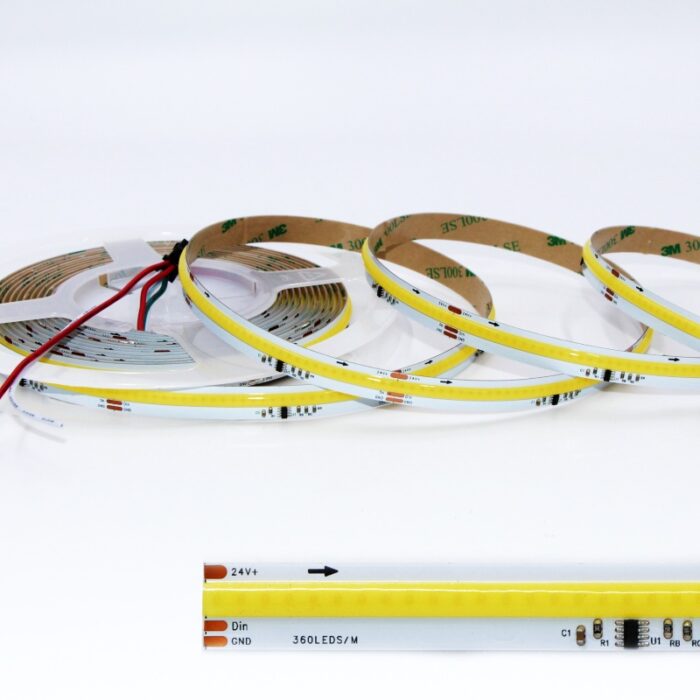
2700K, 3000K, 4000K — three numbers that decide whether a strip light project feels warm and inviting, balanced and clean, or clinical and flat. According to industry observation, CCT is where most strip light specifications quietly go wrong: buyers pick a number from a datasheet without matching it to the space, and the mismatch only becomes obvious after installation. This CCT guide explains what the numbers mean, how to choose 2700K vs 3000K vs 4000K by space and application, the trade-offs between them, and how to specify CCT per room with confidence instead of guesswork.
What the Numbers Actually Mean
Correlated color temperature describes the tone of white light in kelvins — not its quality, rendering, or brightness. Lower numbers read warmer with more amber and red; higher numbers read cooler with more blue. According to industry observation, the most common misunderstanding is treating CCT as a quality tier — assuming 4000K is “better” because the number is higher — when the correct question is which tone the space and its surfaces need. CCT describes appearance; CRI, binning, and efficacy describe quality, and they are specified separately.
2700K vs 3000K: The Warm Choices
2700K is the classic residential warmth — the tone of incandescent lamps — and it suits wood-heavy interiors, bedrooms, restaurants, and anywhere relaxation leads the brief. 3000K sits between warmth and neutrality: slightly crisper than 2700K while still warm, which is why according to industry observation it has become the default for hospitality, lobbies, and premium retail. The practical difference is visible side by side and subtle in isolation, which is why sampling in the actual space beats datasheet comparison — surface colors, wood tones, and finishes shift the perception of both.
4000K: The Neutral Workhorse
4000K reads clean, neutral, and slightly cool — the standard for workspaces, commercial kitchens, bathrooms, and retail where accuracy and clarity lead the brief. According to industry observation, 4000K also suits modern interiors with cool surfaces, white palettes, and minimal designs, where warm light can make surfaces look yellowed. The trade-offs: 4000K spaces feel more alert and less relaxing, which is why mixed-use projects increasingly layer both — 3000K ambient in social zones and 4000K task light in work zones — rather than committing to one temperature everywhere.
Specifying CCT Per Room With Confidence
The specification discipline that prevents CCT mistakes: state the CCT per room or zone rather than project-wide, sample the chosen CCT in the actual space before ordering, and fix the binning window so production matches the sample. According to industry observation, projects that skip the in-space sampling discover the mismatch after installation — and mismatched CCT across adjacent spaces reads as a defect, not a design choice. Documenting the CCT per zone also keeps multi-order projects consistent, which is the discipline covered alongside batch data in our binning and consistency guide, and the application context follows the pattern in our cove lighting specification guide.
Frequently Asked Questions
Is 3000K or 4000K better for kitchens?
3000K suits residential kitchens where warmth matters; 4000K suits task-heavy modern kitchens with cool surfaces where clarity matters. According to industry observation, the kitchen palette — wood versus white — decides which reads better.
Can CCT-tunable strips solve the choice?
They can — CCT-tunable strips cover the range and support scenes that shift through the day. The specification should still document the default scenes and the control ecosystem, since tunable products need matching control gear to deliver the range.
Does CCT affect how colors render?
Only indirectly — CCT describes tone, while CRI describes rendering. A 3000K strip with poor CRI renders worse than a 4000K strip with high CRI, which is why the two are specified separately.
Choosing CCT for an upcoming strip light project? GPD Technology manufactures fixed-CCT, tunable, and multi-white COB and SMD LED strip lights in Shenzhen and supports importers and distributors with CCT sampling, binning documentation, and per-room specification guidance. Contact our team to sample the right CCT in your actual space.
LED Strip for Gyms and Fitness Studios: Lighting That Works
Fitness studios light for motivation, movement, and cameras — three requirements that ordinary office lighting never addresses. According to industry observation, LED strip for gyms and fitness studios has become a defining feature of the category: color-changing lines that shift with training phases, perimeter glows that make spaces feel larger, and studio lighting that members photograph and share. But gyms also combine humidity, impact, and long operating hours, which is why the specification needs to cover durability and comfort alongside the visual effects. This guide covers LED strip lighting for gyms and fitness studios zone by zone — and the details that decide whether the installation survives the environment.
Zone Lighting: Matching Color to Training Areas
Fitness studios train different energy states in different zones, and lighting can support or fight them. Color-changing RGB and tunable strips let studios shift moods: energizing cool white and saturated colors over cardio and HIIT areas, neutral task light over weights, warmer calming tones in stretching and recovery zones. According to industry observation, this zone-based color strategy has become standard in boutique studio design — and it requires addressable or multi-zone control specified at design stage, rather than improvised with wall dimmers after installation.
Perimeter and Ceiling Lines: The Signature Look
The signature fitness studio look is architectural: perimeter lines along walls and ceilings, light lines framing mirrors, and ceiling patterns that make the space feel designed. According to industry observation, these lines are why studios specify high-density COB rather than dot-visible SMD — mirror walls double every visible defect, and members photograph reflections constantly. High-density COB delivers the continuous line at close viewing distance that the mirror-and-camera environment demands, and aluminum profiles add the rigidity and heat spreading that long ceiling runs need.
Durability: Humidity, Impact, and Continuous Hours
Gyms combine humidity from showers and heavy breathing, impact from dropped weights near floor-level strips, and operating hours that exceed most commercial spaces. According to industry observation, the durability specification should cover: IP-rated or sealed construction in humid zones and near showers, protected mounting for floor-adjacent lines, drivers with thermal protection for long daily operation, and strips documented for the continuous hours gyms run. The specification should also name the cleaning compatibility — disinfectants attack non-rated diffusers, which is the same hygiene discipline healthcare projects apply.
Control Scenes and the Member Experience
Control is the feature that members actually experience: class scenes that shift lighting with the workout phase, color cycles synchronized to music, and app or console control that staff can operate between classes. According to industry observation, the control specification belongs at design stage with the lighting — retrofitting scene control onto static strips disappoints, while addressable or multi-zone systems specified at design stage deliver the studio experience that photos and member reviews amplify.
Frequently Asked Questions
Which lighting do fitness studios actually need?
Zone-based color-changing and tunable systems over training areas, high-density COB perimeter lines for the signature look, and durable sealed construction in humid zones — according to industry observation, this combination covers the studio lighting brief.
Is RGB strip enough, or is addressable needed?
RGB covers color changes; addressable adds animations and gradients. Boutique studios increasingly choose addressable for the effects members share on social media, while simpler studios find multi-zone RGB sufficient.
How should gyms handle humidity and cleaning chemicals?
Sealed or IP-rated construction in humid and shower-adjacent zones, disinfectant-resistant diffusers, and drivers placed outside the wet zones — the hygiene discipline from healthcare and wet-room lighting applies directly.
Specifying strip lighting for a gym or fitness studio? GPD Technology manufactures COB and SMD LED strip lights in Shenzhen and supports fitness studios, gym chains, and importers with addressable and tunable options, zone lighting guidance, and durable constructions. Contact our team to design the studio experience with lighting.
LED Strip for Signage and Channel Letters: Fabricator Guide
Channel letters and signage are the original commercial application for LED modules and strips — and the market keeps professionalizing. According to industry observation, sign fabricators who once bought whatever modules were cheapest now specify by efficacy, color consistency, IP rating, and warranty, because signage failures are public: a dark letter or a color-shifted section is visible to every customer who passes. This guide covers LED strip for signage and channel letters as a specification decision: module versus strip formats, brightness by viewing distance, IP and UV for outdoor signs, and the fabrication details that decide whether a sign performs for its full rated life.
Module Versus Strip: Matching Format to Sign Type
Signage illumination comes in two formats, and they solve different sign geometries. LED modules — three-chip pods on wire leads with attached lenses — fill channel letters of any depth and spacing, handling the irregular geometry of fabricated letters. LED strip runs continuously along letter strokes in shallow depth applications. According to industry observation, the specification should follow the letter construction: deeper letters with wider strokes tolerate module spacing flexibility, while shallow halo-lit and slim-face applications favor strip formats. Matching format to sign construction at quotation prevents the density problems that surface as visible hot spots or dark bands after installation.
Brightness by Viewing Distance
Sign brightness is a viewing-distance decision, not a maximum-output decision. Signs read from streets at long distance need high output; signs read from sidewalks at close range need less, with better glare control. According to industry observation, over-bright signs at close range are a growing complaint in mixed-use developments, while under-lit letters at highway distance lose readability. The specification should state the viewing distance and let brightness follow it, rather than defaulting to maximum output — a discipline that also cuts power consumption and extends module lifetime, as the efficacy and lifetime discussions in our energy efficiency guide cover for the underlying products.
Outdoor Durability: IP, UV, and Thermal Reality
Outdoor signs live in the same weather that facades face, with an additional thermal challenge: letters are sealed boxes with little ventilation, and modules inside them run hot in summer sun. According to industry observation, the durability failures concentrate at ingress points and at heat-stressed modules — which makes IP-rated modules, UV-stable materials, and thermal documentation the specification baseline. Sealed connections, drainage considerations in letter bottoms, and UV-stabilized diffusers complete the outdoor package. The same weather-exposure logic applies as for facade lighting, covered in our outdoor facades guide.
Fabrication Details That Decide the Result
The fabrication details that decide the result are small and early: module spacing calculated for even face illumination rather than evenly divided, wiring sized for the total load and routed away from sharp edges, mounting surfaces prepared for adhesive or screw fixation, and power supplies sized with headroom and placed for service access. According to industry observation, fabricators who mock up one letter before a production run catch spacing and brightness issues while they are still cheap — and the practice scales to the whole sign without repeating the mistake.
Frequently Asked Questions
Which format should a sign fabricator choose — modules or strip?
Follow the letter construction: modules for deeper fabricated letters and irregular geometries, strip for shallow strokes and halo-lit applications. Confirming format against letter depth at quotation prevents hot spots and dark bands.
How bright should channel letters be?
Brightness follows viewing distance: long-distance highway signage needs high output, close-range urban signage needs less with better glare control. According to industry observation, over-bright close-range signage is a growing complaint, not a selling point.
What IP rating do outdoor sign modules need?
IP65 or higher for exposed letter interiors, with sealed cable entries and drainage awareness in letter bottoms. The specification should require IP testing of the assembled letter, since modules alone passing IP does not describe the sealed box they operate in.
Fabricating channel letters or illuminated signage? GPD Technology manufactures LED modules, strips, and neon flex in Shenzhen and supports sign fabricators with brightness planning, IP-rated options, and per-model documentation. Contact our team to match products to your sign construction.
LED Strip for Garden and Landscape Lighting: A Buyer Guide
Garden and landscape lighting is where strip lighting leaves the building — and where the specification questions multiply: rain from every direction, soil moisture, UV year-round, and installations buried or concealed where correction means digging. According to industry observation, LED strip for garden and landscape lighting has grown from a niche deck-lighting product into a specification category of its own — pergolas, planters, steps, pathways, and water features — driven by low-voltage safety and the design flexibility strips offer. This guide covers the requirements that decide an outdoor strip lighting result: IP protection by exposure, low-voltage planning, mounting that survives outdoors, and the CCT choices that flatter planting schemes.
IP Protection by Exposure: The First Specification Decision
Garden and landscape exposures vary more than facades do: covered pergolas stay dry, open planting beds take direct rain, and water features create constant wet conditions. According to industry observation, the IP specification should follow the actual exposure per location — IP65 for open garden runs, IP67-68 for ground-level, buried, or underwater installations — with terminations and connectors rated to match. The weak points are rarely the strip body; they are the connections and cable entries, which is why assembled-system testing belongs in the specification rather than bare-strip claims alone.
Low-Voltage Planning: Safety and Distribution
Gardens are where low-voltage systems earn their safety case: 12V and 24V systems eliminate the mains-voltage risks of buried or exposed wiring in soil and planting beds. According to industry observation, the planning details that matter: driver placement in dry, accessible locations with low-voltage distribution out to the runs, wiring sized for the total load and distances, and voltage drop managed through feed positioning or heavier cable on longer runs. Buried cabling needs rated protection, and every connection point should remain accessible — buried joints are where outdoor systems develop intermittent failures that are expensive to excavate.
Mounting and Materials That Survive Outdoors
Outdoor mounting combines weather, UV, and physical wear in ways interior mounting never does. Aluminum profiles with drainage, UV-stabilized silicone and diffusers, and corrosion-resistant fixings are the specification baseline. According to industry observation, the failures concentrate at UV degradation of non-stabilized materials and at fixing points that loosen with thermal movement — both visible after the first season rather than at installation. Where strips run inside handrails, steps, or planter edges, the profile and sealing system should be specified as an assembly, as the profile selection guidance in our aluminum profile guide covers.
CCT Choices That Flatter Planting Schemes
CCT in gardens works differently from interiors: green foliage shifts perceived color, and warm light can make planting look flat while cooler light flattens warm-toned surfaces. According to industry observation, the practical guidance: 2700–3000K flatters timber structures, warm stone, and social areas; 4000K reads cleaner against modern planting schemes and hard landscaping; and tunable white supports seasonal planting changes without relamping. Color consistency across zones matters in gardens too — mixed whites between deck, path, and planting runs are visible from a single viewpoint, which is why one documented family across the scheme, like the GPD COB 10mm 360D 24V strip, keeps the result professional.
Frequently Asked Questions
Which IP rating does garden strip lighting need?
Open garden runs need IP65 or higher with rated terminations; ground-level, buried, or underwater installations need IP67-68. The specification should follow the actual exposure per location and require assembled-system testing.
Should garden lighting be 12V or 24V?
12V suits compact fixtures and short runs with standard garden-low-voltage ecosystems; 24V suits longer runs with less voltage drop. Both are safe for soil and planting-bed installation when cabling is rated for burial.
Which CCT works best for planting schemes?
2700–3000K flatters timber and social areas, 4000K reads cleaner against modern hard landscaping, and tunable white supports seasonal change. Consistency across zones matters more than the per-zone choice, as mixed whites are visible from a single viewpoint.
Specifying strip lighting for gardens and landscapes? GPD Technology manufactures COB and SMD LED strip lights in Shenzhen with IP-rated outdoor configurations, low-voltage systems, and documentation for landscape architects, contractors, and importers. Contact our team to match protection and CCT to your planting scheme.
LED Strip for Outdoor Facades: Weatherproof Linear Lighting
Facades are the most exposed environment strip lighting will ever face: rain driven horizontally by wind, daily and seasonal temperature swings, ultraviolet radiation year-round, and mounting heights that make every correction expensive. According to industry observation, outdoor facade strip installations succeed or fail on decisions made at specification — IP rating, thermal design, and mounting — rather than on the strip’s light output. This guide covers LED strip for outdoor facades as a weatherproof linear lighting specification: matching protection to exposure, surviving thermal and UV stress, mounting that endures, and the details that decide whether a facade performs for years or fails in its first season.
IP Ratings by Exposure: Matching Protection to Reality
Facades see wind-driven rain that finds every gap, so the IP specification should follow the actual exposure rather than a catalog default. Protected reveals and covered coves may justify IP54-65; exposed horizontal runs and parapets need IP65-67; fully washed or ground-level accessible locations justify IP68 with sealed terminations. According to industry observation, the weak points are rarely the strip body — they are the terminations, joints between sections, and cable entries, which is why the specification should require IP testing of the assembled system, not just the bare strip.
Thermal Cycling and UV: The Tests That Matter
Facades live through daily and seasonal temperature swings that expand and contract everything — and UV degrades the materials that survive water. The specification details that matter: silicone jacket and encapsulation materials with UV stabilization, PCB and component grades that tolerate the full temperature range, and mechanical fixing that absorbs movement without stressing solder joints. According to industry observation, UV degradation of non-stabilized silicones is a quiet failure cause that appears after the first summer — yellowing, cracking, and then ingress. Requesting UV-aging data alongside IP testing is the verification that separates outdoor-rated products from indoor products with a weatherproof claim.
Mounting That Survives Weather and Service
Facade mounting combines mechanical load (wind), thermal movement, and service access in one design. Rigid aluminum channels absorb movement and carry heat, mounting systems need corrosion-resistant fixing for the facade substrate, and drainage should prevent water pooling in channels. According to industry observation, the installation failures concentrate at fixing points and cable entries — the details that belong in shop drawings rather than improvised on scaffolding. Service access planning matters because facade access is expensive; drivers and injectors should sit in accessible locations with weatherproof enclosures, not behind sealed cladding.
The Specification Details Facades Demand
The facade specification details that decide long-term results: IP rating per exposure zone with assembled-system testing, UV-stabilized materials documented by grade, temperature range data covering the site’s real extremes, corrosion-resistant fixings matched to the facade substrate, and driver/injector placement in accessible weatherproof enclosures. Where projects combine linear runs with curved signatures, quoting both families against the geometry — as covered in our LED strip vs neon flex comparison — prevents mismatched expectations. And the documentation package matters: per-model IP, thermal, and UV data lets the facade specification be verified rather than trusted, following the model-level documentation practice from our aluminum profile guide.
Frequently Asked Questions
Which IP rating should exposed facade strips carry?
Exposed horizontal and upward-facing runs need IP65-67 with sealed terminations; fully washed locations justify IP68. The specification should test the assembled system, because terminations and joints are where ingress occurs.
Does UV degrade outdoor LED strip materials?
Yes — non-stabilized silicones yellow, crack, and lose sealing over seasons of UV exposure. Requesting UV-aging data for jacket and encapsulation materials is the verification that prevents first-summer failures.
Where do facade strip installations fail most?
At terminations, section joints, and cable entries — according to industry observation, the strip body rarely fails first. The specification should require assembled-system IP testing and rated cable entries at every transition.
Specifying strip lighting for an outdoor facade? GPD Technology manufactures COB, SMD, and high-voltage LED strip lights in Shenzhen with IP-rated and UV-stabilized outdoor configurations, documented thermal data, and facade specification support. Contact our team to match protection to your facade’s exposure.
LED Strip Installation Mistakes to Avoid: A Field Guide
Strip lights fail in the field for reasons that were decided long before the electrician arrived — in sizing calculations skipped, terminations rushed, and sealing assumed rather than verified. According to industry observation, the most common LED strip installation mistakes repeat across projects, factories, and markets, which makes them predictable and preventable. This field guide compiles the installation mistakes that cause most strip light failures, why each happens, and the practices that prevent them — compiled for importers, contractors, and distributors from the failure patterns that repeat across projects.
Power Sizing and Voltage Drop Mistakes
The power-side mistakes concentrate at two points. Driver sizing: undersized supplies cycle or shut down, while oversized dimmable drivers dim poorly at low loads — the calculation is watts per meter times run length plus roughly twenty percent headroom, using the exact product’s data. Voltage drop: long runs dim toward the far end because trace resistance consumes voltage, and the fix belongs in the design — 24V platforms for extended runs, power injection at planned intervals, and feed wires sized for the load, as covered in our voltage drop and power injection guide. According to industry observation, installations that skip the far-end brightness test discover the gradient after the ceiling closes — when the fix has become rework.
Cutting, Connection, and Termination Mistakes
The physical connection mistakes repeat across every market. Cutting between marked points severs circuits beyond the cut and leaves nothing to connect. Clip connectors specified in damp or outdoor locations corrode and lose tension where soldered and potted terminations would survive. Reusing corroded clips from demolished installations repeats the same failure in the same spot. And polarity reversals at joins scramble controllable sections. The prevention is procedural: cut discipline at marked points, termination types matched to environment, and every join tested before assembly continues, with the termination failure patterns detailed in our connector failures guide.
Sealing and Environmental Mistakes
Waterproof strip installations fail at the transitions, not the sealed sections. Cutting IP-rated strip destroys its seal, and the rating survives only if the cut is rebuilt with rated end caps and full-cure potting — a partial seal passes visual inspection and fails in the first rain. According to industry observation, the second-most-common callback source is the partially sealed cut, and the prevention is treating re-sealing as a verified step rather than a finishing touch. Where strips mount inside profiles in wet zones, the assembled system carries the rating — a specification detail from our aluminum profile guide that matters wherever profiles meet moisture.
Dimming and Control Mistakes
Dimming mistakes surface after handover, when clients actually use the system. Mismatched dimmers create flicker and dead zones; oversized dimmable drivers drop out at low loads; and untested strip-driver pairings discover incompatibility after the profile closes. The prevention belongs at specification: name the dimming method, require flicker performance at low dimmed levels, and test the exact pairing before ordering — the verification sequence covered in our flicker-free lighting guide.
Frequently Asked Questions
Which installation mistake causes the most failures?
According to industry observation, the top two are voltage drop on unplanned long runs and connector failures in damp locations — both predictable, both preventable at specification stage.
Can installation mistakes be fixed after handover?
Yes, but at multiplied cost: access, rework, and customer impact all exceed what the same correction costs at installation. Testing before closing assemblies is the cheapest insurance available.
What single habit prevents most strip light failures?
Testing every run and every join before assembly continues — power, brightness at both ends, and control behavior — because it converts hidden defects into caught ones while access is still open.
Preventing installation failures in your strip light projects? GPD Technology manufactures COB and SMD LED strip lights in Shenzhen and supports importers, contractors, and distributors with installation documentation, power planning guidance, and per-batch quality data. Contact our team to review your installation plan before ordering.
LED Strip for Hospital and Healthcare Lighting: Buyer Guide
Healthcare lighting holds products to requirements that commercial projects never face: hygienic surfaces that survive cleaning chemicals, flicker performance that protects patients and staff, color rendering that supports clinical observation, and quiet reliability in spaces that operate continuously. According to industry observation, LED strip hospital and healthcare lighting has grown into a standard specification across patient rooms, nurses’ stations, corridors, and medical workplace applications — driven by LED technology’s low heat, dimming precision, and compact formats that fit the hygienic geometries healthcare demands. This guide covers the healthcare applications, the specification requirements, and what importers and contractors should verify before committing products to clinical environments.
Hygiene and Cleanability: The Healthcare Baseline
Healthcare environments disinfect relentlessly, and lighting hardware must survive it. Sealed or encapsulated constructions that wipe clean without crevices, materials resistant to disinfectant chemicals, and IP-rated builds where washing reaches are the baseline. According to industry observation, exposed connectors and open PCB builds are the most common rejection points in healthcare lighting reviews — hygiene inspection treats crevices as infection risks. Sealed silicone constructions and profiles with closed diffusers pass where open builds fail, which makes construction choice a clinical requirement rather than an aesthetic one.
Flicker, Color, and Patient Comfort
Healthcare spaces run continuously, and lighting quality affects patients and staff differently. Flicker control is the hard requirement — patients spend long hours watching spaces where low-frequency flicker causes headaches and fatigue, and staff work under that light through entire shifts. Color rendering supports clinical observation: CRI 90+ where skin tone assessment matters, consistent CCT across patient areas. And dimmable, tunable configurations support circadian-oriented lighting that according to industry observation is growing in healthcare design — warmer night levels that protect patient sleep while keeping night-shift visibility. The flicker specification discipline from our flicker-free lighting guide applies directly to healthcare projects.
Reliability for Continuous Operation
Healthcare lighting runs continuously, and reliability requirements scale accordingly. Quality drivers with thermal protection, strips with documented lifetime under continuous operation, and redundant power planning for critical areas are the specification baseline. According to industry observation, healthcare retrofits often discover lifetime shortfalls from heat rather than from the LEDs themselves — strips in enclosed, continuously running installations need thermal planning or derating. Products documented for continuous operation, like the GPD COB 10mm 480D 24V strip with its published thermal and electrical data, let project teams verify continuous-operation suitability rather than assume it.
Compliance Documentation for Healthcare Procurement
Healthcare procurement reviews documentation more thoroughly than most markets, and the specification should anticipate it. Safety certifications matched to the destination market, material documentation for hygienic environments, photometric and flicker data at model level, and IP test evidence where sealed builds are specified. According to industry observation, the suppliers who pass healthcare procurement reviews are those with complete documentation — which is the same preparation that serves the broader compliance direction covered in our regulatory compliance update. Importers serving healthcare programs should expect deeper document requests than commercial markets and pre-package accordingly.
Frequently Asked Questions
Which IP rating do patient room strip lights need?
Patient rooms typically need sealed, cleanable constructions rather than high IP alone — IP44-class sealed builds with wipeable surfaces cover most patient area requirements, while wash-down zones need higher ratings per the cleaning protocol.
Why is flicker control critical in healthcare lighting?
Patients spend long hours in lit spaces and staff work entire shifts — low-frequency flicker causes headaches, fatigue, and visible strobing for sensitive occupants. High-frequency PWM or constant-current driving is the specification baseline.
What documentation do healthcare projects request?
Safety certifications, material and hygiene documentation, photometric and flicker data at model level, and IP test evidence where sealed builds are specified. According to industry observation, healthcare reviews go deeper than commercial documentation — preparation wins the specification.
Specifying strip lighting for healthcare environments? GPD Technology manufactures COB and SMD LED strip lights in Shenzhen with sealed constructions, flicker-verified driving, and documentation packages for healthcare projects. Contact our team to review products against your clinical requirements.
LED Strip Fire Safety: What Buyers Should Verify
Fire safety is the strip light topic buyers ask about least and regulators care about most. Strip lights themselves run at low voltage and low temperature — but the complete system includes drivers carrying mains voltage, wiring sized for real loads, terminations in joinery, and installations that sometimes get covered in insulation. According to industry observation, most strip-related fire risks trace back to that surrounding system rather than to the strip — which is why the COB LED strip range is specified alongside certified drivers and proper wiring, and why LED strip fire safety deserves verification at the system level. This guide covers the materials and ratings that matter, the driver protections to require, and the installation practices that prevent the failures that make news.
Materials and Flammability Ratings
The strip’s own materials start the fire safety review. PCB substrates are graded for flammability — UL94 V-0 grade stops burning within seconds after flame removal, while ungraded substrates can sustain it. Silicone and encapsulation materials vary in their flame behavior too, and diffusers differ: polycarbonate is impact-resistant but needs flame-retardant grades for ceiling installations, while PMMA behaves differently under heat. According to industry observation, buyers rarely see this data because datasheets omit it — which is exactly why requesting flammability grades for PCB, encapsulant, and diffuser materials belongs in the sourcing conversation, especially for strips installed in ceilings, joinery, and enclosed channels.
Driver Protection and Electrical Safety
The driver carries the mains voltage, and its protection systems are the real fire safety layer. Quality drivers include overload, short-circuit, and over-temperature protection that shuts the system down before faults become fires; certified drivers carry the safety marks for their destination market. The verification points: SELV or Class 2 output classification where the specification calls for it, certification marks matched to the destination market rather than generic claims, and thermal ratings that match the installation environment — enclosed ceiling voids run hotter than open cabinets. According to industry observation, uncertified or mismatched dimmers are a recurring ignition source in strip systems, because pairing untested dimmers with drivers creates loads neither was designed for.
Installation Practices That Prevent Failures
Installation is where fire safety is won or lost. The practices that prevent failures: never covering drivers with thermal insulation, because sealed drivers overheat; respecting the strip’s maximum run lengths instead of over-daisy-chaining, which overloads trace copper near the feed; using adequately sized wiring for runs and injections; and keeping terminations clean and insulated. Profiles help — aluminum profiles act as heat sinks and keep strips away from combustible surfaces, as detailed in our aluminum profile guide — but drivers and wiring still need their clearance and ventilation. For higher-wattage runs, the specification should pair the strip with an aluminum channel for heat spreading — the GPD COB 10mm 480D 24V strip documents its thermal and electrical data at model level for exactly this reason.
Frequently Asked Questions
Are low-voltage LED strips themselves a fire risk?
Quality strips run cool and carry low risk. The fire-safety focus belongs on the system: drivers, wiring, terminations, and installations — which is where overloading, overheating, and poor terminations concentrate the risk.
What fire-safety documentation should buyers request?
Flammability grades for PCB and encapsulant materials, driver safety certifications matched to the destination market, and thermal test data for enclosed installations. According to industry observation, these three document sets cover most professional review requirements.
Does IP sealing affect heat and fire safety?
Sealed strips run warmer because encapsulation insulates. The specification should pair IP requirements with thermal data and derating guidance, so waterproofing decisions do not silently create overheating risks.
Which certification marks matter most for strip drivers?
Match the marks to the destination market: CE and UKCA for Europe, UL or ETL listing for installed work in North America. Generic safety claims without certifiable marks belong to a different conversation.
Verifying fire safety across your strip lighting system? GPD Technology manufactures COB and SMD LED strip lights in Shenzhen with documented materials, certified driver pairings, and installation guidance for importers, contractors, and distributors. Contact our team to review the fire-safety documentation for your project.
LED Strip for Museums and Galleries: Lighting Requirements
Museums and galleries light their exhibits under constraints that ordinary commercial projects never face: conservation limits on heat and radiation, close viewing distances that expose every defect, and curatorial requirements that change with every exhibition. According to industry observation, LED strip lighting has quietly become a workhorse in museum and gallery applications — case lighting, plinth washes, back-of-frame illumination — precisely because compact formats, low heat, and dimmable control fit conservation constraints better than most fixtures. This guide covers LED strip lighting requirements for museums and galleries: the conservation constraints, the specification details, and what curators and exhibition teams will ask of the products you supply.
Conservation Constraints: Heat, UV, and Radiated Energy
Conservation starts with what light does to exhibits over time: heat dries and degrades sensitive materials, UV accelerates fading, and even visible light carries radiated energy that accumulates across years of display. According to industry observation, this is where LED strip lighting earns its museum position: LEDs emit negligible UV compared to halogen sources, run cool enough for close-range case installations, and dim cleanly for conservation-controlled exposure levels. The specification should still require documented UV and IR data rather than assumptions, because conservation officers will ask — and the compact format of products like the GPD COB 3mm 400D 12V strip fits the shallow case profiles and plinth details that museum casework uses.
High CRI at Close Range: Where Defects Show
Museum and gallery lighting is viewed closer than any other application: visitors stand centimeters from exhibits, and the light quality shows everything. High CRI and quality color data are the baseline — CRI 95+ with good R9 (deep red rendering) for paintings, textiles, and artifacts where color fidelity matters. Beyond the numbers, uniformity along the strip matters: color shifts along a run are visible inside a display case in a way they never would be in a corridor. According to industry observation, this is where high-density COB strip performs well in case lighting — continuous emission, no dot pattern at centimeter distances, and dimmable control for conservation-managed light levels.
Control and Flexibility for Changing Exhibitions
Exhibitions change, and the lighting must follow without rework. Dimmable control per case and per zone lets conservation teams set exposure levels per exhibit, and re-programmable scenes support new layouts without rewiring. The specification should fix the control protocol, dimming range down to conservation levels, and the wiring topology per case — because retrofitting control inside built casework is the most expensive change in museum lighting. According to industry observation, exhibitions that plan control at design stage re-light their spaces in days rather than weeks.
Practical Installation Details in Casework
The installation details that matter in casework are mostly geometry: miniature strip formats for shallow case profiles, mounting channels that position the strip for even wash without direct view, wiring routed through case joinery without visible runs, and service access for drivers outside the sealed display volume. Heat management inside sealed cases matters too — low-wattage strips in ventilated positions keep case interiors at conservation-safe temperatures. According to industry observation, casework projects that mock up one case before replicating across an exhibition catch most of these details early, which is the practice that separates professional casework installations from disappointing ones.
Frequently Asked Questions
Is LED strip lighting safe for sensitive exhibits?
LED strip emits negligible UV and runs cool compared to halogen sources, making it suitable for most case applications. Conservation officers may still require documented UV and IR data, and exposure levels are managed through dimming and operating hours.
What CRI should museum and gallery lighting specify?
CRI 95+ with strong R9 rendering is the professional baseline for paintings and artifacts, with TM-30 data where color fidelity is critical. Consistency along runs matters at museum viewing distances.
Can strip lighting be dimmed to conservation levels?
Yes — quality systems dim smoothly to very low levels for conservation-managed exposure, with the control protocol and dimming range fixed in the specification so curators can set exposure per exhibit.
Specifying strip lighting for museum casework or gallery exhibitions? GPD Technology manufactures compact, high-CRI COB and SMD LED strip lights in Shenzhen and supports exhibition teams, casework fabricators, and importers with samples, photometric data, and dimming documentation. Contact our team to match strips to your conservation requirements.
LED Strip Integration in Acoustic Ceiling and Baffle Systems
Open ceilings, felt baffles, acoustic rafts, and suspended felt systems have taken over office and hospitality architecture — and lighting is now being designed into the acoustic layer itself rather than hung below it. According to industry observation, LED strip integration in acoustic ceiling and baffle systems has become one of the fastest-moving specification trends in fit-out work, because combining the two functions saves ceiling real estate, simplifies the visual layer, and matches how designers now think about ceilings. This guide covers the integration formats, the specification details, and what importers and fit-out contractors should prepare for this category.
Why Acoustic Systems and Lighting Are Converging
Acoustic performance has become a first-order requirement in open offices, restaurants, and classrooms — and the products that deliver it (felt baffles, PET rafts, perforated metal systems) hang in exactly the volume where lighting used to hang. Rather than stacking two systems, designers now integrate: linear light lines running between acoustic baffles, strips recessed into acoustic raft frames, and perimeter washes built into the acoustic perimeter. According to industry observation, the integration trend also serves retrofit economics — updating lighting and acoustics in one installation pass rather than two ceiling visits.
Integration Formats That Work
The proven integration formats balance light output with acoustic transparency. Linear lines running parallel between baffle rows keep the acoustic coverage uninterrupted while delivering even ambient light. Strips recessed into raft frames add perimeter definition and indirect wash. And task-zone integration puts light directly into acoustic partition systems. According to industry observation, the specification detail that matters most is the spacing rhythm: the baffle-to-light-line spacing affects both acoustic performance and illumination evenness, so the two systems should be designed together, not sequenced.
Specification Details: Mounting, Wiring, and Light Behavior
The specification details for acoustic integration go beyond standard strip installation. Suspension systems must carry both the acoustic elements and the light lines with a shared leveling plan. Wiring routes through or behind the acoustic layer need service access planning. And light behavior needs real attention: acoustic felt absorbs light, matte surfaces reduce reflectance, and the indirect component should be calculated against the actual ceiling condition rather than assumed. According to industry observation, this is where acoustic-integrated projects most often underperform — the light was calculated for a reflective ceiling that the acoustic design replaced.
What Importers and Fit-Out Contractors Should Prepare
The category rewards preparation. Importers should stock compact, high-efficacy formats suited to baffle-channel integration, documentation packages for acoustic system partners, and samples for designer mockups. Fit-out contractors should expect combined suspension and wiring plans, and coordinate the acoustic and electrical scopes before installation. According to industry observation, the projects that coordinate both scopes at design stage — rather than sequencing them — finish faster and perform better, which is the argument that wins these specifications. More selection background is available in our Technical Support knowledge base, and the office applications are covered further in our office workspace lighting guide.
Frequently Asked Questions
Does the acoustic material absorb the light from integrated strips?
Felt and PET materials absorb a measurable share of adjacent light. The design response is spacing and orientation — light lines positioned for downlight contribution rather than relying on the acoustic surface as a reflector.
How is wiring routed through acoustic systems?
Through the suspension structure, with service loops at each light line and access planned at connection points. The routing should be coordinated with the acoustic layout so neither system compromises the other.
Is acoustic-integrated lighting more expensive than separate systems?
The combined installation usually saves ceiling height, suspension hardware, and a second installation pass. According to industry observation, the integrated approach often lands at or below the cost of two sequenced systems — with a cleaner result.
Integrating lighting into acoustic ceilings for an upcoming project? GPD Technology manufactures COB and SMD LED strip lights in Shenzhen and supports fit-out contractors, acoustic system partners, and importers with compact formats, wiring guidance, and specification review. Contact our team to plan the integration together.
LED Strip for Office Workspaces: Linear and Task Lighting
Office lighting is being rebuilt around strip-based systems: suspended linear lines that define open plans, indirect ceiling washes that replace glare-prone panels, and task integration that puts light where work happens. According to industry observation, office LED strip workspace lighting has shifted from a decorative accent to the primary specification in fit-outs — driven by wellbeing standards, ceiling design trends, and the move away from flat-panel grids. This guide covers the office applications, the specification details that matter for workspaces, and what importers and fit-out contractors should check before committing.
Suspended Linear Lines: The Open-Plan Standard
Suspended linear profiles with embedded high-density COB have become the open-plan office standard — continuous lines that define zones, replace panel grids, and integrate with acoustic and track systems. According to industry observation, the specification details that matter here: mounting height and spacing for even illumination across workpoints, uplight plus downlight combinations for ceiling illumination without glare, and efficacy documented at real operating temperature. The specification should also fix the suspension system and the joiner continuity for full-building line runs, where a visible break between profiles reads as a defect.
Indirect Ceiling Wash: Comfort Without Glare
Indirect lighting — strips washing the ceiling from suspended or wall-mounted channels — has become the comfort play in offices, because reflected light eliminates the direct glare that flat panels and downlights produce on screens. According to industry observation, indirect wash systems are increasingly specified alongside or instead of direct lines in meeting rooms and focus areas. The specification details that decide the result: reflectance of the ceiling surface, strip-to-ceiling distance, and the power budget for the indirect layer — all calculable before ordering, rather than adjusted after installation.
Task Integration: Light Where Work Happens
Beyond the ceiling layer, task integration puts strip lighting into desks, joinery, and acoustic systems — under-shelf task lines, acoustic-baffle integrations, and meeting room coves. According to industry observation, the trend direction is integration at the furniture level, mirroring the furniture and joinery programs covered in our furniture integration guide: office OEMs design the lighting in at the drawing stage, with wiring, sensors, and controls routed through the furniture system. For importers, office OEM programs are compact-format, volume-stable business — the same dynamics that made kitchen and wardrobe programs dependable.
Wellbeing, Control, and the Compliance Direction
Office specifications increasingly include wellbeing and control requirements that strip systems must meet. Flicker performance for camera and screen environments, tunable white for circadian-oriented workspaces, and scene control per zone are becoming standard asks. According to industry observation, European office projects also connect lighting to the broader compliance direction — efficacy documentation and sustainability data — a trend covered from the regulation side in our energy efficiency regulation guide. The specification should fix these requirements at tender stage, per the discipline in our tender guide, so products are selected against the full requirement set rather than price alone.
Frequently Asked Questions
Suspended linear lines or ceiling panels — which should an office fit-out choose?
According to industry observation, linear lines have taken the lead in modern fit-outs for their zoning flexibility, aesthetics, and integration with acoustic systems, while panels remain the budget option. The choice usually follows the design concept and ceiling architecture.
What strip density works for office task areas?
High-density COB suits close-range task integration and shallow profiles; standard densities suffice for suspended ambient lines with generous mounting height. State the mounting height and task locations so density can be verified.
Is tunable white worth specifying in offices?
For wellbeing-oriented and multishift workspaces, according to industry observation, yes — circadian-tuned scenes support comfort across the day. Fixed CCT remains the budget option for standard office programs.
Specifying strip lighting for an office fit-out program? GPD Technology manufactures COB and SMD LED strip lights in Shenzhen and supports office OEMs, fit-out contractors, and importers with linear formats, documented efficacy, tunable options, and specification review. Contact our team to match strips to your workspace program.
LED Strip for Bars and Restaurants: Backbar to Dining Guide
Bars and restaurants light their spaces for one customer above all: the phone camera. According to industry observation, strip lighting in bars and restaurants is specified less for illuminance and more for atmosphere, color, and how the space photographs — while still needing to meet the durability and service realities of venues that run late, every night. This guide covers LED strip for bars and restaurants application by application: backbars and shelf displays, dining coves and perimeter lines, CCT strategy for food and faces, and the operational details venues demand from the products they specify.
Backbars and Shelf Displays: The Signature Application
The backbar is the visual centerpiece of most bars, and strip lighting is what makes it work. Per-shelf LED strip lights each bottle row, front-lit so labels and glass read from across the room, with the mirror behind doubling the effect. According to industry observation, the specification details that separate professional backbars from improvised ones: high-density COB for dot-free light at viewing distance, per-shelf control so slower-moving shelves dim without relamping, and consistent color across every shelf — mixed whites on a backbar are immediately visible to every guest. Tiered shelving systems with integrated strip channels simplify both the build and the look.
Dining Areas: Coves, Perimeters, and Pendant Support
Dining areas layer strip lighting into coves, ceiling perimeters, and joinery — the warm ambient layer that makes guests comfortable staying for another course. According to industry observation, the specification point for dining strip lighting is the dimmed evening state: restaurants operate most hours at low, warm output, and cheap dimming reveals flicker and color shift exactly then. The specification should require high-frequency dimming performance at low levels, and the CCT should hold its rendered quality when dimmed — the pairing checks described in our flicker-free lighting guide apply directly to restaurant projects.
CCT Strategy for Food and Faces
Food and faces are the two subjects every restaurant lights, and they pull CCT in different directions. Warm 2700–3000K flatters wood, stone, and skin — the residential-feeling warmth dining venues want. Food display counters and open kitchens often add 3500–4000K zones where accuracy matters more than warmth. CRI 90+ keeps produce, plating, and guests rendering honestly. According to industry observation, the venues that solve this best layer both: warm ambient strip as the base, accurate accent zones where food is presented — and consistency between zones, because visible CCT shifts between dining and counter areas read as improvisation.
Operational Details Venues Demand
Venues run late, clean with liquids, and renovate on tight closures — and the specification should respect all three. Strips in bars need sealed or wipeable construction where sprays and spills reach. Drivers need accessible placement for service without closing the venue. Emergency and egress lighting requirements apply in dining areas. And venues renovate overnight: products with reliable availability and fast resupply matter, because a failed backbar strip on a Friday is an operational problem, not a maintenance ticket. According to industry observation, importers serving venue programs compete on resupply speed and documented durability as much as on price.
Frequently Asked Questions
Which CCT works best for bar backbars?
3000K is the dependable default that flatters spirits, glass, and faces, with RGB or tunable accents where venues want scene flexibility. Consistency across every shelf matters more than the exact temperature chosen.
What protection do bar and restaurant strips need?
Wipeable or sealed construction near counters and bars, IP54 or higher where cleaning sprays reach, and drivers placed accessibly outside splash zones. Durability requirements should follow the cleaning reality of the venue.
How is restaurant strip lighting best controlled?
With scenes: full task output for service prep, warm dimmed levels for service hours, and accent scenes for events. High-frequency dimming at low levels is the specification point, per the flicker discipline above.
Specifying strip lighting for a bar or restaurant program? GPD Technology manufactures COB and SMD LED strip lights in Shenzhen and supports venue fit-outs, importers, and distributors with high-density options, dimming-tested samples, and durable constructions. Contact our team to match strips to your venue’s atmosphere.
LED Strip Hotel and Hospitality Lighting: Application Guide
Hotels specify strip lighting in more places than almost any other building type — guest room coves and headboards, wardrobes and vanities, backbars, corridors, and facade accents — and hospitality projects also hold those products to a higher standard than most. According to industry observation, LED strip hotel and hospitality lighting succeeds when the specification treats each application with its own requirements, rather than one product repeated everywhere. This guide maps the hotel strip lighting applications, the specification details per application, and the sourcing practices that keep hospitality projects on schedule and on standard.

Guest Rooms: Headboards, Wardrobes, and Vanities
Guest room lighting is where strip integration earns its premium. Headboard coves set the room’s mood layer, wardrobe interiors light the space guests actually use, and vanity strips put accurate light on faces. According to industry observation, the specification differences per location matter: headboard coves want low wattage and deep-dim warmth for evening scenes, wardrobe lighting wants clean task-grade output with door sensors, and vanities need high CRI with front-and-side placement to avoid facial shadows. Standardizing on one 24V platform across the room keeps drivers, spares, and controls unified while each application gets its own configuration.
Public Areas: Coves, Backbars, and Corridors
Public areas scale the same products into larger systems with stricter demands. Lobby coves run long lengths that need power injection planning; backbar and shelf lighting behind bars and reception desks needs color rendering that flatters both bottles and staff; corridor coves run for hours every night and reward documented efficacy and drivers with serviceable placement. According to industry observation, hospitality projects also demand consistency across floors and wings — meaning per-batch binning discipline and locked production windows, since a color shift between phase one and phase two is visible to every returning guest.
The Specification Details Hospitality Demands
Hotel specifications hold products to operational standards beyond the datasheet. Flicker performance at dimmed evening levels, because guests notice what cameras confirm. Low minimum loads on dimmable drivers, because cove scenes run at low output most of the night. Documentation completeness per model — photometric files, safety certifications, and batch data — because hotel owners, operators, and brands each review submittals separately. And service life expectations matched to hotel renovation cycles, which run longer than residential cycles. According to industry observation, importers who pre-package this documentation per model win hospitality tenders on preparation, not price.
Sourcing Practices for Hospitality Programs
Hospitality programs reward sourcing practices that match their structure. Locking production windows across phases keeps multi-phase hotels consistent. Sample reels retained as reference standards keep color matching enforceable. Per-batch documentation submitted with each phase keeps operator and brand sign-offs moving. And confirming dimming and control compatibility with the project’s chosen ecosystem at sampling — rather than after installation — prevents the callback pattern described in our flicker-free lighting guide. Importers serving hospitality programs should also expect brand-standard reviews, where operators check the lighting against their own manuals before acceptance.
Frequently Asked Questions
Which hotel applications use strip lighting most?
Guest room headboards, wardrobes, and vanities; lobby and reception coves; backbars and shelving; corridors; and facade accents. According to industry observation, guest room integration and backbar lighting are the two fastest-growing hospitality applications.
What CRI and CCT should hotel strip lighting specify?
CRI 90+ as the baseline for guest-facing areas, with CCT per space: 3000K for guest rooms and residential-feeling areas, 4000K for back-of-house and commercial zones. Consistency across phases matters as much as the per-space choice.
How do hotel projects handle brand-standard reviews?
Operators and brands review lighting submittals against their own standards before acceptance. Importers who pre-package per-model documentation — photometric data, safety certifications, batch records — pass those reviews without delays, while gaps surface as re-submittal cycles.
Specifying strip lighting for a hotel or hospitality program? GPD Technology manufactures COB and SMD LED strip lights in Shenzhen and supports hospitality projects with per-application configurations, batch documentation, and phase-consistency practices. Contact our team to align your strip specification with hotel standards.
LED Strip vs LED Neon Flex: How to Choose for Your Project
LED strip and LED neon flex solve different problems that customers often describe with the same words. According to industry observation, the two products are quoted against each other constantly, and the wrong choice usually traces back to matching the product to a description rather than to the project. This comparison covers the real differences — light distribution, installation behavior, waterproofing, flexibility, and cost structure — and the project cases where each is the better specification.
Light Distribution: Line Versus Form
Standard LED strip emits from one face in a continuous line — its strength is even, architectural illumination along flat runs in profiles and coves. Neon flex emits through a silicone jacket in every direction, designed to bend into shapes, letters, and curves that rigid PCB strips cannot follow. According to industry observation, the practical dividing line: if the run is straight, concealed, and viewed as a lighting layer, strip wins; if the design bends, curves, or the source itself is the visual feature, neon flex wins. Projects that need both — linear architectural lighting plus curved accent signatures — increasingly specify both families together.
Installation Behavior: Cut Points Versus Bending
Strip lights cut at marked points and install in profiles; their constraint is straightness and minimum bend radius for the PCB. Neon flex bends freely in every direction and cuts at its own marked intervals, with splicing requiring specific connectors and techniques. According to industry observation, installation failures differ by family: strips fail on voltage drop and profile fit, neon flex fails on bending radius violations and sealed-joint leaks at splices. Neither is harder to install — they fail differently, and the specification should name the expected geometry so the right family is quoted.
Waterproofing and Durability
Both families reach IP65 and beyond, but they achieve it differently. Strip lights rely on coating or sleeving over the PCB — effective, with the caveats about cut-and-reseal covered in our termination guides. Neon flex jackets seal integrally, which makes high-IP ratings more consistent across the product and simplifies outdoor confidence. According to industry observation, this is why neon flex dominates outdoor signage and facade work while coated strips dominate weather-protected architectural runs. Durability in service depends more on the upstream quality system — chip sourcing, soldering, and aging — than on the jacket, which is why factory capability matters more than the IP number alone.
Cost Structure: Purchase Price and Installed Cost
Purchase price per meter usually favors strip lights, especially in standard 24V configurations produced at volume. Installed cost can flip the comparison: neon flex saves profile, diffuser, and bending labor on curved designs, while strip wins on straight runs where those accessories were never needed. According to industry observation, the honest comparison quotes both families against the installation geometry — and for straight architectural runs, strip lighting remains the value specification. For projects mixing straight and curved signatures, quoting both together with matched CCT and output avoids the mismatched-light complaints that surface after installation.
Frequently Asked Questions
Can LED neon flex match the light quality of COB strip?
For decorative and signage purposes, yes — modern neon flex with good diffusing jackets reads as a continuous line. For architectural illumination where color rendering, efficacy data, and CCT precision matter, COB strip retains the specification advantage.
Which product handles cold climates better?
Both families have low-temperature-rated variants; the jacket material and chip grade decide. Ask for low-temperature test data rather than assuming either family fails in cold climates.
Can the two families be mixed in one project?
Yes — matched CCT and output make the combination seamless, and it is the common specification for projects combining straight architectural runs with curved accent signatures.
Choosing between LED strip and neon flex for a project? GPD Technology manufactures COB and SMD LED strip lights and supports importers and distributors with comparison guidance, matched-CCT samples, and documentation across both linear families. Contact our team to quote the right product against your project geometry.
LED Strip Staircase and Handrail Lighting: A Design Guide
Staircases are where strip lighting becomes a safety feature rather than a decorative one — and where underperforming products announce themselves with every step. According to industry observation, staircase and handrail LED strip lighting has grown into a standard specification for residential stairs, commercial escape routes, and premium hospitality staircases, driven by aging-in-place design, safety codes, and the clean look of recessed handrail integration. This design guide covers the requirements that decide a staircase lighting result: placement and viewing angles, brightness and glare control, density, and the safety and installation details that stairs uniquely demand.
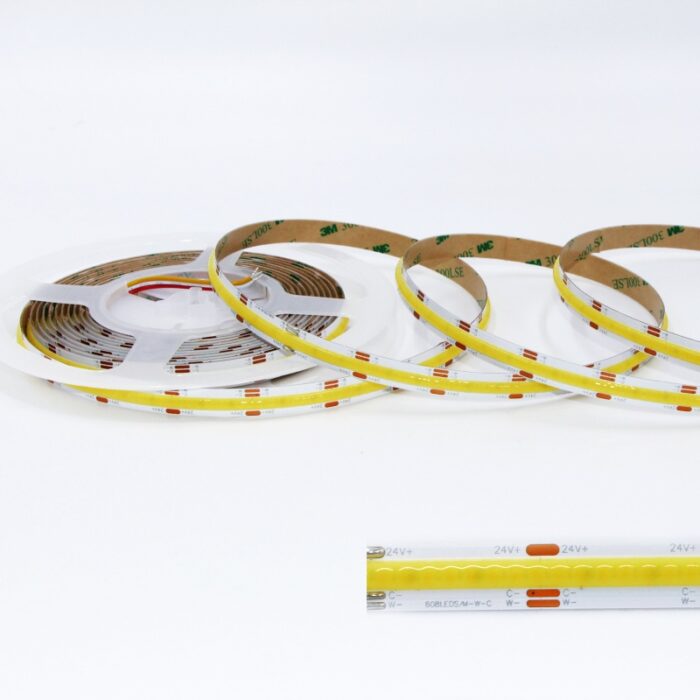
Placement: Handrail Integration Versus Step Edge
Staircase strip lighting has two dominant placements, and they serve different purposes. Handrail integration mounts the strip under or within the handrail, washing each tread evenly while keeping the source hidden from direct view — the premium residential standard. Step-edge (nosing) lighting mounts strips or profiles into each step nosing, delivering direct light exactly on the walking surface — common in commercial escape routes and public stairs. According to industry observation, handrail integration wins on aesthetics and uniformity, while nosing lighting wins on code compliance and retrofit simplicity; hybrid designs combine both. The specification should commit to one placement per staircase rather than improvising on site.
Density and View Angle: The Critical Pair
Stair viewing angles are uniquely demanding: users look down directly onto treads they are walking on, at close range and shallow angle — exactly the geometry that exposes individual diodes. According to industry observation, this is why staircase applications moved to high-density COB earlier than most decorative uses. The specification should pair density with the mounting geometry: nosing profiles with tight diffusers need high-density strip to read continuous, while deeper handrail channels tolerate moderate density. Viewing distance and angle should be stated in the specification so the density choice can be verified against them, rather than chosen by datasheet habit.
Brightness, Glare, and Control Behavior
Staircase lighting must be bright enough to define each tread edge, controlled enough to avoid glare in upward sight lines, and smart in how it responds to occupancy. Motion-triggered activation at reduced night levels, full output on demand, and smooth dimming transitions are the standard control sequence. According to industry observation, glare is the most common post-installation complaint — visible strip lines that compete with the stair view — and it traces back to diffusor depth and mounting angle rather than the strip itself. The specification should include the diffuser and mounting depth so glare is designed out rather than discovered.
Safety, Compliance, and Installation Details
Stairs carry safety obligations that decorative applications do not. Commercial escape routes may require maintained lighting with defined response behavior, handrail integrations must not compromise the grip surface, and electrical work on stairs is regulated in several markets. The installation details that matter: step-edge profiles need clean cut discipline and secure fixings, handrail channels need wiring routed through the rail with connectors accessible, and power injection follows run-length planning on longer flights, as covered in our voltage drop guide. Certification documentation follows the per-model discipline in our certification guide, and compact products such as the GPD COB 3mm 400D 12V strip fit the narrow handrail and nosing channels stairs use.
Frequently Asked Questions
Handrail integration or step-edge lighting — which should a project choose?
Handrail integration for aesthetics and even tread washing in residential and hospitality stairs; step-edge nosing for direct tread definition, commercial compliance, and retrofit simplicity. Hybrid designs combine both where budgets allow.
What density should staircase strips use?
High-density COB is the practical default — stairs are viewed directly at close range and shallow angle, where lower densities read as dots. The specification should state the viewing geometry so density can be verified.
How is staircase lighting typically controlled?
Motion sensors at top and bottom trigger scenes: reduced night levels for safety navigation and full output for daytime use. Dimming and scene control belong in the specification rather than improvised with wall dimmers.
Specifying strip lighting for a staircase project? GPD Technology manufactures COB and SMD LED strip lights in Shenzhen with compact, high-density formats and specification support for staircase and handrail programs. Contact our team to match strips to your staircase design.
LED Strip Bathroom and Mirror Lighting: A Buyer Guide
Bathrooms and mirrors are where strip lighting meets its harshest environment and its most flattering application at the same time. According to industry observation, bathroom and mirror LED strip lighting has become standard in hotel renovations, premium residential projects, and furniture-grade mirror cabinets — driven by the move from bulb-lit mirrors to continuous, dimmable, well-graded light. But bathrooms combine moisture, regulations, and reflective surfaces that punish shortcuts, so the specification and installation details decide the result. This guide covers IP ratings by bathroom zone, mirror lighting technique, CCT and dimming choices, and the installation details wet rooms demand.
IP Ratings by Bathroom Zone
Bathroom electrical zones exist for a reason, and strip specifications should follow them. Inside shower and bath enclosures — the wettest zones — strips need IP65 or higher with sealed terminations. Around washbasins and mirrors within a meter of water sources, IP44 is the practical minimum with splash protection. Beyond those zones, IP20 in profiles is acceptable for interior use. According to industry observation, the most common compliance mistake is treating a whole bathroom as one zone and specifying a single IP rating throughout — which either overspends or under-protects. The specification should name the zone per installation point and require terminations that match, because a sealed strip with an open connector fails exactly the same way.
Mirror Lighting: Technique Before Product
Mirror lighting is technique-first: front-lit mirrors need light from both sides at face height to avoid facial shadows; backlit mirrors need even diffusion across the panel with no hot spots near the edges; and cabinet mirrors combine both. The strip’s density matters — close viewing distances in front of mirrors expose individual diodes on lower-density products. According to industry observation, high-density COB has become the default for mirror applications precisely because its continuous line renders cleanly at close range and in reflections. CCT completes the technique: 3000K flatters skin tones in residential settings, while commercial washrooms often prefer 4000K for a cleaner look.
CCT, CRI, and Dimming for Bathrooms
Bathroom lighting serves two modes: bright, accurate task light for grooming and softer ambient for evening routines. The specification should support both: CRI 90+ for accurate skin and color rendering at the mirror, 3000K as the residential default with dimmable control for evening comfort, and drivers that dim without flicker — the discipline covered in our flicker-free lighting guide. According to industry observation, dimming performance at low levels is where bathroom projects most often disappoint, because the evening-low setting is the most-used scene in premium bathrooms.
Installation Details Wet Rooms Demand
The installation details wet rooms demand go beyond the strip itself. Drivers belong outside the wettest zones or in rated enclosures, terminations need sealing matched to the strip’s IP rating, and profiles in wet zones should drain or seal rather than trap water. According to industry observation, profile cavities that collect condensation are a quiet failure cause in bathroom coves and mirrors — drainage or full-sealing decisions belong in the installation plan. Power routing should follow the zone map, and testing every run before sealing or closing the assembly remains the cheapest insurance, as with all strip installations. Where mirrors and cabinets are involved, coordination with the furniture program follows the practices in our furniture integration guide.
Frequently Asked Questions
Which IP rating does a bathroom mirror strip need?
Inside a meter of water sources, IP44 is the practical minimum with splash-protected construction; inside shower enclosures, IP65 or higher with sealed terminations. Beyond those zones, IP20 in profiles is acceptable for interior use.
What density works best for backlit mirrors?
High-density COB is the practical default — mirror panels are viewed and reflected at close range, where lower densities show dots and edges. Even diffusion across the panel matters as much as raw density.
Can bathroom strip lighting connect to smart-home controls?
Yes — dimming, CCT tuning, and scene control are standard options in premium bathroom programs, with the driver and control gear placed outside the wettest zones per the zone map.
Specifying strip lighting for bathrooms and mirrors? GPD Technology manufactures COB and SMD LED strip lights in Shenzhen with IP-rated configurations, high-density mirror options, and zone-mapped documentation for importers, contractors, and bathroom furniture programs. Contact our team to match strips to your wet-room requirements.
LED Strip for Furniture and Joinery: Integrated Lighting
Furniture has quietly become one of the largest growth applications for strip lighting: wardrobes that light when opened, shelving that presents products, beds with cove glow, and office joinery that doubles as task lighting. According to industry observation, furniture OEMs and joinery workshops now specify LED strip for furniture and joinery as an integrated component — designed in at the drawing stage rather than added after production. That shift changes the sourcing conversation: furniture integration has requirements that general lighting projects do not, and this guide covers them for furniture makers, joiners, interior fit-out contractors, and the importers who supply them.
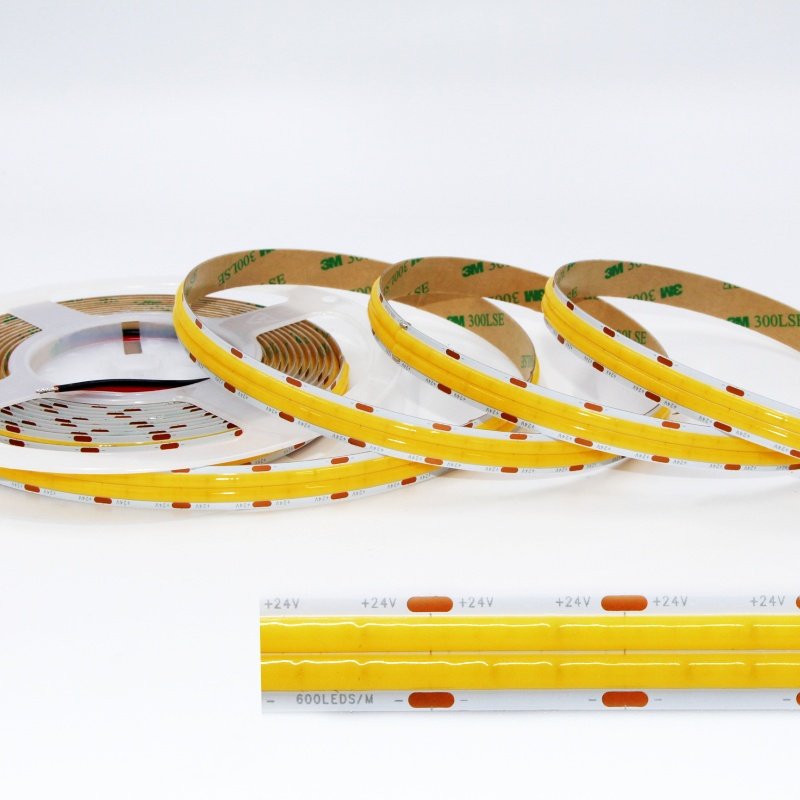
Design In, Not Bolted On: What Integration Means
Integrated lighting means the strip is part of the furniture drawing: channels routed for the strip width, diffuser seats machined, power and control routing planned through the carcass, and sensor or switch positions fixed before finishing. According to industry observation, retrofitting lighting into finished furniture is where most visible problems originate — strips that don’t sit flush, drivers with nowhere to go, and finishes damaged during late-stage installation. Furniture OEMs that design the lighting in at the drawing stage avoid all three, and importers who supply integration-ready products — slim widths, cut-to-length flexibility, matched channels — win those programs.
Sizing and Format for Furniture Applications
Furniture applications are close-range by definition, which changes both density and wattage requirements. Wardrobe and shelf lighting needs high-density COB for dot-free output at 30–50 centimeter viewing distances; cove details in beds and headboards run lower densities; and display cabinetry balances output against glare on glass and glossy surfaces. Voltage matters differently in furniture: 12V suits compact pieces with short runs and standard power supplies, while larger joinery programs run 24V for longer wiring paths. According to industry observation, heat is the overlooked input — strips in enclosed, unventilated furniture cavities need lower wattage per meter or aluminum channels to hold rated lifetime, and the compact GPD COB 3mm 400D 12V strip exists exactly for those tight, low-heat cavities.
Controls, Sensors, and the Experience Layer
Furniture lighting is interactive by expectation: open-door sensors, hand-wave switches, app control, and scene presets are now standard asks in premium joinery programs. The specification should fix the sensor type (door, IR, or hand-wave), the control ecosystem, and the wiring routing through hinges and moving parts — the detail that fails first when not planned. According to industry observation, wiring through moving doors is the most common furniture lighting failure point, and specifying silicone-sheathed or coiled leads at the hinge resolves it at negligible cost.
Installation and QC Details for Furniture Programs
Furniture production runs at tolerances and volumes that general electrical installation does not, and the QC details should match. Test every lit section before the carcass leaves the workshop, photograph sensor and control function for the production record, standardize connector systems across the range so replacement parts stay available, and document driver locations for service. According to industry observation, furniture OEMs who standardize one strip platform across their range — with per-model cut lengths and connector kits — reduce assembly errors and simplify after-sales support simultaneously. Importers serving furniture OEMs should expect and support this platform approach.
Frequently Asked Questions
Which strip density works for wardrobe and shelf integration?
High-density COB is the practical default for close-range viewing in wardrobes and open shelving, where the emission line stays visible. Lower densities suit concealed cove details inside bed frames and headboards.
How is strip lighting powered in furniture safely?
With 12V or 24V systems, power supplies sized to the load with accessible placement, and wiring routed away from hinges and moving parts. Enclosed cavities need heat-aware wattage selection or aluminum channels, as covered in our aluminum profile guide.
Can furniture lighting connect to smart-home systems?
Yes — sensor-triggered, app-controlled, and ecosystem-compatible options are standard in furniture programs. The specification should fix the control ecosystem per product line so replacement and expansion stay simple.
Integrating lighting into a furniture range? GPD Technology manufactures COB and SMD LED strip lights in Shenzhen and supports furniture OEMs and joinery programs with compact formats, sensor-compatible options, per-model documentation, and sample support. Contact our team to design the lighting into your next range.
LED Strip Warranty: What Buyers Should Verify Before Ordering
Strip light warranties are long, confident, and frequently untested — until the moment a project needs one to mean something. According to industry observation, the gap between what warranty pages promise and what the warranty actually covers is one of the least examined risks in strip light sourcing, precisely because buyers assume a long number equals strong protection. It usually does not. This guide explains what an LED strip warranty actually covers, the terms that quietly limit it, and the questions importers and distributors should ask before trusting one.
Duration Is the Least Informative Number
Warranty periods on strip lights commonly range from two to five years, and according to industry observation the number alone predicts almost nothing. The informative questions live underneath: what does the warranty cover — replacement parts, labor, freight, or only the LEDs; what triggers a valid claim — measured lumen depreciation, outright failure, color shift, or visible defects; and who assesses the claim — the factory’s own QC department or an independent process. A five-year warranty that covers parts only, assessed by the seller, with freight paid by the buyer, is weaker than a three-year warranty that covers the full chain.
The Terms That Quietly Limit Coverage
Several warranty clauses do most of the limiting. Exclusions for improper installation move responsibility to the installer even when the root cause was the product. Requirements to return failed samples at the buyer’s freight cost discourage claims on low-value failures. Clauses that void coverage for cutting the strip remove protection for exactly the use case strips are made for. And voltage, dimming, or environmental misuse clauses deserve reading against the installation reality — a warranty that excludes dimmed operation on a dimmable product has excluded its main use case, as covered in our flicker guide. According to industry observation, importers who read these clauses before ordering consistently avoid the disputes that surface later.
The Questions That Reveal a Real Warranty
Four questions separate real warranties from marketing pages. Who pays freight in both directions on a valid claim? What evidence does the claim require — returned samples, photos, or third-party testing? How are systemic failures handled — one replacement, or a batch review across the shipment? And how does the warranty interact with project timelines, because a replacement arriving after the project closes has limited value. According to industry observation, suppliers who answer these questions specifically — in writing — run the quality systems that make warranties rarely needed.
Documenting What You Expect
The strongest position converts the warranty conversation into order terms. Name the coverage scope in the purchase confirmation, attach the warranty document as a reference, and agree the claim process and evidence format before the first shipment. Distributors gain a second benefit: documented warranty terms become a sales asset with commercial customers, for whom replacement certainty is part of the product, as noted in our binning and batch consistency guide. Selection and testing background is available in our Technical Support knowledge base.
Frequently Asked Questions
Is a longer warranty always the better choice?
According to industry observation, no — the coverage scope, claim process, and supplier quality systems matter more than the year count. A shorter warranty with clear terms and a responsive supplier outperforms a long number with narrow coverage.
What voids strip light warranties most often?
Improper installation clauses, cutting-related exclusions, unapproved drivers and dimmers, and evidence requirements that failed samples cannot meet. Reading the exclusions before ordering prevents most of them.
Should importers hold their own spare stock instead of relying on warranties?
Both have roles: warranties cover systemic defects, while spare stock covers fast-moving project timelines. According to industry observation, distributors running both mechanisms handle failures with the least customer impact.
Reviewing warranty terms before your next strip order? GPD Technology manufactures COB and SMD LED strip lights in Shenzhen with written warranty terms, per-batch quality documentation, and responsive claim support for importers and distributors. Contact our team to see the warranty behind the product.
Under Cabinet LED Strip Lighting: A Kitchen Task Light Guide
Under cabinet lighting is the application that turned strip lights into a kitchen standard: hidden behind the cabinet lip, washing the worktop in continuous light, and making the task area genuinely usable after dark. According to industry observation, it is also the application where the small decisions — mounting position, brightness, CCT, driver sizing — decide between a professional result and a worktop full of glare, shadows, and visible dots. This guide covers under cabinet LED strip lighting the practical way: what to specify, where to mount it, and which checks to run before the cabinet goes back together.
Mounting Position: The Detail That Changes Everything
Where the strip sits under the cabinet decides where the light lands on the worktop. Mounted at the front lip facing backward, light grazes the backsplash and leaves the front of the worktop darker. Mounted toward the rear against the wall, it lights the worktop evenly where the tasks happen. According to industry observation, this single placement decision separates kitchens that people love working in from kitchens that photograph well and work badly. The mounting should also hide the diodes from direct view at standing height — which is where high-density COB helps, because its continuous line tolerates shallow lips and close viewing without showing individual dots.
Brightness, CCT, and Dimming for Real Kitchen Work
Under cabinet lighting is genuine task lighting: it needs enough output for knife work and food preparation, not just a decorative glow. According to industry observation, the practical specification for quality kitchen projects is high-density COB at moderate wattage per meter, CRI 90+ for accurate food color, and a neutral-to-warm CCT matched to the kitchen’s palette — 3000K remains the residential default, with 4000K in task-heavy modern kitchens. Dimming completes the system: full output for cooking, low warm light for evenings. The dimming requirements — high-frequency PWM and driver compatibility — follow the discipline described in our flicker-free lighting guide, because kitchens combine reflective stone worktops and camera use more than most rooms.
Power Planning: Drivers, Runs, and Voltage
The power planning rules from commercial projects apply directly. 24V strip handles kitchen run lengths with less voltage drop than 12V, and the driver should be sized to the load with headroom and installed accessibly — under the sink or in a cabinet carcass, not sealed behind the dishwasher. Where runs continue around an L-shaped or U-shaped kitchen, plan the run layout and injection points the way our voltage drop and power injection guide describes, so the corner does not become the dim spot.
Installation Details That Prevent Callbacks
The installation details that prevent callbacks are small and early. Mount the strip to a mounting channel or clip rather than relying only on adhesive, so a later swap does not peel the cabinet finish. Keep cut points at the marks and terminate cleanly, following the discipline in our cutting and connection guide. Test every run before the cabinets are refilled, and confirm the dimming behaves at the low evening level — according to industry observation, that is the setting kitchens actually live at most of the time. The COB LED strip range offers the density and width options that most kitchen layouts need.
Frequently Asked Questions
How bright should under cabinet strip lighting be?
It is task lighting, so it should clearly supplement the room’s general light — enough for knife work without glare on reflective worktops. Dimmable systems let one installation serve both cooking brightness and evening ambience.
Which CCT works best for kitchen worktops?
3000K is the residential default and flatters most finishes, while 4000K suits modern task-heavy kitchens with cool surfaces. Match the CCT to the kitchen palette rather than mixing temperatures.
Where exactly should the strip be mounted?
Toward the wall-side rear of the cabinet underside, with the front lip hiding the diodes at standing height. The mounting should also leave service access to the strip and driver rather than sealing them in.
Specifying under cabinet strip lighting for a kitchen program? GPD Technology manufactures COB and SMD LED strip lights in Shenzhen and supports kitchen dealers, furniture OEMs, and contractors with density guidance, dimming-tested samples, and documentation. Contact our team to match strips to your cabinet system.
LED Strip Shelving and Display Lighting for Retail Projects
Retail shelving lives or dies by how visibly the merchandise presents — and light does more for that presentation than shelf design does. According to industry observation, LED strip shelving and display lighting has become standard in supermarket, pharmacy, apparel, and convenience formats, driven by LED strips’ slim format, even distribution, and controllability. This guide covers the practical specification: density and placement by shelf height, color choice by merchandise category, control and scene requirements, and the installation details that decide whether a display system looks professional or improvised.
Density and Placement by Shelf Height
Shelf lighting geometry differs by where the strip sits: front-lit shelves mount the strip under the front edge of each shelf above, washing light down the products below; back-lit or mid-shelf mounting hides the source behind the merchandise. Viewing distance is short in all cases — shoppers stand close — which is why density matters more here than in almost any other application. According to industry observation, low-density strips that look acceptable in coves produce visible dots on shelf front edges at retail distances, which is why high-density COB has become the default for quality shelving systems. The specification should state the mounting position and shelf pitch, because both determine the density requirement per shelf.
Color Choice by Merchandise Category
Color rendering and CCT choices follow the merchandise, and they differ more across retail categories than most buyers expect. Food retail benefits from high CRI with tailored spectra for produce and bakery; apparel and fashion favor neutral-to-cool tones with strong rendering; pharmacies and cosmetics lean warm and flattering. According to industry observation, this is where CRI 90+ and documented color data earn their place in shelving specifications — mixed whites across adjacent shelves are immediately visible to shoppers. Standardizing one high-CRI family across the store, as in the GPD COB 10mm 360D 24V strip format, keeps the palette consistent while allowing per-shelf brightness control.
Control, Scenes, and Energy
Control is what turns shelf lighting from static strips into a merchandising tool. Per-shelf dimming lets staff balance brightness across a bay; scheduled scenes support dayparting and promotions; and sensors can dim empty shelves to save energy. The specification should fix the control protocol, driver placement, and wiring topology per gondola, because retrofit control planning after installation is where costs multiply. According to industry observation, energy performance matters operationally: shelves run long hours every day, so documented efficacy and quality drivers pay back in ways buyers can calculate.
Installation Details That Decide the Result
The installation details that decide the result are mostly small and early. Strips must be cut at marked points and terminated cleanly, since shelf runs are short and joints are frequent. Power injection applies on long gondola runs. Diffusion — a small profile lens or a light-guide front piece — softens the line at close viewing distance. And testing per shelf before the next one is built prevents repeating the same wiring mistake across a whole bay. Background on profiles and mounting styles is covered in our aluminum profile guide, and long-run power planning in our voltage drop guide.
Frequently Asked Questions
What density works for retail shelf lighting?
High-density COB is the practical default for front-lit shelves viewed at retail distances, where lower densities show dots. The specification should state mounting position and shelf pitch so the density can be verified against them.
Which CCT should different retail categories choose?
Food and fresh produce favor warmer high-CRI spectra; apparel and cosmetics range from neutral to cool with strong rendering; pharmacies lean warm and flattering. Consistency across the store matters as much as the per-category choice.
Is per-shelf control worth the extra wiring?
For stores that change promotions or dayparts, yes — per-shelf dimming and scenes are the feature that makes shelf lighting a merchandising tool rather than static illumination, and the wiring premium is modest when planned before installation.
Specifying LED strip shelving and display lighting for a retail program? GPD Technology manufactures high-density COB and SMD LED strip lights in Shenzhen and supports shopfitters, importers, and retail distributors with density guidance, samples, and documentation. Contact our team to match strips to your shelving system.
LED Strip Cove Lighting: Specification and Installation Guide
Cove lighting is the application that made strip lights an architectural product: hidden in a reveal, washing a ceiling with continuous light, turning a building detail into a design feature. It is also the application where product and installation shortcuts show most clearly — dotted lines, color shifts between runs, and glare from exposed sources all announce themselves on a flat ceiling. This guide covers the specification and installation details that decide a cove lighting result: profile geometry, density and distance, CCT and output, and the checks that happen before the reveal is closed.
Profiles and Mounting: Setting Up the Geometry
Cove lighting starts with the reveal’s construction, and the profile choice follows it. Surface-mounted profiles sit in joinery and millwork where the cove is built as furniture; recessed profiles integrate into gypsum or plaster reveals and need precise cut-outs; corner profiles solve the angled cove where ceiling and wall meet. The mounting orientation matters more than installers expect: strips facing straight up collect dust over time (dimming the run gradually), while angled or downward-facing mounting keeps the emitting surface clean. According to industry observation, orientation is also the most common oversight in cove retrofits — the geometry was inherited from the original design without asking whether the strip direction still suits it.
Density and Distance: Getting a Continuous Line
The distance between strip and ceiling decides how much density the application actually needs. With generous throw distance, lower densities read as continuous; with tight reveals and short throws, individual dots or hot spots appear on the ceiling unless the density is high or the source is diffused. High-density COB has changed this calculation substantially — its continuous emission line tolerates close range and shallow profiles that would expose SMD dots, which according to industry observation is why COB has largely displaced SMD in new cove specifications. The specification should state the throw distance explicitly, because that single input determines the density choice — the GPD COB 10mm 360D 24V strip format exists for exactly these shallow, close-viewing installations.
CCT and Output for the Space
CCT should follow the space’s palette and purpose: 3000K remains the default for hospitality and residential coves, 4000K for commercial and office reveals, with tunable white where scenes change through the day. Output is the second decision — coves are usually a layer in a layered lighting scheme, not the primary illumination, so the strip’s wattage per meter should be chosen to complement rather than dominate. Dimming belongs in the specification too: cove lighting dims visibly across long runs, so the driver and control requirements from our flicker-free lighting guide apply directly.
Installation Details That Prevent Callbacks
The installation details that decide the result are mostly invisible after handover. Power injection at planned intervals keeps long cove runs even from end to end, per the planning in our voltage drop guide. Driver access should remain serviceable — cove drivers installed permanently out of reach turn a driver swap into ceiling work. Cut points, connector quality, and termination sealing follow the same rules as any strip installation, and testing every run before the reveal closes remains the cheapest insurance in the whole assembly.
Frequently Asked Questions
How far should the strip sit from the ceiling?
It depends on density and the look intended: greater distance reads softer and more even at lower densities, while close range needs high-density COB to stay continuous. The specification should state the distance so the density choice can be verified against it.
Is COB or SMD the better choice for coves?
For shallow reveals and close viewing, COB — its continuous line tolerates proximity without dots. For deep coves with generous throw, quality SMD remains a workable budget option.
How much light does a cove actually contribute?
Cove lighting works as an ambient layer, not the primary illumination — it defines architecture, softens contrast, and adds comfort. Designing it as the sole light source usually disappoints; designing it as a layer succeeds.
Specifying cove lighting for an upcoming project? GPD Technology manufactures COB and SMD LED strip lights in Shenzhen and supports architects, contractors, and importers with density-by-distance guidance, samples, and specification review. Contact our team to verify your cove design before ordering.
How to Cut and Connect LED Strip Lights Correctly
Cutting an LED strip in the wrong place, or sealing a cut badly, can quietly ruin an otherwise perfect installation — dark sections, corroded joints, and callback visits that cost more than the strip itself. According to industry observation, most cutting and connection problems trace back to a handful of avoidable mistakes: cutting between marked points, pairing mismatched connectors, and skipping the re-sealing step after cutting waterproof products. This guide walks through how to cut and connect LED strip lights correctly — where to cut, how to join, how to re-seal, and what to check before the profile is closed.
Cut Only at the Marked Points
Every quality strip marks its cutting points — usually a scissor icon or a dashed line with exposed solder pads either side. The copper traces run in pairs or groups, and cutting anywhere else severs the circuit for everything beyond the cut. According to industry observation, this is the single most common DIY and even contractor mistake: cutting to an arbitrary measured length instead of to the nearest marked point. The professional approach is to measure to the nearest cut line on the relevant side, confirm with the strip datasheet for the exact product — COB strips and high-density designs can have tighter cut-point spacing than standard SMD — and cut squarely with sharp scissors or a blade in one clean pass. For high-voltage strips, cutting is restricted to marked intervals entirely, per the certification file.
Soldering Versus Clip Connectors
Two ways to join a cut: soldering leads directly to the pads, or using snap-on clip connectors. Soldering is the more reliable connection — especially for anything beyond dry interior use — but demands a steady hand, the right temperature, and tinned wires. Clips are fast and tool-free but their contacts corrode in damp environments and lose tension over time, the failure pattern covered in our connector failures guide. The professional split: solder and heat-shrink for permanent, hidden, or damp installations; clips for dry interior work where adjustments are likely. Whichever method, the polarity must match strip to strip — reversing positive and negative on a single-color strip does nothing, and on addressable products scrambles the data line.
Re-Sealing After Cutting Waterproof Strip
Cutting waterproof strip destroys its seal, and the IP rating only survives if the cut is rebuilt correctly. The process: clean the cut end, attach a IP-rated end cap or termination with adhesive or potting that covers the joint fully, and let the sealant cure completely before any moisture exposure. According to industry observation, the most common post-cut failure is a partially sealed end — adhesive on the edges but not over the copper — which passes a visual check and fails in the first rain. For strip mounted inside profiles, the profile’s end caps carry the sealing duty instead, and the spec should name the assembled system’s rating, as covered in our tender specification guide.
Checks Before the Profile Closes
The last step costs nothing and prevents the most callbacks: test every section before final assembly. Power each cut and connected length, confirm brightness at both ends, check polarity and any controllable sections, and inspect each joint under magnification if the installation is hidden or hard to access. Only after every section lights correctly should profiles be closed and surfaces finished — because the difference between a five-minute fix and a ceiling rework is whether the test happened before or after the strip became inaccessible.
Frequently Asked Questions
Can LED strip be cut anywhere between the marked points?
No — the marks exist because the copper pads sit there. Cutting between them severs the circuit beyond the cut and leaves no solderable surface for a connection.
Do COB strips cut differently from SMD strips?
The principle is the same — cut at the marks — but COB pads sit closer to the chips and the phosphor layer covers the board, so a clean square cut and gentle handling matter more to avoid damaging the emission layer.
How should waterproof strip be re-sealed after cutting?
With a rated end cap or potted termination covering the joint completely, cured fully before exposure — and the assembled rating should be treated as restored only after a quick water or spray check on a sample.
Cutting and connecting strip lights for a project? GPD Technology manufactures COB and SMD LED strip lights in Shenzhen with clear cut-point marking, documented termination guidance, and IP re-sealing accessories for importers, contractors, and distributors. Contact our team for products and process support.
LED Strip Connectors: Avoiding the Most Common Failures
When a strip light section fails in the field, the strip itself is rarely the culprit. According to industry observation, the majority of section-level failures on construction projects trace back to connectors and terminations — solder joints that crack, clip-on connectors that corrode, and end caps that leak where the strip was cut. Connectors are also the cheapest component to upgrade at specification stage, which makes understanding LED strip connectors and the failures they cause one of the highest-value topics for importers, contractors, and distributors. This guide covers the common connector types, where each fails, and the specification and QC practices that prevent callback issues.
The Common Connector Types and Where Each Fails
Strip light terminations come in four families, each with a characteristic failure mode. Soldered joints are the most reliable electrical connection but depend on workmanship — cold joints crack under thermal movement. Snap-on clip connectors are fast on site but their contact points corrode in damp environments and lose spring tension over time. Silicone-potted end caps seal well when correctly applied but depend on surface preparation. And screw-terminal blocks handle higher currents but loosen with vibration. According to industry observation, clip connectors in outdoor or damp locations are the single most common callback source, followed by solder failures at cut points on COB strips where the cut lands too close to a chip.
Why the Strip Type Changes the Termination Problem
Strip construction determines which terminations are even possible. Standard SMD strips with exposed pads accept both solder and clips easily. COB strips — with their continuous phosphor layer and closely packed chips — are less forgiving: cuts must land on the marked solder zones, and clip connectors designed for SMD spacing may not align with COB pad layouts at all. High-voltage strips add cutting-length restrictions per their certification. According to industry observation, mismatched connectors — an SMD-spacing clip forced onto a COB cut — are a recurring finding when non-specialist distributors cross between product families. Buyers crossing between families should confirm connector compatibility per product, not assume carry-over. Factory-attached lead wires are worth specifying too, because they move the most failure-prone joint from the job site into controlled factory conditions.
Specification and QC Practices That Prevent Failures
The specification stage prevents most connector failures. For damp or outdoor zones, require soldered and potted terminations rather than exposed clips. For long runs, define where joins are permitted and require power injection at those points instead of mid-run clips. For QC, require photos of representative terminations with each shipment, and specify pull or bend checks on sample joints. On renovation projects with existing terminations, inspection before reuse matters as much as new installation — a clip that corroded in service will fail again in the same spot. A practical reference: products in the COB LED strip range ship with documented termination guidance, and pairing them with the checks above closes the gap between the datasheet and the installation. The compliance paperwork behind those products follows the documentation discipline in our regulatory compliance update.
Frequently Asked Questions
Are soldered joints always better than clip connectors?
For reliability, generally yes — especially in damp, outdoor, or movement-prone installations. Clips remain a legitimate choice for dry interior work where speed matters and rework is accessible.
Can a failed connector be repaired on site?
Yes — section replacement, re-soldering, or swapping to potted terminations usually restores the run. The repair cost rarely justifies living with the failure, because the same weakness tends to recur across identical terminations.
How should connectors be stored before installation?
Dry and sealed, with contact points protected. Corrosion of stored connectors is a quiet failure cause according to industry observation, particularly for projects with long gaps between delivery and installation.
What does a properly potted termination involve?
Solder first, then a encapsulation step that covers the joint completely without air pockets, in a housing that provides mechanical strain relief. Potting without strain relief just moves the failure point to where the flexible wire exits the pot.
Troubleshooting connector failures or specifying terminations for a project? GPD Technology manufactures COB and SMD LED strip lights in Shenzhen with documented termination guidance and per-batch quality data for importers, contractors, and distributors. Contact our team to review terminations before your next shipment.
How to Choose LED Strip Aluminum Profiles for Your Project
Strip lights get specified, purchased, and installed — and then the profile decision gets improvised. According to industry observation, that improvisation is behind a surprising share of strip light complaints: overheated runs, dotted lines, and diffusers that glare instead of soften. The aluminum profile is not an accessory; it is the heat sink, the optical system, and the mounting structure in one extrusion, and choosing it deserves the same rigor as choosing the strip itself. This guide walks through how to choose LED strip aluminum profiles for a project — heat, diffusion, mounting, and the specification details that decide the result.
Heat Sinking: The Function Nobody Sees
LED lifetime depends on how heat leaves the diode, and in a strip installation the aluminum profile is that path. The strip’s adhesive transfers heat into the profile, the profile spreads it and releases it to the air — and how well that works depends on the profile’s mass, surface area, and contact. According to industry observation, higher-wattage strips run without any profile at all in projects, trading lifetime for convenience: the LEDs run hotter, lumen depreciation accelerates, and the failure arrives years earlier than the datasheet suggested. For strips above moderate wattage per meter, a profile with real thermal mass is the difference between the rated lifetime and a shortened one.
Diffusion: Matching the Cover to the Application
The diffuser decides what the viewer sees. Clear covers protect without softening; frosted covers soften partially; opal covers deliver the smooth continuous line that architectural work expects — at the cost of some light loss. The choice depends on two specification inputs: the strip’s density and the viewing distance. High-density COB tolerates lighter diffusion because the output is already continuous, while lower-density SMD needs opal covers to hide the dots. According to industry observation, diffusion choice is also where glare complaints get solved: an opal cover at the right depth turns a harsh line into a comfortable one, and the profile depth sets that distance.
Mounting Styles and Installation Details
Profiles come in surface, recessed, corner, and suspended formats — and the tender should name which type per location, because the installation details differ. Recessed profiles need precise cut-outs and ceiling or joinery preparation. Surface profiles mount with clips or tape and forgive imperfect substrates. Corner profiles solve the 45-degree cove and under-cabinet angles. According to industry observation, the practical installation failures concentrate in recessed work: cut-outs cut before the profile’s actual dimensions were confirmed, and drivers or wiring planned without checking whether the profile cavity can hold them alongside the strip.
Specification Details That Matter in Writing
The profile specification details that prevent site problems: the alloy and wall thickness (structural and thermal), the anodizing or finish (reflectivity inside the channel and appearance), the diffuser material (PMMA for optical clarity and aging, polycarbonate for impact resistance), standard lengths and joiners for continuous runs, and end caps with cable entry points that match the wiring plan. Where profiles combine with IP requirements, the sealing responsibility between strip, diffuser, and end caps should be stated — the assembly, not the strip alone, carries the rating, as covered in our earlier tender specification guide. Projects pairing profiles with high-density strip lights, like the GPD COB 10mm 480D 24V configuration, should confirm the profile’s thermal capacity against the strip’s wattage per meter.
Frequently Asked Questions
Does a profile really extend strip lifetime?
For strips at moderate-to-high wattage per meter, yes — the profile is the heat sink that keeps LED junction temperature in range. According to industry observation, the effect is most visible in enclosed or warm installations; low-wattage runs in open air benefit less dramatically.
Which diffuser works with COB versus SMD strips?
COB tolerates lighter diffusion — frosted covers often suffice because the output is already continuous. SMD generally needs opal covers to hide individual dots, with the corresponding light loss planned into the design.
Can aluminum profiles be cut to length on site?
Most can be cut with standard tools, but check the diffuser material and the joiner system first. Corners and continuous runs need compatible joiners, and cutting affects end-cap fit — measure twice before the profile is ordered.
Matching profiles to strips for an upcoming project? GPD Technology manufactures COB and SMD LED strip lights in Shenzhen and supports importers, contractors, and distributors with profile pairing, thermal guidance, and specification review. Contact our team to confirm the combination before ordering.
LED Strip Power Supplies: How to Size Drivers Correctly
Driver sizing is the quietest failure point in strip light projects: an undersized power supply shuts down or cycles, an oversized one dims badly and wastes budget, and according to industry observation both mistakes trace back to skipping one calculation. This guide walks through how to size LED strip power supplies correctly — wattage per meter, run length, headroom, voltage matching — and the installation mistakes that cause most field problems. Pair it with our voltage drop planning guide and the power side of a strip project becomes predictable from quote to handover.
Start With Watts per Meter and Run Length
The sizing calculation begins with two numbers from the strip datasheet: wattage per meter and total run length. Multiply them, and you have the load the driver must supply — for example, a 24V strip rated in the mid-twenties watts per meter over an eight-meter run draws in the neighborhood of two hundred watts. According to industry observation, the most common sizing error is using the strip’s advertised length or a rounded wattage instead of the actual configuration being ordered, so the calculation should always use the real numbers from the specification sheet of the exact product.
Add Headroom — but Not Too Much
The standard practice is to size the driver at roughly twenty percent above the calculated load. The headroom covers inrush at power-on, keeps the supply in its efficient operating range, and accounts for tolerance. But oversizing has its own costs: constant-voltage drivers running far below their rated load can show higher no-load output voltage, and some dimming drivers behave poorly — flicker, dead zones, or stepped dimming — at very low loads. According to industry observation, this is why “bigger is safer” fails in dimmable projects: the right driver is the one sized for the load with sensible headroom, not the largest unit available.
Voltage Matching and Wiring Distance
The driver output must match the strip voltage exactly — 24V strip on 24V driver, without exceptions. Beyond matching, driver placement matters as much as driver sizing: the closer the driver sits to the strip, the shorter the low-voltage wiring run, and the less voltage drop eats into the margin the headroom was meant to provide. Long low-voltage runs between driver and strip waste cable budget and create the exact gradient problems described in our voltage drop and power injection guide. Where drivers must sit remotely, size the connecting wiring for the load and distance rather than assuming standard gauge is sufficient.
Certification, Environment, and Access
The driver carries the safety certification burden for the system, so its approvals matter: SELV or Class 2 output classifications for interior work, IP-rated enclosures for damp or outdoor placement, and thermal ratings that match the installation space — enclosed ceiling voids run hotter than open cabinets. Access completes the checklist: drivers installed accessibly can be inspected, maintained, and replaced without opening finished surfaces. According to industry observation, inaccessible driver placement is one of the most regretted decisions in strip projects, discovered the first time a driver needs replacing years later.
Frequently Asked Questions
Can I connect multiple strip runs to one driver?
Yes, as long as the combined wattage stays within the driver’s rated output with headroom, and the wiring topology keeps voltage drop under control. Parallel connection is standard; series is not.
Why does my oversized driver dim poorly at low levels?
Dimmable drivers have a minimum load below which their output becomes unstable — flicker, dead zones, or stepped dimming. The fix is matching driver size to the actual load, not adding load to reach the minimum.
Should the driver wattage exceed the strip load at all?
Yes, with headroom around twenty percent. That margin covers inrush and tolerance without pushing the driver into the low-load behavior that causes dimming problems.
Sizing drivers for a strip project and want the numbers checked? GPD Technology manufactures COB and SMD LED strip lights in Shenzhen and supports importers, contractors, and distributors with wattage documentation, driver pairing guidance, and specification review. Contact our team to verify your configuration before ordering.
LED Strip Flicker: Specifying Flicker-Free Lighting
Flicker is the strip light problem nobody photographs and everyone feels: headaches and eye strain in offices, rolling bands on camera in retail and content work, and complaints that arrive after installation when the profile is closed and the ceiling is painted. According to industry observation, flicker is also among the most preventable strip light issues — most cases trace back to driver and dimming choices that a clear specification would have caught. This guide explains why LED strip lights flicker, how to specify flicker-free strip lighting, and the checks that keep the problem out of your projects.
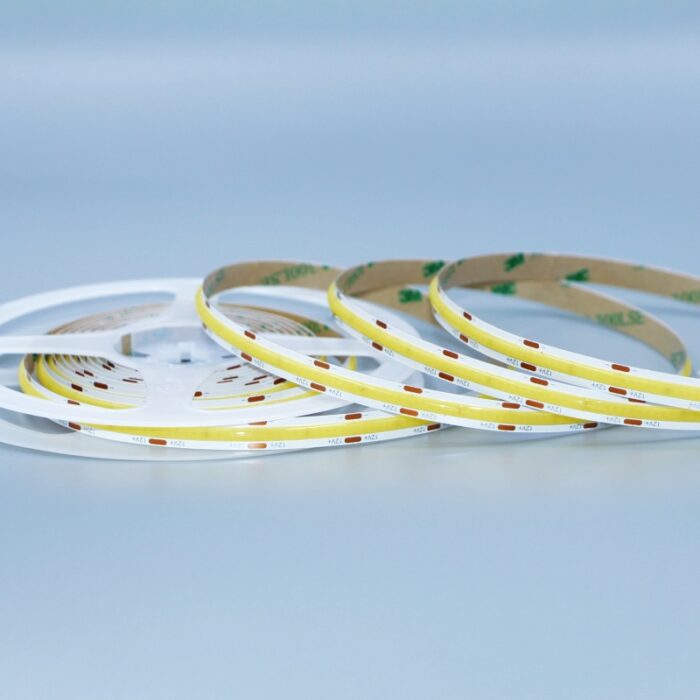
Why LED Strip Lights Flicker
Strip light flicker has three common origins. Dimming is the first: PWM (pulse-width modulation) dimming works by switching the output on and off rapidly, and low PWM frequencies produce visible or camera-detectable flicker, especially at low brightness where the off-time lengthens. The second is driver quality: undersized or poorly filtered constant-voltage drivers ripple their DC output, which appears as fine 100/120 Hz bands on camera. The third is mismatched dimmers — trailing-edge or leading-edge wall dimmers designed for incandescent loads paired with strip drivers that were never designed for them. According to industry observation, the mismatch case is the most frequent in renovation projects and the easiest to prevent at specification stage.
How to Specify Flicker-Free Strip Lighting
Flicker-free performance is a specification, not a luck. The requirements that work in tenders and purchase orders: a PWM frequency high enough to be invisible — according to industry observation, frequencies of several kilohertz and above are the practical expectation for quality projects; deep-dim performance stated at low output levels, where flicker is worst; and for camera-critical spaces, verified flicker metrics such as IEEE 1789 compliance or SVM/Phi values rather than a “flicker-free” adjective. Asking for these numbers at quotation stage separates factories that test from factories that assert — the same documentation discipline described across our compliance and binning guides.
Practical Checks Before and After Installation
Between specification and sign-off, two checks catch most issues. Before ordering, test the exact strip and driver combination at low output — the pairing, not the individual products, is where flicker usually appears. After installation, walk the space with a smartphone slow-motion camera: rolling bands confirm flicker that the eye may have adapted to. According to industry observation, hospitality and retail clients discover PWM problems this way and expect a fix — typically a driver or dimming-module replacement — to be quick and blame-free.
Where Flicker-Free Matters Most
Some applications treat flicker as a hard requirement rather than a preference. Workspaces and classrooms, because occupant comfort over long hours matters. Anywhere cameras operate — broadcast studios, content-creation spaces, retail media walls, and video-heavy showrooms. Healthcare and educational environments, where photosensitivity and comfort standards apply. And premium hospitality, where dimmed evening scenes are exactly the operating point where cheap dimming misbehaves. According to industry observation, importers who carry a verified flicker-free option for these segments keep winning the inquiries that price-led competitors lose — and the verification effort is modest when the factory documents PWM frequency and dimming data at model level.
Frequently Asked Questions
Can flicker be fixed after installation?
Often, yes — usually by replacing the dimmer or driver with a compatible high-frequency unit rather than the strip itself. Matching the pairing exactly, as tested at sampling, is the reliable fix.
Do all LED strips flicker on camera?
No. Quality strips with high-frequency PWM or constant-current driving render cleanly on camera. Flicker on camera points to the driver, the dimming level, or a mismatched pairing — not to strip lights as a category.
Does flicker affect LED strip lifetime?
Frequent deep PWM switching at low frequencies adds stress to drivers and solder joints over time. According to industry observation, the lifetime effect is secondary to the comfort and camera issues, but quality driving improves both.
Specifying flicker-free strip lighting for a demanding project? GPD Technology manufactures COB and SMD LED strip lights in Shenzhen with verified high-frequency dimming performance and driver pairing guidance for importers, contractors, and designers. Contact our team for samples tested at your dimming levels.
LED Strip Voltage Drop: Planning Power Injection for Long Runs
The far end of a long LED strip run looks dimmer than the feed end, and no amount of driver quality fixes it. The cause is voltage drop — a physics issue, not a product defect — and according to industry observation it is one of the most common avoidable problems in strip light projects. This guide explains why voltage drop happens in long LED strip runs, how 24V systems and power injection solve it, and the planning rules contractors and importers should apply before installation begins.
Why Voltage Drop Happens in LED Strip Runs
Every strip has electrical resistance in its copper traces, and resistance consumes voltage as current travels along the run. The result is a brightness gradient: full output at the feed point, progressively dimmer toward the far end, most visible in warm CCTs and in the first meter beyond the feed. The effect grows with three factors: run length, current draw per meter, and trace resistance — which is why the same wattage behaves differently on a narrow strip than on a wide one, and why planning matters before the profile is closed and the ceiling is closed above it.
The 24V Advantage for Long Runs
Voltage drop scales with current, and current halves when voltage doubles for the same wattage. That single relationship is why 24V strip lights have become the default for anything beyond short segments: the same run at 24V suffers roughly half the voltage drop of a 12V equivalent, allowing longer single-feed distances and thinner wiring. According to industry observation, most visible voltage-drop complaints on commercial projects trace back to 12V strip pushed into runs that should have been 24V — a specification decision, not a manufacturing fault. For new projects, the GPD COB 10mm 480D 24V strip illustrates the format: high density on a 24V platform built for extended runs.
Power Injection: How It Works and Where to Add It
When a single feed is not enough, power injection solves what voltage cannot: additional feeds deliver power at points along the run so no section sits too far from its supply. The practical patterns are feeding both ends of a run, or injecting at intervals from a central driver location. Two rules keep injection reliable: keep injection feeds short and adequately sized, and inject power only — the data line in addressable or controllable systems still needs its own clean routing. According to industry observation, most injection failures come from undersized injection wires or from connecting feeds with even slightly different voltages, which forces current between them instead of into the strip.
Specification and QC Checks for Long Runs
Voltage drop planning belongs in the specification, not just in the installer’s head. The requirements that prevent complaints: maximum run length per feed stated by the supplier, power-injection points marked on the layout, wire gauge for feeds and injections, and a verification method — measuring brightness at the far end before the profile is closed. Batch consistency matters too: reels from the same production window age and dim together, as covered in our color consistency guide. Importers sourcing for long-run projects should ask factories to confirm injection intervals and wire recommendations in writing. More selection background is available in our Technical Support knowledge base.
Frequently Asked Questions
How long can 24V strip run without power injection?
It depends on wattage per meter and trace design, so there is no universal number — ask the factory for the maximum run per feed for the exact model, and plan injection beyond that length rather than accepting a gradient.
Does voltage drop damage the strip?
No — the strip simply outputs less light toward the far end. The risk is aesthetic (visible gradients) and practical (rework after installation), not product damage.
Can 12V and 24V strips share one driver?
No. Voltage must match the strip exactly. Mixing 12V and 24V products on one output damages the 12V strip — a frequent finding according to industry observation when systems are expanded without a voltage plan.
Planning long-run strip lighting and need the injection details right? GPD Technology manufactures COB and SMD LED strip lights in Shenzhen with 24V long-run platforms, documented injection intervals, and specification support for importers, contractors, and distributors. Contact our team to review your run lengths before ordering.
Commercial LED Strip Lighting Industry Report: Key Takeaways
An industry report season rarely changes the products, but it changes how confidently they can be planned — and according to industry observation, this cycle’s commercial LED strip lighting reports tell a more consistent story than usual. Demand keeps expanding, the product mix keeps climbing toward higher density and better control, and pricing pressure splits between softening standard configurations and stubborn specialty builds. This commercial LED strip lighting industry report summary condenses what importers and distributors should take from the current cycle — and what to do differently in the next one.
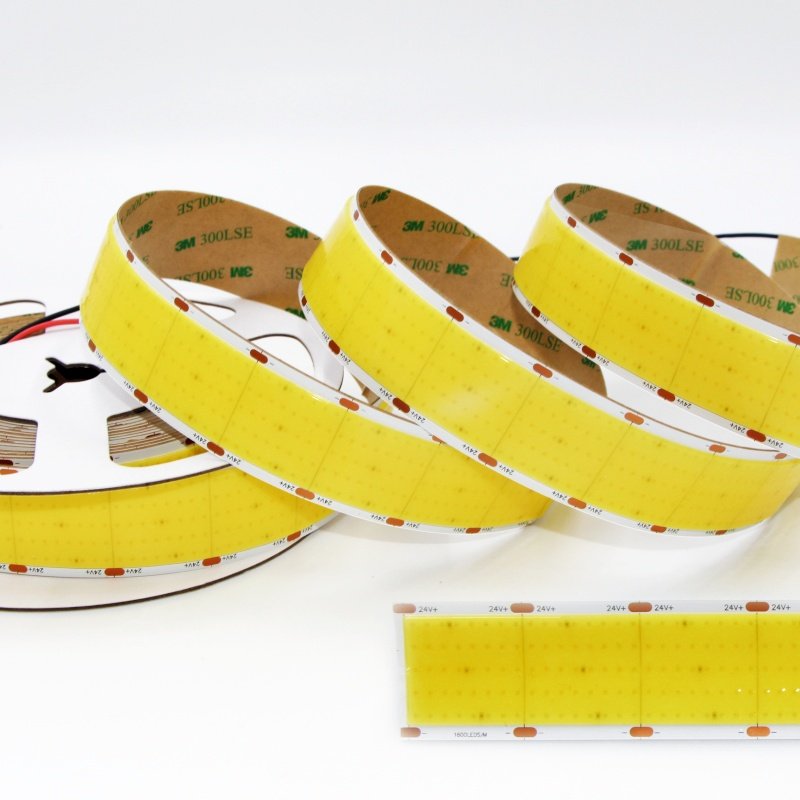
Demand: Broader, More Specification-Driven
The headline from current reporting is continuity: commercial demand for strip lighting keeps expanding across retail, hospitality, office, and public segments. The more useful detail is how the demand quality has changed. According to industry observation, a growing share of orders now arrive with specifications attached — efficacy floors, color rendering requirements, control protocols, and documentation expectations — rather than as simple price inquiries. That shift favors importers and distributors with specification-ready product ranges and penalizes purely price-led catalogs, a direction consistent with the specification discipline described in our tender specification guide. It also raises the value of technical content in the sales process: the distributor who can answer a specification question in writing wins the inquiry that price lists alone lose.
Product Shifts: Density, Control, and Integration
Across the reporting cycle, three product movements appear consistently. High-density COB constructions keep taking share in visible applications, as the dot-free look becomes the default expectation for quality work. Control-rich configurations — tunable white, addressable, and ecosystem-compatible products — grow fastest in percentage terms as scene flexibility moves up the client agenda. And integrated formats — profiles, diffusers, and high-voltage direct-wire lines that simplify installation — expand the addressable market by lowering installation barriers. Distributors structuring their range around these three movements, rather than around individual products, find their catalogs better matched to how inquiries now arrive. The same structure also simplifies supplier conversations, because one manufacturing platform can serve all three movements with documented variants.
Pricing: Two Speeds in One Market
Pricing remains two-speed. According to industry observation, standard, high-volume configurations continue to soften as chip and material efficiency improve, while specialty builds — very high density, custom lengths, IP68, and addressable systems — hold pricing much more firmly because their volumes are smaller and their material share larger. Raw material movement adds the short-term noise, as outlined in our raw material price trend overview. The planning implication is to treat the two segments with different tools: standard lines buy against trend with price windows, specialty lines lock configuration and capacity early.
What to Watch and Do Next Cycle
The watch list for the coming cycle is short and practical. Efficiency regulation in Europe and specification-driven procurement in the US both keep raising the documentation bar, so keep model-level files current — the groundwork also serves the coming ESPR data requirements. Watch inquiry quality, not just volume: specification-bearing inquiries convert differently and deserve faster technical response. And keep testing alternate configurations within your top-selling families, because product mix — not total volume — is where this cycle’s margin is moving.
Frequently Asked Questions
Is commercial demand for strip lighting still growing?
According to industry observation, yes — across retail, hospitality, office, and public segments, with renovation conversions and specification-driven projects carrying much of the growth.
Which product movements matter most for distributors?
High-density COB in visible applications, control-rich configurations, and integrated installation formats. All three shift distributor ranges toward specification-ready products with better documentation.
How should pricing be planned for the next cycle?
Differentiate: buy standard configurations against the softening trend, and lock specialty configurations early with configuration and capacity confirmed in writing.
Which regions show the strongest commercial demand?
Europe leads on specification depth and regulatory-driven upgrades, while North America combines renovation volume with rebate-driven quality requirements. Asia-Pacific and the Middle East concentrate project-driven demand — different structures that reward regionally adjusted ranges.
Want your range aligned with where the commercial market is heading? GPD Technology manufactures COB and SMD LED strip lights in Shenzhen with specification-ready documentation for importers and distributors. Contact our team to review your range against the trends above.
LED Strip Regulatory Compliance Update: What Has Changed
Compliance documentation ages faster than strip lights do. Test reports reference older models, declarations name superseded directives, and customer questionnaires add new questions every season. According to industry observation, importers rarely discover this until a customer audit or a customs check asks for documents that no longer match what is in the box. This LED strip regulatory compliance update summarizes the areas importers and distributors should re-confirm now — and how to keep documentation from drifting out of date with the products it describes.
CE and UKCA: Confirm the Declarations Still Match
For the European market, the core documents remain the Declaration of Conformity backed by LVD, EMC, and RoHS test reports — with UKCA continuing for Great Britain, where the divergence between EU and UK rules makes separate documentation checks worthwhile rather than optional. The update point is not the framework but the match: declarations must reference the exact models, voltages, and configurations being shipped. According to industry observation, the most common audit finding is a declaration for a related but not identical product — a mismatch that turns valid test data into an invalid document. Importers should re-check every declaration against current order configurations this season, and retire any document that no longer matches a live SKU.
RoHS, Substances, and the Widening Data Request
RoHS remains the baseline substances requirement, but the data request around it keeps widening. Customer questionnaires now regularly ask beyond the restricted list — material compositions for recycling statements, packaging declarations, and in Europe, preparation for the expanded product data expectations under the ecodesign framework, as introduced in our ESPR and digital product passport guide. According to industry observation, suppliers who already collect structured material information per model answer these questionnaires in days, while those who do not scramble for weeks per customer.
US Market: NRTL Listing and State Requirements
For the United States, the practical requirement stays the same: safety listing from a Nationally Recognized Testing Laboratory for installed work, plus FCC compliance for addressable and smart products with digital circuitry. The update points are two. State-level efficiency programs keep adjusting their scopes and efficacy thresholds, which affects which configurations qualify in which states. And utility rebate programs — a real pricing lever for commercial customers — require documented efficacy and quality data that matches the shipped product exactly. Because requirements differ by state, importers serving multiple regions should track which configurations qualify where, rather than assuming one national answer.
A Documentation Refresh That Pays Twice
The practical response is a seasonal documentation refresh, and it pays twice. Once as risk control: mismatches between documents and products are found by customers, not by importers. And once as a sales asset: importers with complete, current, per-model documentation answer tender questionnaires and customer audits faster than competitors — an advantage described from the buyer side in our tender specification guide. The refresh itself is simple: list every live SKU, pull its declaration and test reports, check each against the current configuration, and retire or renew what has drifted. Background on the underlying requirements is collected in our EU and US certification guide.
Frequently Asked Questions
How often should compliance documents be re-checked?
According to industry observation, a quarterly or semi-annual review matches how quickly models and regulations change. Any model revision, supplier change, or new destination market should trigger an immediate re-check regardless of calendar.
Does one declaration cover all strip configurations?
No. Declarations and test reports apply to the configurations they describe. Voltage, density, IP sealing, and driver changes can all move a product outside a report’s scope, which is why per-model matching matters.
What triggers the most urgent updates?
Model revisions, new destination markets, and customer audits. Any of these should prompt a documentation check before the shipment or the audit — not after.
Where do I start if my documentation is years out of date?
Start with your top-selling SKUs and work down by volume. Pull each model’s declaration and test reports, compare them against the current configuration, and renew what has drifted. Within a few sessions the highest-risk gaps are closed, and the rest becomes routine maintenance.
Not sure whether your strip documentation is current? GPD Technology manufactures COB and SMD LED strip lights in Shenzhen with per-model documentation maintained as standard, supporting importers and distributors across the EU, UK, and US. Contact our team for a documentation review with our engineers.
High CRI LED Strip Commercial Project Trend: Buyer Notes
Color rendering used to be a footnote in strip light specifications; in commercial projects it has become the headline. According to industry observation, the demand for high CRI LED strip lights keeps expanding beyond premium hospitality into retail, galleries, workplaces, and high-end residential — anywhere the way products, food, faces, and fabrics look under the light decides whether the space succeeds. This guide looks at the high CRI LED strip commercial project trend: what is driving it, how color rendering is actually specified, and what importers and contractors should check before committing to a product.
Why High CRI Keeps Expanding in Commercial Work
Three forces keep pushing CRI up the specification list. Retail learned that better color rendering measurably changes how merchandise looks — food, fashion, wood, and skin tones all benefit from CRI 90+ light. Hospitality and workplace design follow wellbeing-oriented guidance that values accurate, comfortable color. And the technology gap has closed: high CRI used to cost more and deliver less output, while according to industry observation current high CRI COB designs have narrowed both gaps dramatically, bringing the option into mainstream project budgets. Grocery and food-and-beverage projects deserve special mention — produce, meat, and bakery displays are the applications where low CRI fails most visibly and where operators now ask for high CRI by default.
How Color Rendering Is Actually Specified
CRI alone no longer tells the whole story, and professional specifications increasingly say so. The practical trend is to require CRI 90+ as a baseline plus richer data where color matters most: TM-30 metrics (fidelity and gamut), consistent rendering across CCT options, and binning discipline so batches match over time. According to industry observation, projects that specify TM-30 alongside CRI receive more meaningful data from suppliers — and quickly separate factories that test properly from those that copy numbers. Fixing these requirements in the tender, as outlined in our tender specification guide, prevents the mixed-whites and washed-color problems that surface after installation.
Why COB Has Become the Preferred Format
High CRI and COB construction complement each other. COB’s continuous phosphor layer produces a smooth, dot-free line that flatters surfaces and works at shorter viewing distances, while its uniform emission makes color rendering consistent along the entire run — no LED-to-LED variation within a reel. According to industry observation, commercial projects combining high CRI requirements with visible, close-range installations now routinely specify high-density COB strips for exactly this reason. The GPD COB 10mm 360D 24V strip illustrates the format: slim, dense, and specified for applications where the light source stays in view.
What Importers and Contractors Should Check
Before committing to a high CRI strip program, four checks separate good products from good datasheets. Verify CRI and TM-30 data against the exact CCT ordered, not a family average. Check color consistency between production batches — the binning discipline that keeps multi-phase projects matching. Confirm the light quality holds when dimmed, since low-output color shifts are visible in hospitality scenes. And confirm documentation completeness, because European buyers increasingly connect color data to their broader compliance files, as discussed in our ESPR and digital product passport guide.
Frequently Asked Questions
Is CRI 90+ worth the premium in commercial projects?
For retail, hospitality, galleries, and any space where appearance drives results — according to industry observation, most buyers answer yes. The premium has narrowed considerably as high CRI COB designs mature, while the visible improvement has not.
Does high CRI reduce brightness or efficiency?
Older high CRI designs sacrificed output; current generations have largely closed that gap. Verify efficacy and output data alongside CRI rather than assuming a trade-off still exists.
What CRI should non-retail spaces specify?
Offices and public areas typically specify CRI 90+ as well for comfort and appearance, while purely functional or concealed applications can justify CRI 80+ for budget reasons.
How does high CRI work with tunable white strips?
Well-designed tunable products maintain high rendering across the CCT range, but the data must be verified at both ends rather than assumed. Ask for rendering measurements at the warmest, mid, and coolest settings before approval.
Specifying high CRI strip lighting for a commercial project? GPD Technology manufactures high CRI COB LED strip lights in Shenzhen with TM-30 and binning documentation, supporting importers, contractors, and designers. Contact our team for samples rendered under your project conditions.
Smart Addressable LED Strip Industry Outlook for Importers
Addressable LED strips — the ones where every pixel or segment can be controlled individually — spent years as an entertainment product for stages and gaming rooms. According to industry observation, that is changing: media facades, hospitality scenes, retail windows, and increasingly smart-home projects are pulling addressable strip technology into mainstream architectural and decorative work. This smart addressable LED strip industry outlook maps where demand is heading, what the technology challenges are, and how importers and distributors can position for a category that rewards technical understanding as much as price.
What Addressable Means — and Why It Changes Everything
A normal strip lights up as one circuit: all LEDs show the same color and brightness. An addressable strip carries data through the line, so each pixel or segment can be told exactly what to do — color, brightness, timing, animation. That single difference changes the product: data chips on the strip, stricter wiring and power-injection planning, controllers with real processing power, and failure modes that behave differently (one dead pixel versus one dead circuit). For buyers it also changes the supplier conversation, because addressable products are part lighting and part electronics.
Demand Drivers Beyond Entertainment
Entertainment built the category, but according to industry observation the growth is now coming from elsewhere. Media facades turn building exteriors into displays. Hospitality uses scene animations that fixed-color strips cannot deliver. Retail windows choreograph light to merchandise. And the smart-home market keeps normalizing app-controlled, animated cove and joinery lighting for residential buyers. Each of these segments has different requirements — outdoor durability for facades, low latency for retail, ecosystem compatibility for homes — which rewards importers who understand the differences instead of listing one generic SKU. It also changes the certification conversation: outdoor addressable installations combine IP sealing with data electronics, a combination that deserves its own testing attention.
The Outlook: Where the Category Is Heading
Three directions stand out. First, ecosystem compatibility: addressable products that pair cleanly with mainstream smart-home platforms and established protocols reduce the integration friction that currently slows mainstream adoption. Second, simpler wiring: power injection and data-line planning are the most common failure points, so products and accessories that simplify installation lower the barrier for contractors. Third, better addressable light quality: moving from visible pixel dots toward denser, diffused output brings addressable lighting closer to the aesthetic standard that COB set for static strips. According to industry observation, suppliers who solve the wiring-and-quality combination together will take the lead as the category widens.
Sourcing and Stocking Implications
For importers, addressable products deserve a qualification process closer to electronics than to lighting: verify protocol support (SPI, WS2811-family, DMX variants), test power-injection behavior on real run lengths, and check chip quality — data chips vary widely between sources. Stock planning should separate the strips from the controllers, since controllers age faster and drive most returns. And documentation matters more than for static strips: wiring diagrams, power budgets, and controller pairing guides reduce support load dramatically. The high-density COB strip family pairs naturally with addressable programs for premium visible installations, and our Technical Support knowledge base covers the selection basics that distributors can pass on to their customers.
Frequently Asked Questions
Is an addressable strip the same as an RGB strip?
No. RGB strip shows one color at a time across the whole run; an addressable strip controls pixels or segments individually, enabling gradients, animations, and effects. RGB+CCT products add color-temperature control but stay non-addressable unless built with data chips.
Are addressable strips reliable for permanent installations?
Quality has improved significantly, but reliability depends on chip sourcing, soldering, and power-injection design more than on the LEDs themselves. Test real run lengths and ask for aging data before scaling.
What should importers stock first in this category?
According to industry observation, a narrow range works best: one or two densities, the most common protocols for your market, matching controllers, and strong documentation — expanded only once customer questions show which direction demand is taking.
Which control protocols should we support first?
Follow your market: SPI-family chips dominate consumer and DIY ecosystems, while DMX remains the default in professional architectural and stage work. Stocking products and controllers for the ecosystem your customers already use prevents most compatibility complaints.
Exploring the addressable LED strip category? GPD Technology manufactures COB and SMD LED strip lights in Shenzhen and supports importers and distributors with specification guidance, samples, and documentation for addressable programs. Contact our team to discuss the category with our engineers.
LED Strip Raw Material Price Trend: What Buyers Should Know
Strip light pricing does not move on its own — it follows the materials inside the reel. LED chips, flexible copper-clad laminate, phosphor, adhesive, and copper all sit upstream of every meter shipped, and according to industry observation their movements have become the main reason strip quotations change between seasons. This LED strip raw material price trend overview walks importers and distributors through the inputs that matter, how they behave, and how to build purchasing plans that survive the movement instead of being surprised by it.
The Inputs That Drive Strip Light Costs
Four inputs dominate the bill of materials. LED chips — including the bond wires and phosphor used in COB construction — represent the largest electronic share. Flexible copper-clad laminate (FCCL) carries both function and a copper price exposure. Adhesives, encapsulants, and resistors add smaller but volatile amounts. And for finished, waterproof builds, silicone and IP sealing materials matter. According to industry observation, chip pricing and copper-linked laminate are the two inputs most likely to move a strip quotation between quarters.
How Prices Have Been Behaving
Across recent cycles, the pattern has been uneven rather than uniform. Chip costs for common configurations have generally trended down as capacity grew, which is why entry-level strip pricing keeps softening. At the same time, copper and specialty materials have moved upward in bursts tied to broader commodity markets, and freight has swung between extremes. Currency adds a final layer for importers buying across borders. According to industry observation, the net effect for buyers is that standard, high-volume configurations keep getting cheaper while specialty builds — very high density, unusual widths, IP68 — hold their price much more stubbornly, because their material share is larger and their volumes smaller.
What This Means for Purchase Planning
Reading the trend is only useful if it changes behavior. Three habits work in practice. First, separate stable SKUs from custom ones: standard configurations can be bought against trend, while custom builds should be quoted and locked quickly. Second, agree price-adjustment windows with factories — tied to material indices rather than open-ended clauses — so both sides absorb movement fairly. Third, order seasonal volumes early enough that materials are purchased before peak demand tightens capacity, a discipline introduced in our supply chain analysis and worth repeating every cycle.
Communicating Price Changes to Your Customers
Distributors face the movement twice: from factories upstream and from customers downstream. The practical approach is transparency with structure — explain which material inputs drive the change, offer fixed-price windows for confirmed orders, and give customers an option to secure volume early at today’s level. According to industry observation, buyers respond far better to a documented cost explanation with an early-order option than to a sudden increase without context. Products such as the GPD COB 10mm 360D 24V strip illustrate how clear model-level specifications make those conversations concrete. More testing and specification background is available in our Technical Support knowledge base.
Frequently Asked Questions
Which raw material moves strip prices the most?
According to industry observation, LED chips and copper-based FPC laminate are the two largest exposures. Chip prices for common configurations have softened over time, but copper-linked materials can move upward quickly with broader commodity markets.
Do high-density COB strips follow the same price trend?
Partly. They use more chip and phosphor material per meter, so their cost base is larger, but their pricing has held steadier because demand from quality-driven projects keeps growing faster than supply.
How far ahead should buyers lock strip prices?
For standard SKUs, price windows of one to two quarters are common practice. For custom or seasonal programs, locking materials and capacity together — before the peak — is the safer structure.
Should buyers sign material-linked pricing agreements?
For ongoing programs, they are worth considering. Agreements that adjust with a published index — rather than open-ended clauses — share movement fairly between factory and buyer and prevent both surprise increases and awkward renegotiations.
Planning strip purchases around material price movements? GPD Technology manufactures COB and SMD LED strip lights in Shenzhen with rolling forecasts, transparent cost structures, and specification documentation for importers and distributors. Contact our team to build a purchasing plan that survives the cycle.
LED Strip Sustainability and ESG Lighting: Buyer Guide
ESG has moved from annual-report language into purchasing conversations, and LED strip lights — visible, energy-consuming, and shipped across oceans — sit squarely in that conversation. According to industry observation, European and global buyers increasingly ask strip suppliers questions that have nothing to do with lumens: What is in the product? How is it packaged? What happens at end of life? Can the factory document any of it? This guide translates LED strip sustainability and ESG lighting into the practical questions and answers that importers, contractors, and distributors can actually use.
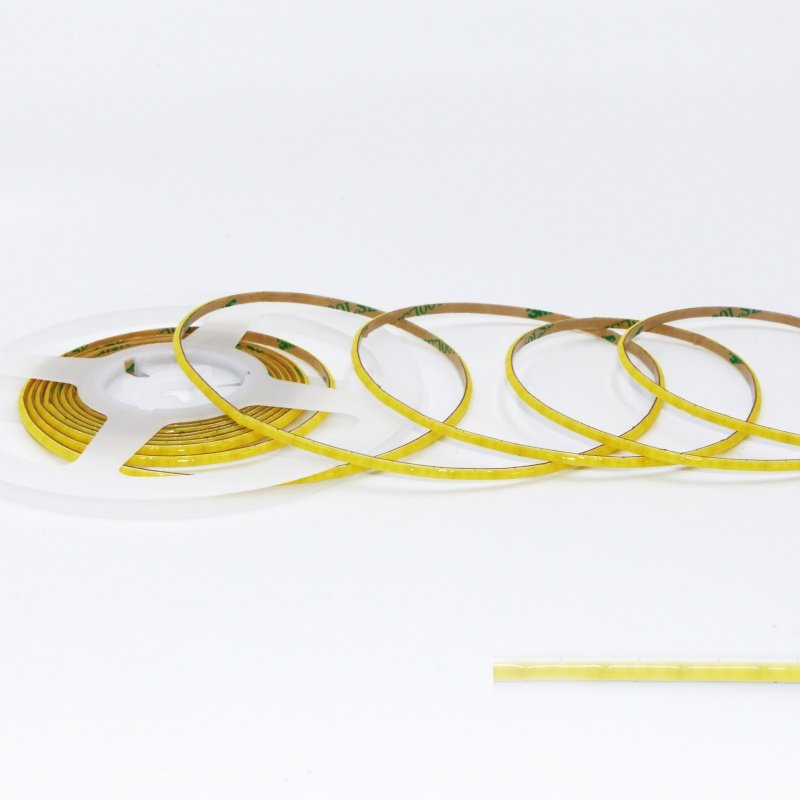
What Sustainability Means for Strip Light Sourcing
For components like strip lights, the environmental side of ESG concentrates in four areas: energy in use (efficiency and lifetime), materials (what is in the PCB, phosphors, adhesives, and housings), packaging (volume, recyclability, and recycled content), and logistics (freight weight and consolidation). None of these requires exotic technology — they require measurement and honest documentation. According to industry observation, factories that can quantify even two of the four areas stand out immediately, because most datasheets quantify none.
The Questions Buyers Are Asking Suppliers
The ESG conversation becomes concrete through specific questions: What is the rated lifetime and how was it tested? Are materials and substances documented beyond RoHS minimums? Can packaging be reduced, or made from recycled content? What are the factory’s quality and labor standards, and are they audited? And how does the product support repairability — replaceable sections, standard connectors, documented cut points. Suppliers able to answer with data, rather than adjectives, are the ones that survive these conversations. The EU ESPR and digital product passport direction makes this documentation increasingly formal for the European market.
Honest Answers Beat Green Claims
Greenwashing — vague claims without evidence — is the fastest way to fail an ESG review. “Eco-friendly” means nothing; “packaging uses 30 percent recycled corrugate, documented here” means something. According to industry observation, buyers in Europe increasingly check the claim against the paperwork, and a single unsupported claim damages a supplier’s credibility across the whole catalog. The most credible sustainability position for a strip factory is therefore a modest, documented one: real efficiency data, real material disclosures, real packaging specifications, and a clear statement of what is not yet measured. The high-density COB configurations in the COB LED strip range demonstrate how documented performance and honest material descriptions work together.
A Practical Starting Point for Your Product Line
ESG readiness can be built incrementally. Start with the data that already exists: efficiency figures, RoHS documentation, packaging dimensions and materials. Then improve what is measurable year over year — packaging reduction, documentation structure, factory audit summaries — and publish it plainly in the catalog. A short ESG section in the catalog, one honest page rather than a brochure, signals seriousness without overclaiming. For distributors, carrying a documented line makes their own ESG reporting easier, which according to industry observation is becoming a real factor in range reviews.
Frequently Asked Questions
Is LED strip lighting already “green” enough?
LED technology is highly efficient in use, which covers the largest part of a lighting product’s footprint. ESG buyers, however, increasingly look beyond use-phase energy to materials, packaging, transport, and end of life — areas where honest documentation still differentiates suppliers.
What ESG data can a strip factory realistically provide?
Efficiency and lifetime test data, material and substance disclosures, packaging composition and recyclability, factory quality and labor standard documentation, and product lifetime evidence. Anything beyond that should be verified rather than assumed.
Does ESG documentation overlap with CE and ESPR paperwork?
Substantially. Test reports, Declarations of Conformity, and material disclosures prepared for CE and the coming ESPR digital product passport cover most of what ESG questionnaires request — which is exactly why assembling that documentation now pays twice.
Does building ESG readiness raise product costs?
Documentation and packaging improvements carry modest costs that are frequently offset by design simplifications and fewer quality disputes. According to industry observation, the larger cost is organizational — collecting and maintaining the data — not per-unit.
Looking for a strip partner who can answer ESG questions with data? GPD Technology manufactures COB and SMD LED strip lights in Shenzhen with documented efficiency, material disclosures, and packaging specifications for European and global programs. Contact our team to review the documentation with our engineers.
LED Strip Tender Specification for Contractors: A Guide
Tenders turn lighting requirements into enforceable documents — and strip lights deserve better than the vague one-liners that often represent them. According to industry observation, a large share of strip-related disputes on construction projects trace back to specifications that named a product without defining density, color consistency, or IP protection. This LED strip tender specification guide for contractors and project owners walks through the requirements that belong in writing before bids are invited, so the installed result matches the design intent.
Define the Application Before the Product
The most common specification error is naming a product before defining the application. The tender should state, for each location: whether the strip is visible or concealed, the viewing distance, the mounting profile, and the environment it must survive. These four answers determine chip density, IP rating, and CCT far more reliably than habit. An exposed line above a reflective counter needs high-density COB; a concealed cove tolerates lower density; a bathroom run needs damp-location protection regardless of everything else.
Electrical and Photometric Requirements to Fix in Writing
Next, fix the measurable requirements. Specify 24V as the default for runs beyond a few meters, with wattage per meter budgeted against driver capacity. State efficacy at real operating temperature, not laboratory conditions. Define CCT (typically 2700–3000K for hospitality and residential, 4000K for commercial), CRI 90+ where merchandise and faces matter, and a color consistency window per batch — the binning discipline covered in our color consistency binning guide. Requiring photometric files (IES/LDT) for the exact configuration turns claims into checkable data. Products such as the GPD COB 10mm 480D 24V strip demonstrate the level of published data a tender can reasonably reference.
Environmental and Durability Requirements
IP ratings should be assigned by zone: IP20 for dry interiors, IP54 or higher for bathrooms and damp zones, IP65–IP67 for facades and wash-down areas. Durability requirements belong beside them — adhesive grade, FPC copper thickness for thermal performance, and minimum bending radius where profiles curve. Certification expectations close the section: require CE or UKCA declarations and, where applicable, NRTL listing, referenced by model number so substitutions cannot quietly widen the scope.
Tender Language That Prevents Disputes
Three clauses prevent most strip-related disputes. First, require an approved physical sample reel as the reference standard against which all delivered batches are judged. Second, state that substitutions must meet or exceed every specified parameter and require written approval before shipment. Third, define verification: per-batch binning data and IP test reports submitted with delivery. According to industry observation, contractors who include these clauses report fewer color and quality disputes — and suppliers with strong documentation, like the range described in our Technical Support knowledge base, welcome them as a level playing field.
Worked Example: A Hotel Corridor Requirement
Putting it together, a typical corridor line might read: concealed aluminum profile, COB construction, 24V, 10W per meter, 3000K, CRI 90+, 3-step SDCM maximum, IP20, CE declared, with IES files and an approved sample reel as the reference standard. One sentence — and every later conversation has a written target. According to industry observation, projects that specify at this level receive tighter first quotes, because suppliers can price exactly what is asked instead of padding for unknowns.
Frequently Asked Questions
What chip density should a tender require for exposed versus concealed runs?
Exposed or closely reflected runs need high-density COB — commonly several hundred chips per meter — so the line reads continuous. Concealed coves tolerate moderate density because distance hides small differences.
Should tenders name specific brands?
Best practice is to specify by performance parameters with one named example and allow equivalents that meet or exceed every requirement. This keeps pricing competitive without opening the door to substandard substitutions.
Who verifies that delivered strips meet the specification?
The contractor verifies against the approved sample and the submitted per-batch data, with the consultant or project owner spot-checking. Clear verification duties in the tender keep quality conversations factual.
How do IP ratings work for strips mounted inside profiles?
The profile system — diffuser, end caps, and gaskets — provides the protection, so the assembled combination must carry the rating. Specify IP for the finished installation and require the profile supplier’s test evidence, not just the bare strip’s.
Writing strip lighting requirements into a tender? GPD Technology manufactures COB and SMD LED strip lights in Shenzhen with model-level documentation, batch data, and sample support for tender and project teams. Contact our team for specification input and samples.
LED Strip Energy Efficiency Regulation: An Importer Guide
Energy efficiency regulation has moved from the background of the LED strip trade to one of its defining forces. According to industry observation, the questions importers receive from European and American customers have shifted from “what is the price per meter” toward “what is the lumens per watt, and can you document it.” This guide summarizes LED strip energy efficiency regulation across the EU and US, what the rules mean for strip products, and the practical documentation and design decisions importers should make now — before compliance questions arrive mid-project.
The EU Framework: Ecodesign and What Is Tightening
In the European Union, lighting has been regulated under ecodesign rules for years, and the framework keeps tightening. For products built from strip lights — finished luminaires and, increasingly, the modules themselves — the practical requirements center on efficacy floors, driver efficiency, and functional performance such as flicker control. The broader Ecodesign for Sustainable Products Regulation extends the agenda toward durability, reparability, and traceability, as covered in our digital product passport guide. According to industry observation, European buyers are already writing these expectations into specifications, well ahead of formal deadlines for strip components.
The US Patchwork: Federal, State, and Utility Programs
The United States regulates through a patchwork. There is no single federal approval for strip lights, but state-level efficiency standards — California is the most visible — set efficacy floors for certain light source categories, and utility rebate programs across the country effectively require documented efficacy and quality data before incentives apply. Safety listing from a Nationally Recognized Testing Laboratory remains the de facto expectation for installed work. According to industry observation, distributors serving US commercial customers increasingly treat “rebate-eligible with documentation” as a product feature, not an afterthought.
What These Rules Mean for Strip Specifications
Efficiency regulation changes strip design in concrete ways. Higher efficacy floors push factories toward better LEDs, more efficient driving, and thermal designs that do not waste output. Flicker requirements push driver quality forward. And photometric documentation — lumens per meter at real operating temperature, not lab fantasies — becomes part of the deliverable. For importers, the specification conversation with factories should now include: efficacy at real operating temperature, driver compatibility and flicker data, and the exact configuration the test data describes. Products like the GPD COB 10mm 480D 24V strip are documented at that level of detail precisely for these conversations.
How Importers Should Respond Now
Three practical moves keep importers ahead of the rules. First, build a documentation inventory per model — the habit that also prepares you for the digital product passport era. Second, select products whose underlying design already clears today’s floors with margin, so tomorrow’s tightening does not strand your inventory. Third, watch the regulatory calendars in your destination markets and ask factories to confirm compliance positioning in writing. Where utility rebates matter to your customers, ask early whether a model’s documentation supports rebate applications — according to industry observation, that single question has decided more strip light tenders than unit price. More testing and selection background is available in our Technical Support knowledge base.
Frequently Asked Questions
Do LED strip lights themselves need an energy label in the EU?
It depends on how the product is placed on the market. Finished luminaires carry energy labelling obligations, while bare strips and modules are usually covered through ecodesign and CE documentation. The exact boundary depends on how the product is defined and sold — worth confirming per configuration.
Which US rules affect strip lights most?
State efficiency standards and utility program requirements are the practical drivers, alongside NRTL safety listing expectations for installed work. Requirements vary by state and application.
How do I verify a supplier’s efficacy claims?
Ask for test reports that match the exact model and operating conditions, prefer reports from recognized laboratories, and cross-check a sample photometric measurement on receipt.
Will efficiency rules affect tunable white and smart strips too?
Yes — added channels and control electronics make efficacy and flicker performance harder, not easier, to achieve. Expect the same direction of requirements, applied with attention to how tuning and smart functions affect output.
Need strip lights that clear today’s efficiency requirements? GPD Technology manufactures COB and SMD LED strip lights in Shenzhen with documented efficacy, model-level test data, and EU/US compliance support. Contact our team for products and documentation that hold up to scrutiny.
EU ESPR Digital Product Passport for LED Strips: A Guide
The Ecodesign for Sustainable Products Regulation — ESPR — entered into force in 2024 and is reshaping how products sold in the EU will document their lives: what they contain, how they were tested, and how they can be repaired or recycled. At the center of that framework sits the digital product passport, a structured digital record that will accompany regulated products market by market. According to industry observation, lighting sits high on the list of product groups expected to be addressed early, which makes preparation a current topic for anyone importing LED strip lights into Europe. This guide explains the ESPR digital product passport in plain terms, what it will likely mean for LED strip lights, and the groundwork importers and brands can start now.
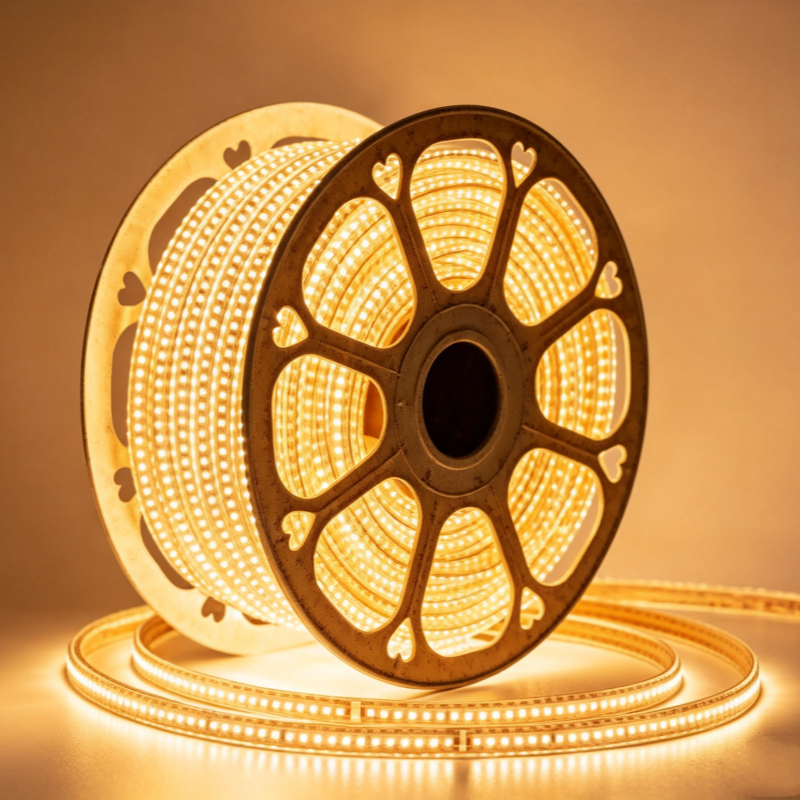
What the ESPR and the Digital Product Passport Actually Are
The ESPR extends ecodesign thinking beyond energy use to circularity: durability, reparability, recycled content, and traceability. Its tool for delivering that is the digital product passport — a machine-readable record tied to each product model (and in some designs, each batch), accessible through a data carrier such as a QR code. The passport is expected to carry structured information: technical parameters, substances of concern, compliance documents, repair instructions, and supply chain details. Importantly, the framework phases in through delegated acts per product group, so timelines differ by category and final requirements are still being shaped.
What It Likely Means for LED Strip Lights
Lighting has been part of ecodesign since the beginning, and according to industry observation it is widely expected to be among the earlier product groups under the new framework. For LED strip lights, practical requirements would likely include: technical documentation tied to specific models rather than families; material and substance information beyond the current RoHS declarations; efficiency and photometric data in standardized formats; and durability or repairability indicators where applicable. None of this is fundamentally new to a well-organized factory — but the depth, format, and per-model granularity will exceed what most compliance files contain today. Importers should expect to hold and present this data themselves, since the importer of record carries the responsibility in the EU.
What Importers and Brands Should Prepare Now
Waiting for final delegated acts wastes the preparation window. Three moves make sense today. First, build a documentation inventory per model: test reports, Declarations of Conformity, material information, and photometric files — the package described in our EU and US certification guide is the foundation. Second, tighten supplier data requests so factories deliver information in structured, reusable formats rather than scattered PDFs. Third, organize storage so any model’s full record can be produced quickly — because whatever form the passport takes, its content will come from exactly these documents. Buyers sourcing from the COB LED strip range can already request this style of model-level documentation as standard.
The Window Before Enforcement
There is a commercial angle beyond compliance. According to industry observation, European retail chains and contractors are asking suppliers about ESPR readiness earlier than regulation strictly requires — readiness is becoming a selection signal in tenders and shelf negotiations. Factories with structured documentation respond to those questions in days; factories without them lose the conversation. For importers, the same logic applies to their own customers: being the partner who already knows its data wins specification conversations, especially with the high-density COB configurations that European projects increasingly favor. More selection and testing background is available in our Technical Support knowledge base.
Frequently Asked Questions
Is the digital product passport already mandatory for LED strip lights?
Not yet. The ESPR framework is in force, but requirements arrive product group by product group through delegated acts, and lighting timelines are still being defined. Preparation now is prudent; compliance dates do not yet apply to strip lights.
Who creates and maintains the passport — the factory or the importer?
Manufacturers hold the underlying product data, but the importer of record carries the EU responsibility for the product as placed on the market. In practice, importers need the data assembled, verified, and presentable on demand.
What data should we start collecting today?
Per-model technical documentation, test reports, material and substance information, Declarations of Conformity, photometric files, and supplier chain details — organized so any single model’s record can be retrieved complete within minutes.
Getting ahead of ESPR and digital product passport requirements? GPD Technology manufactures COB and SMD LED strip lights in Shenzhen with structured, model-level documentation for European import programs. Contact our team to review your documentation readiness with our engineers.
LED Strip Distributor Market Opportunities: Where to Start
Distributors sit at the most competitive point of the LED strip trade — squeezed by factory pricing on one side and project expectations on the other. Yet according to industry observation, the distributors growing fastest through this cycle are not the ones discounting deepest. They are the ones reading where LED strip distributor market opportunities are actually opening: renovation-driven replacement demand, tunable and COB upgrade cycles, and specification-driven commercial work. This article maps those openings and the practical steps — product mix, supplier programs, and margin levers — that turn them into sustainable profit, plus the distribution models that fit different customer bases.
Where Demand Is Opening Up
Three openings deserve attention now. Renovation and retrofit continues to convert old halogen and fluorescent installations into linear LED — a segment that rewards distributors stocking standard 12V and 24V COB configurations with short replenishment cycles. Commercial spec work keeps pulling high-density COB and tunable white into projects, growing the upper tier of the catalog. And high-voltage direct-wire lines — products like the GPD 2835 high-voltage strip series — serve long-run installations where drivers are impractical, a niche with fewer competing SKUs and steadier margins.
Product Mix That Moves the Needle
According to industry observation, distributors trimming their range to “cheap and long” are losing ground to those structuring it in three tiers: volume-grade fixed-CCT strips for price-driven buyers, high-density COB strip lights for quality-driven projects, and specialty lines — tunable white, waterproof, high-voltage — for specification-driven work. Each tier answers a different customer conversation, and together they lift average order value without multiplying suppliers.
Supplier Programs Worth Negotiating
Beyond unit price, several factory programs change distributor economics: forecast-based production reservations that lock capacity for peak season; per-batch color and IP documentation that reduces project disputes (the binning discipline covered in our color consistency guide); private-label reels and packaging that build brand equity; and sample support that shortens the path from inquiry to first order. According to industry observation, distributors who formalize these terms annually — rather than accepting defaults — report smoother inventory and better gross margin stability.
Two Distribution Models, Two Factory Conversations
Project-focused distributors serve contractors and designers: their inventory leans on standard COB configurations with reliable replenishment, and their value is speed, documentation, and technical answers. Catalog-focused distributors serve retail and e-commerce buyers: their needs center on private-label packaging, content-ready product information, and stable consumer-grade configurations. According to industry observation, the factory conversation changes accordingly — the first model is about capacity reservations and batch consistency terms, the second about packaging tooling, labeling, and marketing support. Knowing which model fits your customer base sharpens every later negotiation with the factory.
Margin Levers Beyond Price
Price is the bluntest lever in distribution. Sharper ones include: complete documentation packages that let customers approve faster; technical answers sourced from the factory’s engineering knowledge base instead of generic replies; and bundled configurations (strip plus profile plus driver) that raise order value while simplifying the buyer’s purchasing. Distributors who publish this kind of guidance — not just product listings — increasingly win the specification conversations that used to belong to lighting designers alone.
Frequently Asked Questions
Which LED strip segments offer the best distributor margin today?
According to industry observation, high-density COB and tunable white carry better margins than volume-grade fixed-CCT strips, while high-voltage and waterproof lines offer steadier demand with fewer competing SKUs.
How much stock is sensible for a new strip program?
Start with standard configurations in one or two best-selling CCTs, hold safety stock on those, and place custom configurations against confirmed orders. Forecast-sharing with the factory keeps replenishment predictable.
What should a distributor ask a new supplier for first?
Documentation samples, per-batch quality data, and a trial production slot. A supplier’s willingness to provide these signals how the partnership will run when volumes grow.
Can a distributor require regional exclusivity from a factory?
Sometimes. Private-label and custom configurations are commonly granted regional exclusivity against volume commitments, while standard catalog items rarely are. Separate the two in the agreement so exclusivity is tied to what genuinely belongs to you.
Growing your LED strip distribution business? GPD Technology partners with distributors worldwide on COB and SMD strip programs — forecast reservations, private-label options, per-batch documentation, and sample support included. Contact our team to discuss a program built around your market.
LED Strip Color Consistency Binning Standard: Buyer Guide
Few strip light complaints are as expensive as mixed whites: a hotel corridor where one floor reads warmer than the next, or a retail wall where two runs of the “same” product visibly disagree. According to industry observation, these cases usually trace back to one skipped step — color binning discipline. This guide explains how the LED strip color consistency binning standard works in practice, why identical-looking datasheets can still produce different whites, and the batch data buyers should request so projects never mix visibly different light.
What Binning Actually Means
LED chips are never perfectly identical. Manufacturing variations place every chip somewhere on a range of color temperature, brightness, and forward voltage — and binning is the factory’s act of sorting those chips into groups. The industry describes tightness in MacAdam ellipses (SDCM): a 3-step bin means the color deviation is small enough that most observers cannot distinguish two adjacent groups side by side, while 5-step and wider bins produce whites that trained eyes — and increasingly, untrained eyes — can tell apart. For strip lights, binning discipline extends beyond the chips: the phosphor mix applied over COB lines and the quality of downstream assembly must hold the sorted chips within their promised window.
Why Strips From the Same Factory Can Still Look Different
Even with sorted chips, several points in the chain can drift. Chip suppliers revise their own processes, so this quarter’s “same” chip may sit in a slightly different bin than last quarter’s. Phosphor and coating batches vary. And on long production runs, equipment warm-up and material changeovers shift output at the margins. COB construction helps — the continuous phosphor layer blends small chip-level differences — but according to industry observation it reduces visible variation rather than eliminating the need for binning. High-density COB strip lights still depend on their chips being sorted and matched before bonding.
The Batch Data Buyers Should Request
Binning claims belong in documentation, not in sales conversations. Before scaling an order, professional buyers ask for:
- Per-batch SDCM values — the measured color deviation of the actual production batch, not a generic family specification.
- CRI or TM-30 data at the ordered CCT — for tunable products, at both ends of the range.
- Adjacent-reel photos — reels from the same run lit side by side, which reveal seams faster than numbers.
- Locked CCT windows per order — a written commitment that repeat orders ship from the same binning window as the approved sample.
A practical benchmark: the GPD COB 10mm 480D 24V strip and the wider COB LED strip range are supported by exactly this style of batch documentation — the depth that keeps multi-phase projects consistent from first floor to last.
Turning Binning Into a Contract Term
The strongest buyers convert binning from a hope into a term of trade. Specify the maximum SDCM in the purchase order, name the approved sample reel as the reference standard, and require re-confirmation whenever production moves to new materials or a new production date. Keeping the approved reel on hand at the factory — rather than only in your warehouse — makes every later shipment comparable against the same physical target. According to industry observation, suppliers respond well to this structure — it gives their production teams a clear target and removes the ambiguity that turns small color shifts into large disputes.
Frequently Asked Questions
What SDCM should I accept for my project?
For most indoor applications, 3-step SDCM is the professional expectation. Retail, hospitality, and any installation where two runs sit adjacent justify requesting tighter windows or single-batch supply.
Does COB construction remove the need for binning?
No. The phosphor layer blends chip-level differences into a smooth line, but if the underlying chips span a wide bin range, the overall tone still drifts between batches.
Why did two orders of the same strip look different?
Most often the two orders were produced from different binning windows or different production dates. A locked binning window in the purchase order prevents exactly this scenario.
Do tunable white strips have the same binning concerns?
Even more so — both channels must stay matched as they age, or the tuned point drifts. Ask tunable suppliers for binning data at both CCT extremes, not just one.
Need color-consistent strip lights across batches and projects? GPD Technology manufactures COB and SMD LED strip lights in Shenzhen with per-batch binning control and documentation, supporting importers, contractors, and distributors. Contact our team for samples and specification data.
Linear LED Lighting Market Forecast: An Importer Guide
Linear lighting continues to take share from traditional fixtures in commercial and residential projects, and strip-based systems are the engine behind that shift. For importers and distributors planning next year’s catalogs, a grounded linear LED lighting market forecast matters more than ever: it decides which configurations to stock, which certifications to prioritize, and how much flexibility to build into supplier agreements. According to industry observation, demand growth remains steady across architecture, retail, and industrial renovation — with the interesting changes happening in product mix rather than total volume. This forecast-style analysis walks through the drivers, the product trends, and the sourcing implications worth acting on now — with the caveat that regional regulation and freight conditions, not global averages, will decide each buyer’s actual numbers.
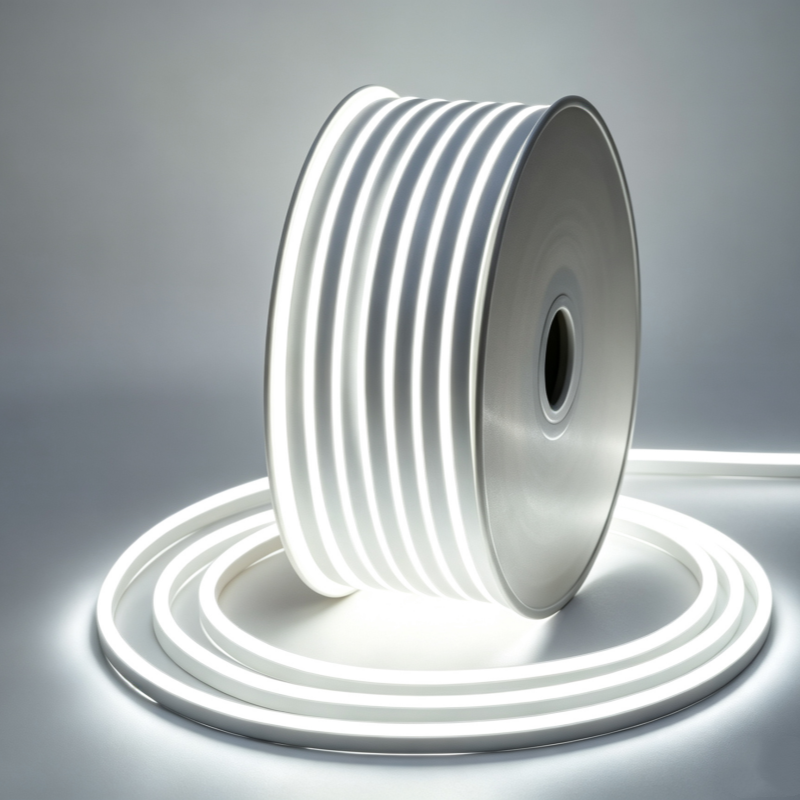
Demand Drivers: Renovation, Retail, and Architecture
Three demand streams keep linear LED lighting growing. Architectural and commercial renovation replaces outdated fluorescent and halogen fixtures with continuous lines of light — a segment that rewards slim profiles and seamless output. Retail and hospitality refresh cycles favor adjustable, scene-capable lighting, pulling tunable and addressable options into the mix. And industrial spaces — warehouses, workshops, parking — convert to linear LED for maintenance savings. According to industry observation, renovation-driven demand is the most resilient of the three, because it is triggered by building age and energy costs rather than discretionary budgets.
Product Mix: Where the Volume Is Moving
Within linear lighting, the mix keeps shifting toward higher performance and simpler installation. High-density COB constructions dominate new specifications for visible runs, while high-voltage direct-wire strips — such as the GPD 230V neon and rigid strip series — grow in projects that want driver-free installation and long continuous runs without voltage drop. Waterproof neon-style lines expand outdoor and facade applications. According to industry observation, buyers increasingly consolidate onto fewer platforms with more configuration options, which favors suppliers with broad, documented ranges like the COB LED strip family.
Efficiency Rules and Certification Momentum
Regulation continues to reshape the market from the specification side. Ecodesign requirements in Europe, state-level efficiency programs in the US, and similar tightening across the Middle East and Asia keep raising efficacy floors and documentation expectations. For linear lighting this translates into practical demands: better lumen-per-watt figures, photometric files for exact configurations, and Declarations of Conformity that match ordered models. Importers who treat certification readiness as part of the product — rather than an afterthought — move faster through tenders and retail onboarding alike, a discipline introduced in our EU and US certification guide.
Regional Patterns Worth Tracking
Demand does not move in lockstep across regions, and blended market commentary can hide that. In Europe, renovation and energy-driven upgrades dominate, which favors high-efficacy, well-documented products. In the United States, residential decoration and commercial refreshes run on different cycles, and buyers expect NRTL-listed options for installed work. Project-driven markets in the Middle East and Australia tend to concentrate volume into fewer, larger tenders with strict IP and voltage requirements. According to industry observation, suppliers who keep regional variants — voltage, IP rating, CCT preferences — ready in their catalogs respond faster to these shifts without re-engineering product lines.
Sourcing Implications for the Coming Cycle
The forecast for buyers is less about predicting a number and more about positioning. According to industry observation, suppliers with vertically organized production and rolling material purchases consistently deliver shorter lead times and more stable pricing through demand peaks. The practical moves: share rolling forecasts early, qualify alternates within a supplier’s range so disruptions do not stall projects, and hold safety stock on fast-moving SKUs while ordering custom configurations against confirmed demand. Buyers who ran this playbook through the last two cycles report smoother inventory and fewer emergency air shipments.
Frequently Asked Questions
Is linear LED lighting still growing, or is the market saturated?
According to industry observation, growth continues, driven by renovation conversions and the expansion of linear formats into outdoor, facade, and furniture applications. The mix shifts toward COB and higher-efficacy products even where total volume grows modestly.
Which product type should importers prioritize for next year?
High-density COB for visible architectural runs, high-voltage direct-wire strips for long seamless installations, and waterproof neon-style lines for outdoor — three segments that consistently appear in project demand.
How should pricing be planned against this forecast?
Agree adjustment windows tied to material indices with suppliers, and lock volumes for peak-season capacity early. Spot buying remains the most expensive way to serve a growing segment.
How does the high-voltage segment fit into the forecast?
It keeps a solid niche in long-run, driver-free installations — facades, coves in concrete, and retrofit projects where access to drivers is difficult. According to industry observation, 230V direct-wire lines hold their position exactly because they simplify installation, even as low-voltage COB wins the premium visible segment.
Positioning your catalog for the linear lighting cycle? GPD Technology manufactures COB, SMD, and high-voltage linear strip lights in Shenzhen, supporting forecast-based production, OEM configurations, and full documentation for importers and distributors. Contact our team to align your next-season plan.
Tunable White LED Strip Market Demand: An Importer View
Among the product decisions importers are weighing this year, few have moved as fast as tunable white. A strip that once offered a fixed 3000K now adjusts across roughly 2700–6500K, letting one installation serve morning, evening, and merchandising scenes alike. According to industry observation, tunable white LED strip market demand has grown from a hospitality niche into a mainstream line item for offices, retail, and high-end residential — and importers who understood the product a year ago are now fielding questions from clients who barely knew the category existed. This article looks at what is driving that demand and how to respond to it commercially.

What Is Driving Demand for Tunable White?
Three forces stand out. Hospitality brands increasingly tune lighting between warm daytime tones and brighter, cooler settings for events and breakfast service — one installation, several scenes. Workspaces follow wellbeing-oriented design guidance that shifts cooler light into the morning and warmer light toward the end of the day. And retail merchandising uses CCT changes to flatter different product lines without refitting. According to industry observation, these are no longer flagship-only requests: mid-range hotels and regional retail chains now ask for tunable white LED strip lights by name.
What Buyers Are Actually Specifying
In practice, most demand concentrates in two-channel (warm plus cool) constant-voltage strips, with RGB+CCT as the premium option where color scenes matter. Typical specifications favor 24V layouts for longer runs, high-density COB constructions for dot-free exposure, and CRI 90+ so the light reads well on skin tones and merchandise. Control compatibility is the second half of the specification — 0-10V and DALI in commercial projects, RF remotes and app-based ecosystems in residential — and buyers increasingly confirm controller matching at sampling rather than discovering conflicts on site. Compact formats matter too: slim profiles such as the GPD COB 3mm 400D 12V strip serve joinery and shelf applications where full-size reels will not fit.
Sourcing Considerations Before You Commit
Tunable white adds a matching problem that fixed-CCT products do not have: both channels must age, dim, and hold color together. Before committing, buyers should verify:
- Mixed-light quality — samples lit at 2700K, 4000K, and 6500K simultaneously should blend without a visible seam or color patchiness.
- Consistency between channels — warm and cool chips must age at similar rates, or the tuned point drifts over time.
- Control compatibility — confirm the strip’s channel wiring and current draw against the controllers your market actually sells.
- CRI across the tuning range — CRI measured only at one CCT is not enough for retail and hospitality work.
The COB LED strip range illustrates the specification depth behind these checks, and our Technical Support knowledge base collects the testing notes behind them.
Where the Market Is Heading
According to industry observation, the price gap between tunable white and fixed-CCT strips keeps narrowing as two-channel COB designs mature, which pulls the product into more mainstream projects each season. Human-centric lighting language now appears in office fit-out specifications that would not have mentioned it two years ago, and smart-home ecosystems continue to normalize app-based CCT control for residential buyers. For importers and distributors, tunable white has become a practical differentiation play: stock it, understand it, and it opens conversations that fixed-CCT catalogs no longer start. The buyers who benefit most treat tunable white not as a novelty SKU but as a second lighting language their catalog can speak alongside fixed CCT.
Frequently Asked Questions
Is tunable white the same as RGB LED strip?
No. Tunable white adjusts only color temperature along the warm-cool axis, which suits architectural and workspace lighting. RGB adds saturated colors for effect lighting; RGB+CCT combines both in one product.
Does tunable white cost much more than fixed CCT?
According to industry observation, the gap has narrowed as two-channel designs mature. Premiums remain, but they are smaller than the scene-flexibility value many hospitality and retail clients assign to them.
What should I check in samples before scaling an order?
Light samples at both CCT extremes and mid-point, check mixed-light uniformity, dim-to-warm behavior at low output, and confirm the strips work with the controllers sold in your market.
Which configurations are most common in project orders?
Two-channel 24V layouts with CRI 90+ and mid-to-high densities dominate commercial orders, while residential programs lean on compact 12V formats for joinery and display work. Confirming cut points and connector types up front avoids rework later.
Adding tunable white to your catalog? GPD Technology manufactures tunable and fixed-CCT COB LED strip lights in Shenzhen, supporting OEM configurations, controller-matched samples, and documentation for importers and distributors. Contact our team to discuss your program.
IP Rated LED Strip Reliability Testing: Buyer Checklist
An IP rating printed on a datasheet is a claim; reliability is what happens after six months of humidity, heat cycles, and handling on site. According to industry observation, most waterproof strip failures traced back by importers were not mysterious — they were ingress points that a proper test would have exposed before shipment. This guide explains what IP rated LED strip reliability testing actually covers, how capable factories verify waterproof designs, and which test data buyers should request before committing to an order.
What IP Ratings Mean — and What They Do Not
The IP code has two digits: the first grades protection against solids, the second against water. For strip lights the common tiers are IP20 for dry interiors, IP54 for damp locations, IP65 for splash-exposed runs, and IP67/IP68 for soak-prone or outdoor installations. What the rating does not describe is lifetime. A strip can pass a water ingress test once and still fail early if the encapsulation overheats, the adhesive creeps, or the end caps separate under thermal cycling. Reliability, in other words, is the rating plus everything around it.
How Capable Factories Test Waterproof Strips
Serious factories verify IP designs with a sequence rather than a single check: water column or spray testing per the declared grade, soak tests for IP67/IP68 builds, then power-on aging of sealed reels so failures surface under real electrical load. According to industry observation, aging is where weak encapsulation and poor end-cap bonding reveal themselves — which is why factories that run full-reel powered aging can catch defects that a visual inspection never will. Thermal cycling between hot and cold chambers adds another layer, especially for outdoor configurations that expand and contract daily in service.
The Test Data to Request From Suppliers
Buyers should treat test documentation as a deliverable, not a courtesy. Before placing an order, request:
- Model-matched IP test reports — the report must reference the exact product and voltage you are buying, not a similar family.
- Aging records — powered aging duration and sampling method, ideally with photos of the aged reels.
- Thermal and insulation data — dielectric strength or insulation resistance results for sealed builds.
- Batch-level consistency — how IP integrity is verified across production runs, since one passing sample does not describe a shipment.
A useful reference point: the GPD COB 30mm 1600D 24V 40W strip and the wider COB LED strip range are supported by this style of documentation, which is what allows buyers to match certificates to models — the discipline described in our EU and US certification guide.
Red Flags Buyers Should Watch
Several patterns deserve caution. Generic reports with no model number or photos. IP68 claims on strips whose end caps are sealed by glue alone without mechanical retention. Prices far below comparable waterproof builds — sealing materials and testing cost money, and the difference shows up somewhere. And factories that cannot explain their own test sequence in a call. None of these proves a bad product, but together they predict the complaints that surface after installation rather than before shipment.
Frequently Asked Questions
Is IP68 always better than IP65?
Not automatically. IP68 describes soak protection, often with a permanently sealed build that can be harder to cut and terminate. IP65 suits splash-exposed runs; choose by installation reality, not by the biggest number.
Can IP20 strips be used outdoors inside profiles?
Yes, when the profile system provides the protection — with rated end caps and diffuser sealing. The specification should then describe the assembled system, because the strip alone no longer defines ingress protection.
How is reliability verified after delivery?
On receipt, buyers commonly sample-test lengths for ingress and insulation, then power-age a portion of the shipment. Any failure pattern should be raised with the supplier against the agreed test reports.
Sourcing IP-rated COB strip lights and need the test data to match? GPD Technology manufactures COB and SMD strip lights in Shenzhen with in-house aging and waterproof verification, supporting importers and contractors with model-matched reports. Contact our team to request samples and documentation.
Architectural LED Strip Lighting Specification Guide
Architectural strip lighting succeeds or fails at the specification stage. When the written specification matches the installation reality, contractors install without surprises and the rendered light matches the designer’s intent. When it does not, the project absorbs the cost in rework, substitutions, and schedule risk. This architectural LED strip lighting specification guide walks through the decisions that belong in a professional specification — mounting and profiles, light quality, electrical and environmental requirements, and documentation — so importers, contractors, and designers can align on one clear document.
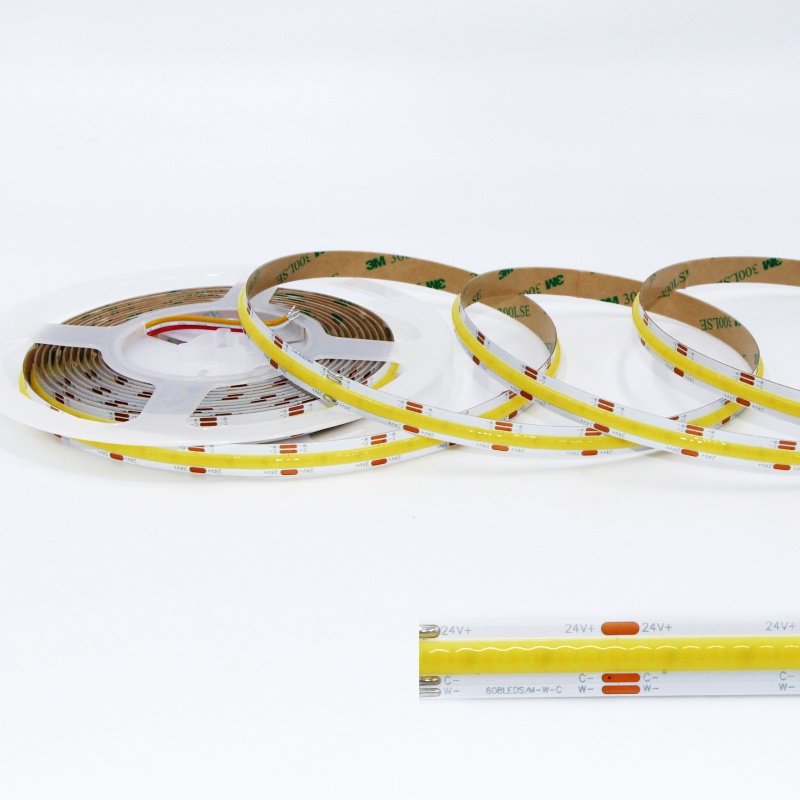
Start With the Installation Detail
The first specification decision is physical: where and how the strip will be mounted. Coves and uplighting hide the source and forgive lower densities; exposed profiles in joinery, shelving, and display work demand high-density COB so no dots appear on reflective surfaces. Profile depth matters too — aluminum profiles act as heat sinks and shape the beam, while deeper diffusers increase the spacing at which the light source can sit from the surface. According to industry observation, most specification disputes trace back to this early section: a strip chosen without confirming profile depth, viewing distance, or bending radius almost always disappoints on site.
Light Quality: CCT, CRI, and Consistency
Correlated color temperature (CCT) should follow the space: warm 2700–3000K for hospitality and residential work, neutral 4000K for commercial and task areas. Color rendering comes next — CRI 90+ is now the standard expectation for retail and hospitality, supported by binning discipline so that one project does not mix visibly different whites across batches. For higher-spec projects, ask suppliers for TM-30 data rather than CRI alone. Consistency across production batches is the part most often left unspecified, and it is the part clients notice first when adjacent runs do not match.
Electrical and Environmental Requirements
Electrical specification keeps long runs predictable. Specify 24V for anything beyond short segments, calculate wattage per meter against driver capacity, and name the dimming method and driver standard so flicker is controlled rather than discovered. Environmental requirements follow the installation: IP20 for dry, accessible interiors; IP54 or higher for bathrooms and damp zones; IP65–IP67 for facades, landscapes, and wet locations. Certification expectations belong in the same section — the CE, UKCA, and NRTL documentation outlined in our EU and US certification guide should be referenced by model, not by family.
Documentation That Keeps Projects on Schedule
A specification is only as strong as the documents that accompany it. Professional submittals include photometric files (IES/LDT) for the exact configuration, wiring diagrams, the manufacturer’s Declaration of Conformity, and physical or digital mockups for color-critical areas. Specifying from a factory’s standard platforms — for example the high-density configurations in the COB LED strip range, such as the GPD COB 10mm 608 24V strip — shortens this stage because test data and files already exist. More selection background is available in our Technical Support knowledge base.
Frequently Asked Questions
What chip density should I specify for coves versus exposed profiles?
Hidden coves tolerate moderate densities because the source is diffused by distance. Exposed or closely reflected installations need high-density COB — commonly several hundred chips per meter — so the line reads continuous rather than dotted.
Should the specification fix one CCT for the whole project?
Usually yes for visual continuity across connected spaces, with deliberate exceptions for task or display areas. Fixing CCT and requiring batch consistency data prevents the mixed-whites effect between floors or phases.
How is dimming best specified for strip lights?
Name the control protocol, the driver, and the minimum load in the specification, and require flicker test data. Mixing strips and drivers without checking compatibility is a common cause of on-site disputes.
Specifying strip lighting for an architectural project? GPD Technology manufactures COB and SMD LED strip lights in Shenzhen and supports architects and contractors with samples, photometric data, and specification review. Contact our team to align your documents before procurement begins.
LED Strip Light Market Trends: What Buyers Should Watch
Every buying season, the questions importers ask about LED strip lights change a little, and this cycle is no exception. According to industry observation, LED strip light market trends over the past year point in one consistent direction: buyers are specifying higher build quality, tighter light uniformity, and documentation readiness — while efficiency rules and sourcing discipline quietly reshape product lines. For B2B buyers the practical question is not whether these trends continue, but how quickly to align specifications and sourcing plans with them. This article summarizes the shifts that matter for importers, contractors, and distributors, and the moves worth making now.
Demand Shifts Toward Higher Density and Better Light
The clearest trend is the migration from entry-level SMD strips to high-density COB configurations in visible applications. Retail fit-outs, hotel corridors, joinery lighting, and residential renovations all reward dot-free illumination, and end clients increasingly recognize the difference. According to industry observation, replacement and renovation demand now drives a growing share of strip volume in mature markets — and renovation buyers tend to trade up rather than down. Products such as the GPD COB 10mm 608 24V strip exist precisely for this segment: high chip density in a slim profile for shallow profiles and exposed lines.
Efficiency Rules Are Reshaping Product Lines
Regulation is the second force. Ecodesign requirements in the EU and state-level efficiency programs in the US keep raising the bar for luminaires and, by extension, for the strip modules that go into them. According to industry observation, factories are responding with better drivers, higher-efficacy configurations, and cleaner data sheets. For buyers the practical effect is simple: efficacy and photometric data are no longer optional attachments to a quotation — they are selection criteria that will follow your product through its market life.
Pricing and the Sourcing Climate
On the sourcing side, the climate rewards planning. Raw material movement, holiday production calendars, and peak-season capacity all influence price and lead time, as covered in our earlier supply chain analysis. According to industry observation, buyers who share rolling forecasts with their factories consistently secure better capacity and more stable pricing than those who buy spot. The COB LED strip range is a good illustration of why specification continuity matters when you plan across seasons.
Regional Patterns Worth Tracking
Demand does not move in lockstep across regions, and blended market commentary can hide that. In Europe, renovation and energy-driven upgrades dominate, which favors high-efficacy, well-documented products. In the United States, residential decoration and commercial refreshes run on different cycles, and buyers expect NRTL-listed options for installed work. Project-driven markets in the Middle East and Australia tend to concentrate volume into fewer, larger tenders with strict IP and voltage requirements. According to industry observation, suppliers who keep regional variants — voltage, IP rating, CCT preferences — ready in their catalogs respond faster to these shifts without re-engineering product lines.
What Buyers Should Watch Next
- Density and uniformity tiers — chip-per-meter counts keep climbing; match density to profile depth instead of defaulting to the top option.
- Color quality expectations — CRI 90+ and consistent binning are becoming standard asks in commercial tenders.
- Specialized IP configurations — waterproof variants grow as outdoor and landscape applications expand; verify aging and IP test data.
- Certification readiness — keep EU and US documentation current with each model revision, as outlined in our certification guide.
More testing background and selection notes are collected in our Technical Support knowledge base.
Frequently Asked Questions
Is COB replacing SMD LED strip lights?
In visible and reflective applications, largely yes — that is where the demand shift is strongest. SMD remains common for coves, indirect lines, and budget segments where dots stay hidden.
Will strip light prices rise or fall this cycle?
According to industry observation, pricing tracks raw materials and capacity more than any single trend. Buyers with forecasts and agreed adjustment windows are the least exposed to surprises.
Which applications drive most demand growth?
Renovation and upgrade projects, retail and hospitality refreshes, and specialty applications — smart equipment, vehicles, and display lighting — keep adding volume on top of traditional decoration demand.
Do these trends change which certifications I need?
Indirectly, yes. As efficiency rules tighten and product categories evolve, certification scope can shift with each revision. Re-confirm documentation whenever you switch models, voltages, or factories rather than assuming last year’s paperwork still applies.
Following the market with a sourcing plan? GPD Technology manufactures COB and SMD LED strip lights in Shenzhen and supports importers, contractors, and distributors with specification guidance, samples, and documentation. Contact our team to align your next order with where the market is heading.
LED Strip OEM ODM Sourcing Insights: A Practical Guide
Private-label and custom LED strip programs are where importers either build durable margin or slowly lose their differentiation. According to industry observation, more distributors and lighting brands are moving from catalog purchases to factory-direct OEM and ODM cooperation — yet many still treat “OEM” and “ODM” as the same thing, and only discover the difference after samples, lead times, or intellectual property go wrong. These LED strip OEM ODM sourcing insights summarize how the two models differ, how to evaluate a factory, and which customization options actually deserve your budget.
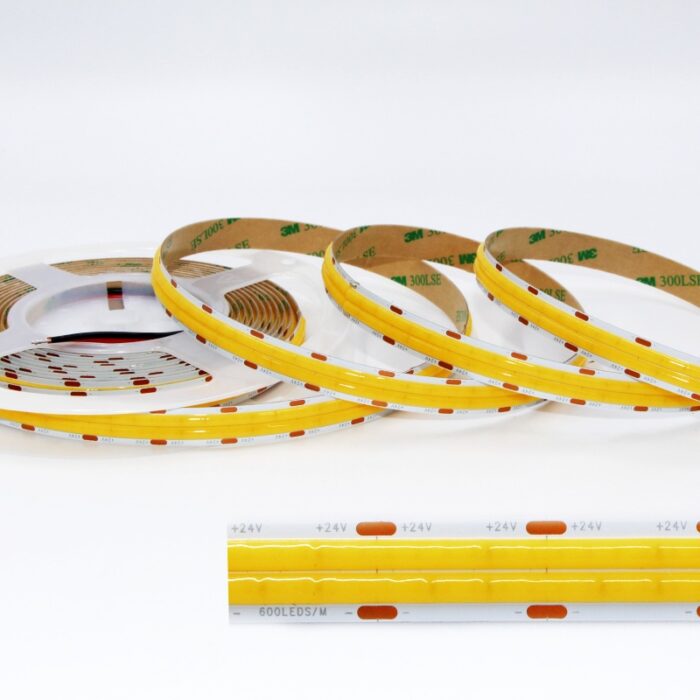
OEM and ODM Are Two Different Commitments
In an OEM relationship, you bring a defined specification and the factory builds to it under your brand. In an ODM relationship, the factory contributes the design: existing platforms, engineering adjustments, and tooling that you customize rather than invent. For LED strip lights the practical dividing line is who owns the specification. If your team defines the FPC width, chip density, voltage, CCT, and packaging, you are buying OEM. If you start from the factory’s platform and adapt it, that is ODM — usually faster and cheaper, but with shared designs your competitors may also access unless you negotiate exclusivity.
How to Evaluate an LED Strip Factory
Factory evaluation for strip lights should focus on process ownership. Ask which steps happen in-house: SMT or COB bonding, phosphor coating, aging, IP encapsulation, and QC. A factory that controls bonding and aging can react to quality issues within days; one that outsources them will always point upstream. Request a walk-through of QC equipment — colorimeters for binning control, aging racks that run full reels, and IP test gear if you buy waterproof configurations. According to industry observation, factories with in-house engineering support also resolve customization questions faster, which matters more than a marginally lower unit price. The COB LED strip range on our site reflects what a vertically organized program looks like in catalog form.
Customization Options Worth Asking For
LED strip customization is modular, and not every option carries the same cost or lead-time impact:
- Electrical basics — voltage (12V/24V), chip density, and wattage per meter; 24V high-density builds such as the GPD COB 12mm 600D 24V 24W strip suit long runs with demanding uniformity.
- Light quality — CCT range, CRI tier, and binning strategy; these define perceived quality more than raw output.
- Mechanical and environmental — PCB width and color, cut points, connector types, and IP rating for the installation environment.
- Brand experience — private-label reels, instruction sheets, and retail packaging; low-cost changes with high shelf impact.
According to industry observation, electrical and light-quality changes reuse existing materials and add little lead time, while new IP encapsulation or custom FPC tooling moves schedules — plan those earlier.
Protect Your Designs and Your Margin
OEM and ODM cooperation only pays off if the assets you create stay yours. Sign NDAs before sharing specifications, agree in writing whether tooling and phosphor formulations are exclusive to your orders, and keep a locked specification document that references your test reports — the compliance paperwork described in our Technical Support knowledge base is part of that package. Buyers who skip this step often find their “custom” strip quoted to competitors within a season.
Frequently Asked Questions
What MOQ should I expect for OEM or ODM strip lights?
Standard platforms adapted to your brand usually carry low or no effective MOQ beyond normal batch sizes. Fully custom FPC or packaging typically needs higher volumes to justify tooling; ask suppliers to separate tooling cost from unit cost so you can compare honestly.
How long does OEM sampling take?
For adaptations of existing platforms, samples are commonly ready within a few weeks according to industry observation; fully custom configurations take longer because materials must be procured before assembly can start.
Can my brand appear on the product itself?
Yes in most cases — printed reels, retail boxes, and instruction sheets are standard private-label options. Confirm trademark authorization and artwork formats early so packaging does not become the bottleneck.
Planning an OEM or ODM strip program? GPD Technology manufactures COB and SMD LED strip lights in Shenzhen with in-house bonding, aging, and IP lines, supporting private-label and custom configurations for importers, brands, and contractors. Contact our team to start with samples and a specification review.
LED Strip Supply Chain Analysis: What Importers Should Know
For importers of LED strip lights, supply chain decisions have quietly become as important as product decisions. According to industry observation, the past two years have reshaped how LED strip lights are sourced: chip allocation, copper and FPC costs, freight cycles, and holiday production calendars all now move prices and lead times in ways that a purchase order alone cannot control. This LED strip supply chain analysis maps where the chain is most exposed and what importers, contractors, and distributors can do to stay ahead of it.
How the LED Strip Supply Chain Is Structured
A strip light travels through several hands before it reaches an installation. Upstream sit the LED chip makers and packaging houses, alongside suppliers of flexible copper-clad FPC material, phosphor mixes, resistors, and pressure-sensitive adhesive. The midstream is the strip factory itself, where chips are bonded or reflowed onto the FPC, coated, aged, and cut. Downstream come drivers, connectors, dimmers, and finally freight forwarders. Each layer adds lead time, and the layers with the least inventory — usually chips and specialty FPC — are the ones that wobble first when demand spikes.
What Moves Costs and Lead Times
According to industry observation, three forces dominate. First, raw material drift: copper and FPC substrate prices flow directly into strip costs, while gold used in bonding affects chip pricing upstream. Second, capacity cycles: high-density COB lines and popular color temperatures sell out first ahead of peak seasons. Third, logistics swings that change the total landed cost even when the ex-works price holds. None of these moves on a fixed schedule, which is why a static price list ages quickly in this category.
Sourcing Implications for Importers and Distributors
The practical response is to buy structure, not just product. Buyers who source COB LED strip lights directly from manufacturers — rather than through trading layers — see problems earlier and get capacity reserved sooner. Two habits stand out. Keep a rolling forecast shared with your factory so chip and FPC purchases can start before your own stock runs low. And qualify a second specification, not only a second supplier, so a disruption on one model does not stop your projects. Our GPD COB 10mm 480D 24V 14.5W strip page shows the specification depth that makes such qualification faster, and the full COB LED strip range gives alternates within one documentation standard.
A Short Checklist Before Your Next Order
- Confirm production windows around major holidays and ask how far in advance materials are ordered.
- Agree on price-adjustment triggers for copper or chip movements instead of absorbing surprise surcharges.
- Hold safety stock on fast-moving SKUs and accept longer lead times only for custom configurations.
- Keep documentation with the goods — test reports and declarations travel with the shipment, as covered in our earlier certification guide.
Supply chains reward buyers who communicate early and penalize those who negotiate late. Background on specifications and testing is available in our Technical Support knowledge base.
Frequently Asked Questions
Which part of the LED strip supply chain causes the most delays?
According to industry observation, chip allocation and specialty FPC material are the most common bottlenecks, especially for high-density COB configurations during peak season.
Should importers hold their own inventory?
For fast-moving SKUs, yes. Safety stock on standard models paired with factory-side material reservations covers most demand spikes without tying up capital on custom items.
How far ahead should a seasonal order be placed?
As a rule of thumb used across the trade, place seasonal orders early enough for materials to be purchased and strips to be aged and tested — typically well before the peak shipping period begins.
Looking for a stable LED strip supply partner? GPD Technology manufactures COB and SMD strip lights in Shenzhen, supports forecast-based production planning, and ships worldwide for importers, contractors, and distributors. Contact our team to discuss your sourcing plan.
LED Strip Certification Requirements EU US: Buyer Guide
For importers of LED strip lights, certification is where compliance, cash flow, and delivery schedules intersect. According to industry observation, shipments between the EU and US are still delayed more often by paperwork gaps than by product faults: a missing Declaration of Conformity, a test report that does not match the invoice model, or markings that never made it onto the product. This guide summarizes LED strip certification requirements in the EU and US markets and lists the documents to demand from your supplier before wiring a deposit.
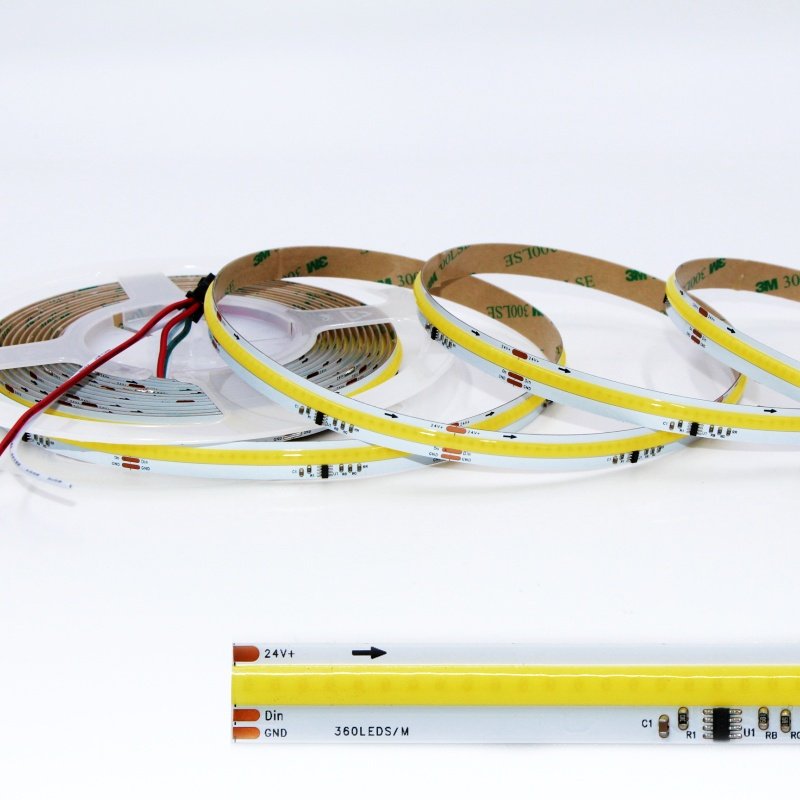
Which Certifications Does the EU Require?
For mains-powered LED strip systems sold in the European Union, the CE marking is the baseline. It is a self-declaration backed by compliance with the Low Voltage Directive, the EMC Directive, and RoHS — supported by test reports rather than a stamp from a lab. Great Britain requires UKCA for products placed on its market. Energy-related rules such as ecodesign requirements apply to finished luminaires, and buyers of strip components should confirm with their suppliers how the rules are passed through. According to industry observation, many EU importers are also preparing for the upcoming digital product passport era under the Ecodesign for Sustainable Products Regulation, which will make traceable product data even more important.
What Does the United States Expect?
The US takes a different route: there is no single federal approval for LED strip lights, but safety certification from a Nationally Recognized Testing Laboratory (UL or ETL) is the de facto requirement — inspectors, retailers, and certification bodies for larger installations expect to see it. Smart or addressable strip systems with wireless control also fall under FCC rules for unintentional radiators. On the energy side, state-level efficiency programs, most visibly in California, keep pushing efficacy requirements upward, which favors higher-density COB and well-driven SMD designs.
Documents to Request From Your Supplier
Experienced buyers treat documentation as part of the product. Before releasing payment, ask for:
- Test reports that match your exact model — including rated voltage, wattage per meter, and IP rating, not a similar family reference.
- The EU Declaration of Conformity — signed by the manufacturer and covering the directives relevant to the product.
- Valid, in-scope certificates — check certificate numbers, validity dates, and whether the certified configuration matches what you order.
- Correct product markings — rated input, trade mark, and traceability codes printed on the strip, reel, or retail box where applicable.
A useful benchmark: the GPD COB 10mm 360D 24V 11W strip ships with documentation structured for EU and US import programs, and the wider COB LED strip range follows the same documentation standard.
Common Pitfalls That Delay Shipments
Three issues cause most of the trouble observed in trade practice. First, model mismatch: the certificate shows one SKU while the invoice shows another, which customs officers and retail auditors read as no certificate at all. Second, recycled reports — documents copied from a different factory or an expired project. Third, assuming one approval covers every market: CE does not open the US market, and a UL file does not satisfy EU directives. Planning certification together with production, not after it, is what keeps delivery dates realistic. More background is available in our Technical Support knowledge base.
Frequently Asked Questions
Is CE marking accepted in the United States?
No. CE applies to EU and related markets. US customers typically expect a safety listing from a Nationally Recognized Testing Laboratory such as UL or ETL, plus FCC compliance for products with radio or digital circuitry.
Who is responsible for compliance — the factory or the importer?
In both the EU and the US, the importer of record carries the legal responsibility. The manufacturer supports the process with test data and declarations, which is why document quality matters when choosing a supplier.
How long does certification take for a new strip model?
According to industry observation, testing and paperwork for a new model usually takes weeks rather than days. Product families with existing reports can be extended much faster, which is worth confirming during supplier selection.
Sourcing certified LED strip lights for the EU or US? GPD Technology manufactures COB and SMD strip lights in Shenzhen with documentation packages prepared for import programs, OEM/ODM configurations, and sample testing. Contact our sales team to request certificates and a quotation.
COB LED Strip Technology Development: A B2B Guide
Over the past few seasons, purchasing teams and lighting specifiers have quietly shifted attention from conventional SMD strip lights to chip-on-board solutions. According to industry observation, COB LED strip technology development has moved from a niche experiment to a mainstream option for retail, hospitality, and architectural projects where smooth, dot-free light matters. This article explains what COB strip lights are, how the technology developed, why B2B buyers increasingly specify it, and what to check before sourcing — so you can brief suppliers with confidence.
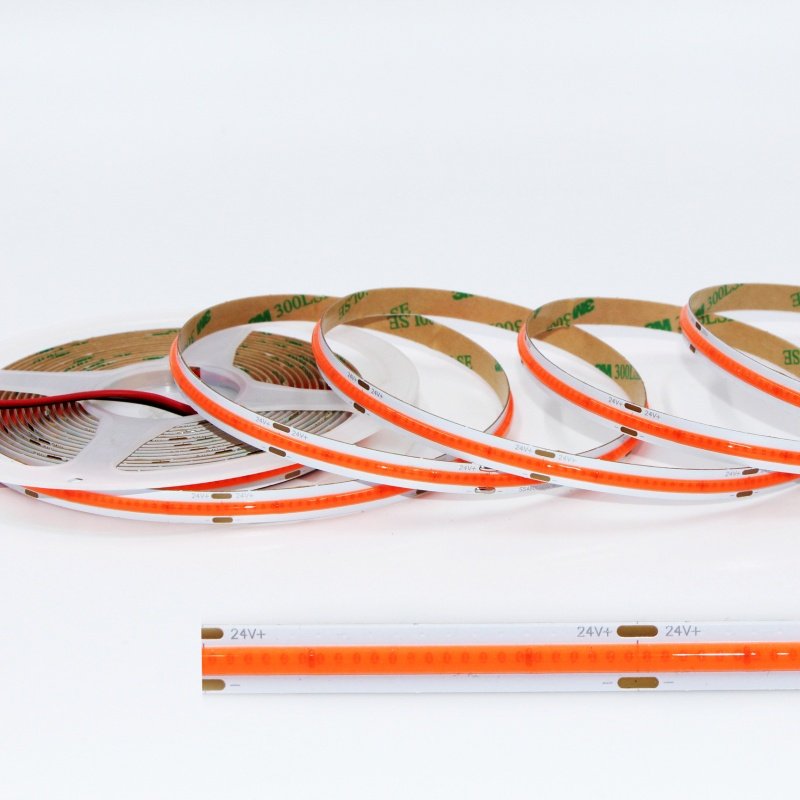
What Is COB LED Strip Technology?
COB stands for chip-on-board. Instead of soldering individual packaged SMD LEDs onto a flexible printed circuit (FPC), COB LED strip lights bond bare LED chips directly onto the board and cover them with a single phosphor gel layer. The whole strip surface becomes one continuous emitter: light comes out as an even line rather than a row of separate points.
For installers this changes the visual result fundamentally. On glossy tiles, marble, or polished metal — surfaces that reflect every LED dot — a COB strip reads as a clean light line, which is why lighting designers often request it for exposed profiles, mirror backlights, and high-end shelving.
How COB LED Strip Technology Development Progressed
The development path is easy to follow. Early flexible strips used 3528 or 5050 SMD packages, which were cheap but produced visible dots and uneven color. High-density SMD designs narrowed the gap, yet the real breakthrough came when manufacturers moved the chips under the phosphor layer. According to industry observation, mainstream COB strips have since climbed from roughly 320 chips per meter to 480–608 chips per meter, with 24V constant-voltage designs becoming the default for longer runs.
Three areas improved the most along the way: light efficacy, color rendering (CRI 90+ is now widely available), and reliability — thicker double-layer FPCs, better thermal adhesives, and more consistent binning. You can browse a typical COB LED strip product range to see how these generations look today.
Why B2B Buyers Are Specifying COB
For project buyers the appeal is practical rather than fashionable. First, uniform output removes the need for extra diffusers in many fixtures, which simplifies assembly and lowers installed cost. Second, light quality sells: in retail displays and hotel corridors, a seamless light line reads as premium. Third, fewer soldered packages mean fewer potential failure points on the board.
In the usual COB vs SMD comparison, SMD strip lights still make sense for coves, budget renovations, and indirect lighting where dots stay hidden. COB earns its premium wherever the strip is seen directly or reflected — a distinction experienced importers now build into their catalogs.
What to Check Before Sourcing COB LED Strips
Because the market has crowded quickly, quality varies noticeably between factories. Before placing an order, experienced buyers typically verify:
- Color consistency across batches — ask how the supplier controls binning, not just for one sample roll.
- Real CRI data — request test reports instead of relying on listing claims.
- Voltage drop — on 24V strips, check brightness at the far end of a five-meter run.
- FPC and adhesive quality — copper thickness and tape grade decide long-term reliability.
- Certification for your market — confirm CE, UKCA, or UL paperwork applies to the exact model you order.
A concrete reference point helps: products such as the GPD COB 10mm 480D 24V strip show the specification level serious buyers should expect from this generation. More testing background is available in our Technical Support knowledge base.
Frequently Asked Questions
Is COB always better than SMD?
No. For hidden coves and budget projects, SMD remains cost-effective. COB wins when the light source is visible or reflected and uniformity matters.
Can COB LED strip lights be dimmed?
Yes. Match the strip to a compatible constant-voltage dimmable driver, and check minimum load and flicker performance before mass production.
What densities and voltages are common?
Mainstream COB strips commonly run from about 320 to 600+ chips per meter, with 24V preferred for longer runs and 12V for short, cut-heavy segments.
Need COB strip lights for your next project? GPD Technology manufactures COB and SMD LED strip lights in Shenzhen with OEM/ODM support, custom lengths, and sample testing for importers, contractors, and distributors. Contact our team for samples and a quotation.
GPD LED Strip Lights Add a Touch of Brilliance to the Home
GPD LED strip lights add a touch of brilliance to the home, mainly in the following aspects:
Ambient Lighting: LED strips can serve as a primary ambient lighting tool, providing soft and even light that helps create a comfortable, cozy home atmosphere. This lighting approach suits modern home decor styles, emphasizing the integration of light effects and furniture, and has largely replaced traditional bulb lighting.
Decorative Effect: LED strips offer a variety of color and lighting-effect options, such as color changing, gradients, and flashing, which can create diverse decorative effects and add interest to living spaces. For example, by choosing waterproof LED strips in attractive colors such as red or orange, you can illuminate a space and provide a dramatic effect.
Flexible Application: Owing to their eco-friendly, low-energy consumption, cuttable, and bendable characteristics, LED strips are widely used in modern home lighting design. These features allow LED strips to adapt to different home layouts and decorative needs, thereby adding a touch of brilliance to the home.
Smart Control: Some LED light strips can be integrated into a smart lighting series, controlled jointly via a remote control or smartphone application. This intelligent control method not only facilitates user operation but also allows light effects to be adjusted as needed, further enhancing home comfort and aesthetics.
Through their characteristics of ambient lighting, decorative effect, flexible application, and smart control, GPD LED strip lights can indeed add a touch of brilliance to the home, making the living space more warm and comfortable.
GPD LED Strip Lights: Innovative Technology Illuminating the Future
Since its establishment, Shenzhen GPD Technology Co., Ltd. has focused on the R&D, manufacturing, and sales of LED strip lights, including flexible LED strips, rigid LED bars, and automotive LED strips.
Leveraging its outstanding technological R&D and manufacturing capabilities, as well as keen market insight, GPD provides a wide range of high-quality products and services to China’s LED product R&D and manufacturing sector. The company’s product portfolio includes not only traditional LED strips but also accessories such as LED strip controllers, demonstrating its comprehensiveness in technological innovation.
In terms of innovation and development of LED lighting technology, innovation in LED lighting is first reflected in energy efficiency. Compared with traditional incandescent and fluorescent lamps, LED lamps offer higher efficacy, converting most electrical energy into light and reducing energy consumption. Furthermore, with the rapid advancement of technology and the booming smart home market, LED lighting technology is being driven toward intelligentization and convenience. For example, Jindingsheng Lighting’s technological innovation combines lighting with smart technology, developing smart LED lamp products capable of remote control, timed switching, and light sensing.
Through continuous technological innovation and market expansion, GPD Technology Co., Ltd. has become an emerging force in China’s LED product R&D and manufacturing. The company’s success is reflected not only in the high quality and broad application of its products, but also in its accurate grasp of industry trends and sustained investment in future technological innovation. With the continuous advancement of LED lighting technology and the expanding market demand, GPD Technology Co., Ltd. is expected to continue leading the innovative development of the LED strip industry in the future.
Dimmable LED Strip Lights: Adjustable Brightness for Every Mood & Scene
Fixed-brightness lighting often limits the comfort of your living space — too bright for relaxation and too dim for daily work. Dimmable LED strip lights solve this problem perfectly by offering full brightness flexibility, letting you tailor lighting intensity to match any moment. As a must-have upgrade for modern homes, these adjustable strips balance practical task lighting and cozy ambient decor, far outperforming traditional fixed lighting fixtures. The core feature of dimmable LED strip lights is seamless brightness adjustment. You can freely dim the light from 1% to 100% without flickering or uneven illumination. Need sharp, bright lighting for reading, cooking, or makeup? Maximize the brightness for clear, detailed visibility. Want soft, warm glow for bedtime relaxation, movie nights, or quiet evenings? Dim the lights gently to create a soothing, low-glare atmosphere. This all-scene adaptability makes them ideal for every room in your home. These adjustable strips greatly improve eye comfort and protect your vision. Harsh, unchangeable bright light causes eye strain, dryness, and fatigue during long-term use, while overly dim light affects concentration. Dimmable LED strips deliver stable, flicker-free soft light with customizable intensity. They eliminate strong light contrast, making them perfect for study rooms, work desks, bedrooms, and kid’s rooms, bringing gentle and eye-friendly lighting for all-day use. Equipped with user-friendly control methods, these lights suit all usage habits. You can adjust brightness via remote control, mobile app, or smart voice assistants like Alexa and Google Home for hands-free operation. Most models support customized timing settings, allowing you to set gradual dimming at night and slow brightening in the morning. This natural lighting transition fits your body rhythm and improves sleep quality effectively. Energy efficiency is another outstanding advantage. Unlike ordinary lights that waste power by staying fully bright all the time, dimmable LED strip lights reduce power consumption when dimmed. Lower brightness means lower energy use, helping you cut down monthly electricity bills easily. Paired with a long service life and stable performance, they become a cost-effective, eco-friendly lighting solution for long-term home use. Ultra-flexible and easy to install, these strips fit diverse scenarios. With bendable bodies and strong self-adhesive backing, they can be installed under cabinets, behind TVs, along ceiling edges, and on headboards without drilling. Compatible with RGB and warm white options, they support both functional lighting and aesthetic decoration for homes, studios, and commercial spaces. If you crave flexible, comfortable, and energy-saving lighting that adapts to your daily routine, our dimmable LED strip lights are the perfect pick. Customize your space brightness and enjoy a smarter, cozier living experience every day.