

Cutting an LED strip in the wrong place, or sealing a cut badly, can quietly ruin an otherwise perfect installation — dark sections, corroded joints, and callback visits that cost more than the strip itself. According to industry observation, most cutting and connection problems trace back to a handful of avoidable mistakes: cutting between marked points, pairing mismatched connectors, and skipping the re-sealing step after cutting waterproof products. This guide walks through how to cut and connect LED strip lights correctly — where to cut, how to join, how to re-seal, and what to check before the profile is closed.
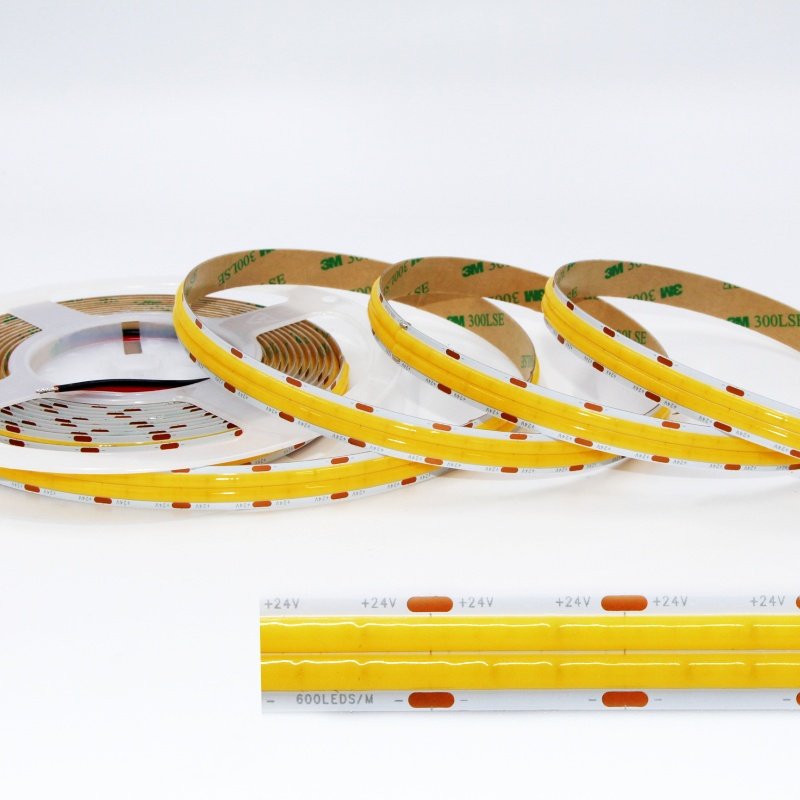
Cut Only at the Marked Points
Every quality strip marks its cutting points — usually a scissor icon or a dashed line with exposed solder pads either side. The copper traces run in pairs or groups, and cutting anywhere else severs the circuit for everything beyond the cut. According to industry observation, this is the single most common DIY and even contractor mistake: cutting to an arbitrary measured length instead of to the nearest marked point. The professional approach is to measure to the nearest cut line on the relevant side, confirm with the strip datasheet for the exact product — COB strips and high-density designs can have tighter cut-point spacing than standard SMD — and cut squarely with sharp scissors or a blade in one clean pass. For high-voltage strips, cutting is restricted to marked intervals entirely, per the certification file.
Soldering Versus Clip Connectors
Two ways to join a cut: soldering leads directly to the pads, or using snap-on clip connectors. Soldering is the more reliable connection — especially for anything beyond dry interior use — but demands a steady hand, the right temperature, and tinned wires. Clips are fast and tool-free but their contacts corrode in damp environments and lose tension over time, the failure pattern covered in our connector failures guide. The professional split: solder and heat-shrink for permanent, hidden, or damp installations; clips for dry interior work where adjustments are likely. Whichever method, the polarity must match strip to strip — reversing positive and negative on a single-color strip does nothing, and on addressable products scrambles the data line.
Re-Sealing After Cutting Waterproof Strip
Cutting waterproof strip destroys its seal, and the IP rating only survives if the cut is rebuilt correctly. The process: clean the cut end, attach a IP-rated end cap or termination with adhesive or potting that covers the joint fully, and let the sealant cure completely before any moisture exposure. According to industry observation, the most common post-cut failure is a partially sealed end — adhesive on the edges but not over the copper — which passes a visual check and fails in the first rain. For strip mounted inside profiles, the profile’s end caps carry the sealing duty instead, and the spec should name the assembled system’s rating, as covered in our tender specification guide.
Checks Before the Profile Closes
The last step costs nothing and prevents the most callbacks: test every section before final assembly. Power each cut and connected length, confirm brightness at both ends, check polarity and any controllable sections, and inspect each joint under magnification if the installation is hidden or hard to access. Only after every section lights correctly should profiles be closed and surfaces finished — because the difference between a five-minute fix and a ceiling rework is whether the test happened before or after the strip became inaccessible.
Frequently Asked Questions
Can LED strip be cut anywhere between the marked points?
No — the marks exist because the copper pads sit there. Cutting between them severs the circuit beyond the cut and leaves no solderable surface for a connection.
Do COB strips cut differently from SMD strips?
The principle is the same — cut at the marks — but COB pads sit closer to the chips and the phosphor layer covers the board, so a clean square cut and gentle handling matter more to avoid damaging the emission layer.
How should waterproof strip be re-sealed after cutting?
With a rated end cap or potted termination covering the joint completely, cured fully before exposure — and the assembled rating should be treated as restored only after a quick water or spray check on a sample.
Cutting and connecting strip lights for a project? GPD Technology manufactures COB and SMD LED strip lights in Shenzhen with clear cut-point marking, documented termination guidance, and IP re-sealing accessories for importers, contractors, and distributors. Contact our team for products and process support.
