

For importers of LED strip lights, certification is where compliance, cash flow, and delivery schedules intersect. According to industry observation, shipments between the EU and US are still delayed more often by paperwork gaps than by product faults: a missing Declaration of Conformity, a test report that does not match the invoice model, or markings that never made it onto the product. This guide summarizes LED strip certification requirements in the EU and US markets and lists the documents to demand from your supplier before wiring a deposit.
Which Certifications Does the EU Require?
For mains-powered LED strip systems sold in the European Union, the CE marking is the baseline. It is a self-declaration backed by compliance with the Low Voltage Directive, the EMC Directive, and RoHS — supported by test reports rather than a stamp from a lab. Great Britain requires UKCA for products placed on its market. Energy-related rules such as ecodesign requirements apply to finished luminaires, and buyers of strip components should confirm with their suppliers how the rules are passed through. According to industry observation, many EU importers are also preparing for the upcoming digital product passport era under the Ecodesign for Sustainable Products Regulation, which will make traceable product data even more important.
What Does the United States Expect?
The US takes a different route: there is no single federal approval for LED strip lights, but safety certification from a Nationally Recognized Testing Laboratory (UL or ETL) is the de facto requirement — inspectors, retailers, and certification bodies for larger installations expect to see it. Smart or addressable strip systems with wireless control also fall under FCC rules for unintentional radiators. On the energy side, state-level efficiency programs, most visibly in California, keep pushing efficacy requirements upward, which favors higher-density COB and well-driven SMD designs.
Documents to Request From Your Supplier
Experienced buyers treat documentation as part of the product. Before releasing payment, ask for:
- Test reports that match your exact model — including rated voltage, wattage per meter, and IP rating, not a similar family reference.
- The EU Declaration of Conformity — signed by the manufacturer and covering the directives relevant to the product.
- Valid, in-scope certificates — check certificate numbers, validity dates, and whether the certified configuration matches what you order.
- Correct product markings — rated input, trade mark, and traceability codes printed on the strip, reel, or retail box where applicable.
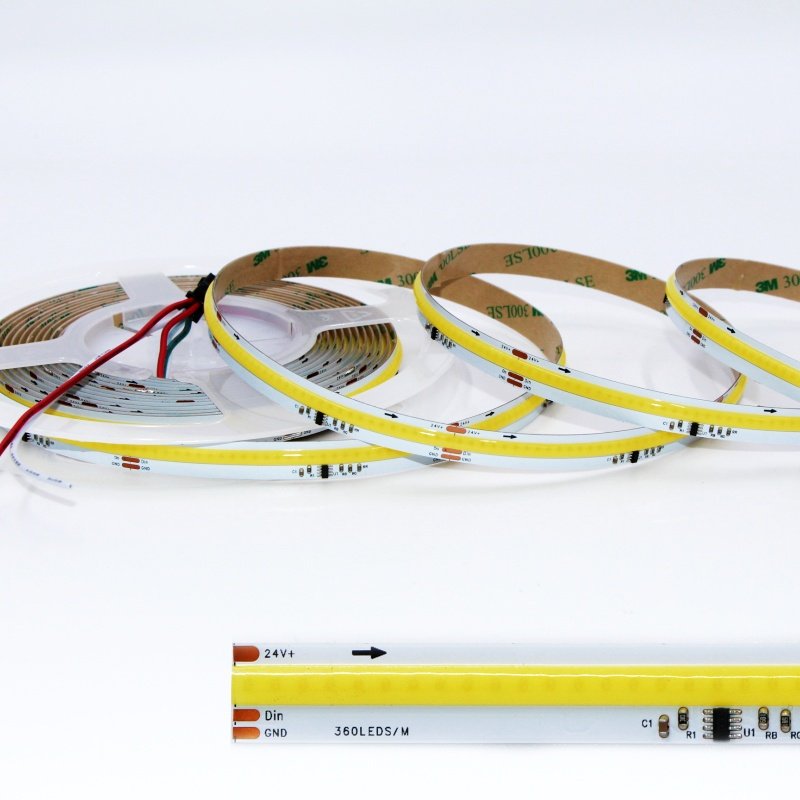
A useful benchmark: the GPD COB 10mm 360D 24V 11W strip ships with documentation structured for EU and US import programs, and the wider COB LED strip range follows the same documentation standard.
Common Pitfalls That Delay Shipments
Three issues cause most of the trouble observed in trade practice. First, model mismatch: the certificate shows one SKU while the invoice shows another, which customs officers and retail auditors read as no certificate at all. Second, recycled reports — documents copied from a different factory or an expired project. Third, assuming one approval covers every market: CE does not open the US market, and a UL file does not satisfy EU directives. Planning certification together with production, not after it, is what keeps delivery dates realistic. More background is available in our Technical Support knowledge base.
Frequently Asked Questions
Is CE marking accepted in the United States?
No. CE applies to EU and related markets. US customers typically expect a safety listing from a Nationally Recognized Testing Laboratory such as UL or ETL, plus FCC compliance for products with radio or digital circuitry.
Who is responsible for compliance — the factory or the importer?
In both the EU and the US, the importer of record carries the legal responsibility. The manufacturer supports the process with test data and declarations, which is why document quality matters when choosing a supplier.
How long does certification take for a new strip model?
According to industry observation, testing and paperwork for a new model usually takes weeks rather than days. Product families with existing reports can be extended much faster, which is worth confirming during supplier selection.
Sourcing certified LED strip lights for the EU or US? GPD Technology manufactures COB and SMD strip lights in Shenzhen with documentation packages prepared for import programs, OEM/ODM configurations, and sample testing. Contact our sales team to request certificates and a quotation.

5 thoughts on “LED Strip Certification Requirements EU US: Buyer Guide”