
Private-label and custom LED strip programs are where importers either build durable margin or slowly lose their differentiation. According to industry observation, more distributors and lighting brands are moving from catalog purchases to factory-direct OEM and ODM cooperation — yet many still treat “OEM” and “ODM” as the same thing, and only discover the difference after samples, lead times, or intellectual property go wrong. These LED strip OEM ODM sourcing insights summarize how the two models differ, how to evaluate a factory, and which customization options actually deserve your budget.
OEM and ODM Are Two Different Commitments
In an OEM relationship, you bring a defined specification and the factory builds to it under your brand. In an ODM relationship, the factory contributes the design: existing platforms, engineering adjustments, and tooling that you customize rather than invent. For LED strip lights the practical dividing line is who owns the specification. If your team defines the FPC width, chip density, voltage, CCT, and packaging, you are buying OEM. If you start from the factory’s platform and adapt it, that is ODM — usually faster and cheaper, but with shared designs your competitors may also access unless you negotiate exclusivity.
How to Evaluate an LED Strip Factory
Factory evaluation for strip lights should focus on process ownership. Ask which steps happen in-house: SMT or COB bonding, phosphor coating, aging, IP encapsulation, and QC. A factory that controls bonding and aging can react to quality issues within days; one that outsources them will always point upstream. Request a walk-through of QC equipment — colorimeters for binning control, aging racks that run full reels, and IP test gear if you buy waterproof configurations. According to industry observation, factories with in-house engineering support also resolve customization questions faster, which matters more than a marginally lower unit price. The COB LED strip range on our site reflects what a vertically organized program looks like in catalog form.
Customization Options Worth Asking For
LED strip customization is modular, and not every option carries the same cost or lead-time impact:
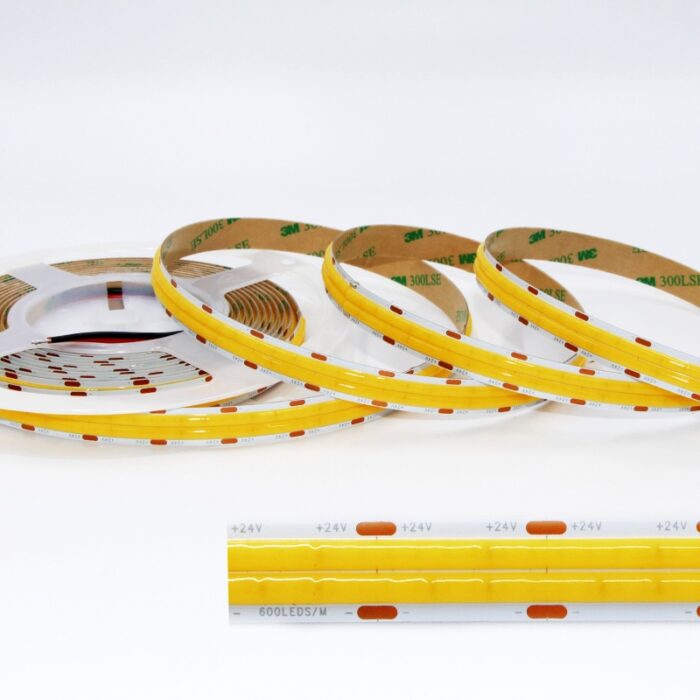
- Electrical basics — voltage (12V/24V), chip density, and wattage per meter; 24V high-density builds such as the GPD COB 12mm 600D 24V 24W strip suit long runs with demanding uniformity.
- Light quality — CCT range, CRI tier, and binning strategy; these define perceived quality more than raw output.
- Mechanical and environmental — PCB width and color, cut points, connector types, and IP rating for the installation environment.
- Brand experience — private-label reels, instruction sheets, and retail packaging; low-cost changes with high shelf impact.
According to industry observation, electrical and light-quality changes reuse existing materials and add little lead time, while new IP encapsulation or custom FPC tooling moves schedules — plan those earlier.
Protect Your Designs and Your Margin
OEM and ODM cooperation only pays off if the assets you create stay yours. Sign NDAs before sharing specifications, agree in writing whether tooling and phosphor formulations are exclusive to your orders, and keep a locked specification document that references your test reports — the compliance paperwork described in our Technical Support knowledge base is part of that package. Buyers who skip this step often find their “custom” strip quoted to competitors within a season.
Frequently Asked Questions
What MOQ should I expect for OEM or ODM strip lights?
Standard platforms adapted to your brand usually carry low or no effective MOQ beyond normal batch sizes. Fully custom FPC or packaging typically needs higher volumes to justify tooling; ask suppliers to separate tooling cost from unit cost so you can compare honestly.
How long does OEM sampling take?
For adaptations of existing platforms, samples are commonly ready within a few weeks according to industry observation; fully custom configurations take longer because materials must be procured before assembly can start.
Can my brand appear on the product itself?
Yes in most cases — printed reels, retail boxes, and instruction sheets are standard private-label options. Confirm trademark authorization and artwork formats early so packaging does not become the bottleneck.
Planning an OEM or ODM strip program? GPD Technology manufactures COB and SMD LED strip lights in Shenzhen with in-house bonding, aging, and IP lines, supporting private-label and custom configurations for importers, brands, and contractors. Contact our team to start with samples and a specification review.
