

Over the past few seasons, purchasing teams and lighting specifiers have quietly shifted attention from conventional SMD strip lights to chip-on-board solutions. According to industry observation, COB LED strip technology development has moved from a niche experiment to a mainstream option for retail, hospitality, and architectural projects where smooth, dot-free light matters. This article explains what COB strip lights are, how the technology developed, why B2B buyers increasingly specify it, and what to check before sourcing — so you can brief suppliers with confidence.
What Is COB LED Strip Technology?
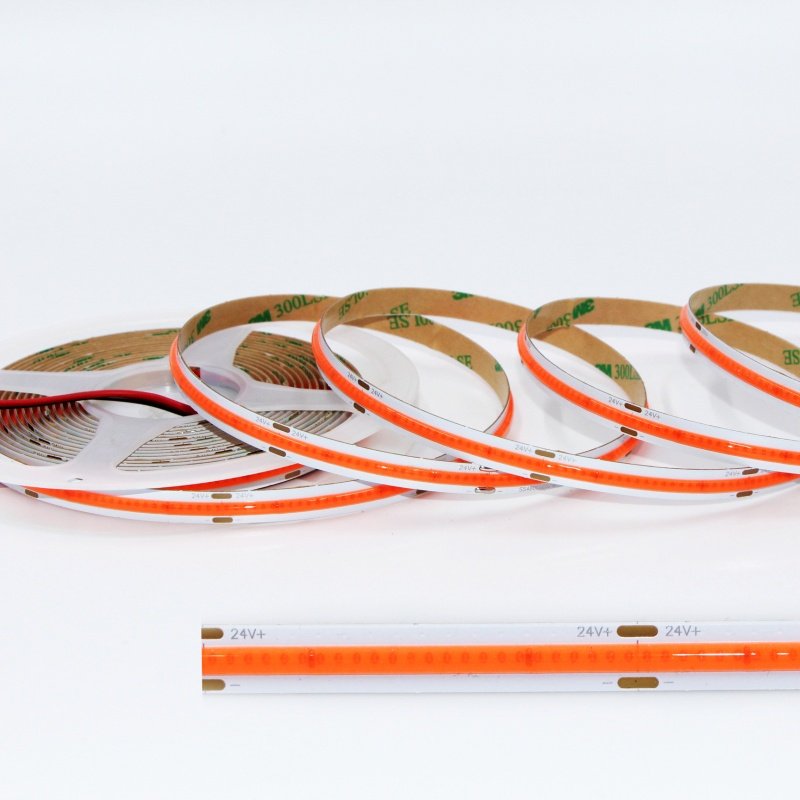
COB stands for chip-on-board. Instead of soldering individual packaged SMD LEDs onto a flexible printed circuit (FPC), COB LED strip lights bond bare LED chips directly onto the board and cover them with a single phosphor gel layer. The whole strip surface becomes one continuous emitter: light comes out as an even line rather than a row of separate points.
For installers this changes the visual result fundamentally. On glossy tiles, marble, or polished metal — surfaces that reflect every LED dot — a COB strip reads as a clean light line, which is why lighting designers often request it for exposed profiles, mirror backlights, and high-end shelving.
How COB LED Strip Technology Development Progressed
The development path is easy to follow. Early flexible strips used 3528 or 5050 SMD packages, which were cheap but produced visible dots and uneven color. High-density SMD designs narrowed the gap, yet the real breakthrough came when manufacturers moved the chips under the phosphor layer. According to industry observation, mainstream COB strips have since climbed from roughly 320 chips per meter to 480–608 chips per meter, with 24V constant-voltage designs becoming the default for longer runs.
Three areas improved the most along the way: light efficacy, color rendering (CRI 90+ is now widely available), and reliability — thicker double-layer FPCs, better thermal adhesives, and more consistent binning. You can browse a typical COB LED strip product range to see how these generations look today.
Why B2B Buyers Are Specifying COB
For project buyers the appeal is practical rather than fashionable. First, uniform output removes the need for extra diffusers in many fixtures, which simplifies assembly and lowers installed cost. Second, light quality sells: in retail displays and hotel corridors, a seamless light line reads as premium. Third, fewer soldered packages mean fewer potential failure points on the board.
In the usual COB vs SMD comparison, SMD strip lights still make sense for coves, budget renovations, and indirect lighting where dots stay hidden. COB earns its premium wherever the strip is seen directly or reflected — a distinction experienced importers now build into their catalogs.
What to Check Before Sourcing COB LED Strips
Because the market has crowded quickly, quality varies noticeably between factories. Before placing an order, experienced buyers typically verify:
- Color consistency across batches — ask how the supplier controls binning, not just for one sample roll.
- Real CRI data — request test reports instead of relying on listing claims.
- Voltage drop — on 24V strips, check brightness at the far end of a five-meter run.
- FPC and adhesive quality — copper thickness and tape grade decide long-term reliability.
- Certification for your market — confirm CE, UKCA, or UL paperwork applies to the exact model you order.
A concrete reference point helps: products such as the GPD COB 10mm 480D 24V strip show the specification level serious buyers should expect from this generation. More testing background is available in our Technical Support knowledge base.
Frequently Asked Questions
Is COB always better than SMD?
No. For hidden coves and budget projects, SMD remains cost-effective. COB wins when the light source is visible or reflected and uniformity matters.
Can COB LED strip lights be dimmed?
Yes. Match the strip to a compatible constant-voltage dimmable driver, and check minimum load and flicker performance before mass production.
What densities and voltages are common?
Mainstream COB strips commonly run from about 320 to 600+ chips per meter, with 24V preferred for longer runs and 12V for short, cut-heavy segments.
Need COB strip lights for your next project? GPD Technology manufactures COB and SMD LED strip lights in Shenzhen with OEM/ODM support, custom lengths, and sample testing for importers, contractors, and distributors. Contact our team for samples and a quotation.
