

An IP rating printed on a datasheet is a claim; reliability is what happens after six months of humidity, heat cycles, and handling on site. According to industry observation, most waterproof strip failures traced back by importers were not mysterious — they were ingress points that a proper test would have exposed before shipment. This guide explains what IP rated LED strip reliability testing actually covers, how capable factories verify waterproof designs, and which test data buyers should request before committing to an order.
What IP Ratings Mean — and What They Do Not
The IP code has two digits: the first grades protection against solids, the second against water. For strip lights the common tiers are IP20 for dry interiors, IP54 for damp locations, IP65 for splash-exposed runs, and IP67/IP68 for soak-prone or outdoor installations. What the rating does not describe is lifetime. A strip can pass a water ingress test once and still fail early if the encapsulation overheats, the adhesive creeps, or the end caps separate under thermal cycling. Reliability, in other words, is the rating plus everything around it.
How Capable Factories Test Waterproof Strips
Serious factories verify IP designs with a sequence rather than a single check: water column or spray testing per the declared grade, soak tests for IP67/IP68 builds, then power-on aging of sealed reels so failures surface under real electrical load. According to industry observation, aging is where weak encapsulation and poor end-cap bonding reveal themselves — which is why factories that run full-reel powered aging can catch defects that a visual inspection never will. Thermal cycling between hot and cold chambers adds another layer, especially for outdoor configurations that expand and contract daily in service.
The Test Data to Request From Suppliers
Buyers should treat test documentation as a deliverable, not a courtesy. Before placing an order, request:
- Model-matched IP test reports — the report must reference the exact product and voltage you are buying, not a similar family.
- Aging records — powered aging duration and sampling method, ideally with photos of the aged reels.
- Thermal and insulation data — dielectric strength or insulation resistance results for sealed builds.
- Batch-level consistency — how IP integrity is verified across production runs, since one passing sample does not describe a shipment.
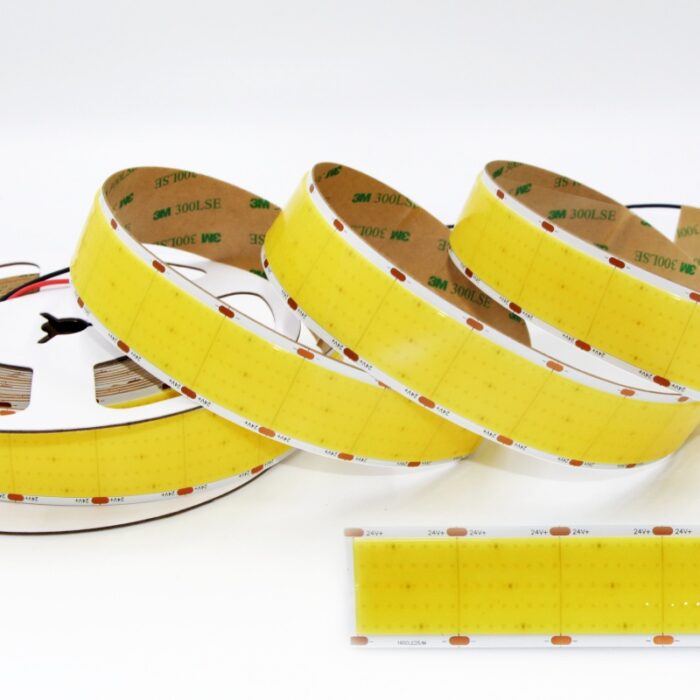
A useful reference point: the GPD COB 30mm 1600D 24V 40W strip and the wider COB LED strip range are supported by this style of documentation, which is what allows buyers to match certificates to models — the discipline described in our EU and US certification guide.
Red Flags Buyers Should Watch
Several patterns deserve caution. Generic reports with no model number or photos. IP68 claims on strips whose end caps are sealed by glue alone without mechanical retention. Prices far below comparable waterproof builds — sealing materials and testing cost money, and the difference shows up somewhere. And factories that cannot explain their own test sequence in a call. None of these proves a bad product, but together they predict the complaints that surface after installation rather than before shipment.
Frequently Asked Questions
Is IP68 always better than IP65?
Not automatically. IP68 describes soak protection, often with a permanently sealed build that can be harder to cut and terminate. IP65 suits splash-exposed runs; choose by installation reality, not by the biggest number.
Can IP20 strips be used outdoors inside profiles?
Yes, when the profile system provides the protection — with rated end caps and diffuser sealing. The specification should then describe the assembled system, because the strip alone no longer defines ingress protection.
How is reliability verified after delivery?
On receipt, buyers commonly sample-test lengths for ingress and insulation, then power-age a portion of the shipment. Any failure pattern should be raised with the supplier against the agreed test reports.
Sourcing IP-rated COB strip lights and need the test data to match? GPD Technology manufactures COB and SMD strip lights in Shenzhen with in-house aging and waterproof verification, supporting importers and contractors with model-matched reports. Contact our team to request samples and documentation.
