

Few strip light complaints are as expensive as mixed whites: a hotel corridor where one floor reads warmer than the next, or a retail wall where two runs of the “same” product visibly disagree. According to industry observation, these cases usually trace back to one skipped step — color binning discipline. This guide explains how the LED strip color consistency binning standard works in practice, why identical-looking datasheets can still produce different whites, and the batch data buyers should request so projects never mix visibly different light.
What Binning Actually Means
LED chips are never perfectly identical. Manufacturing variations place every chip somewhere on a range of color temperature, brightness, and forward voltage — and binning is the factory’s act of sorting those chips into groups. The industry describes tightness in MacAdam ellipses (SDCM): a 3-step bin means the color deviation is small enough that most observers cannot distinguish two adjacent groups side by side, while 5-step and wider bins produce whites that trained eyes — and increasingly, untrained eyes — can tell apart. For strip lights, binning discipline extends beyond the chips: the phosphor mix applied over COB lines and the quality of downstream assembly must hold the sorted chips within their promised window.
Why Strips From the Same Factory Can Still Look Different
Even with sorted chips, several points in the chain can drift. Chip suppliers revise their own processes, so this quarter’s “same” chip may sit in a slightly different bin than last quarter’s. Phosphor and coating batches vary. And on long production runs, equipment warm-up and material changeovers shift output at the margins. COB construction helps — the continuous phosphor layer blends small chip-level differences — but according to industry observation it reduces visible variation rather than eliminating the need for binning. High-density COB strip lights still depend on their chips being sorted and matched before bonding.
The Batch Data Buyers Should Request
Binning claims belong in documentation, not in sales conversations. Before scaling an order, professional buyers ask for:
- Per-batch SDCM values — the measured color deviation of the actual production batch, not a generic family specification.
- CRI or TM-30 data at the ordered CCT — for tunable products, at both ends of the range.
- Adjacent-reel photos — reels from the same run lit side by side, which reveal seams faster than numbers.
- Locked CCT windows per order — a written commitment that repeat orders ship from the same binning window as the approved sample.
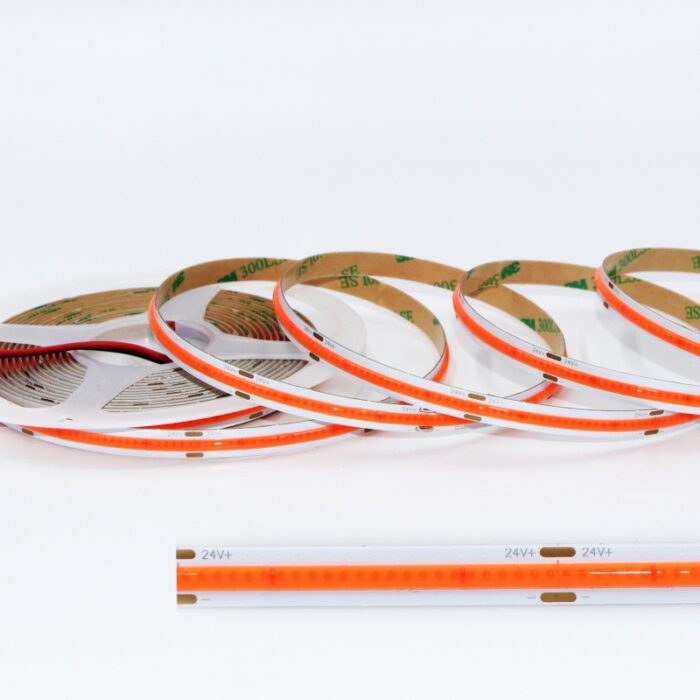
A practical benchmark: the GPD COB 10mm 480D 24V strip and the wider COB LED strip range are supported by exactly this style of batch documentation — the depth that keeps multi-phase projects consistent from first floor to last.
Turning Binning Into a Contract Term
The strongest buyers convert binning from a hope into a term of trade. Specify the maximum SDCM in the purchase order, name the approved sample reel as the reference standard, and require re-confirmation whenever production moves to new materials or a new production date. Keeping the approved reel on hand at the factory — rather than only in your warehouse — makes every later shipment comparable against the same physical target. According to industry observation, suppliers respond well to this structure — it gives their production teams a clear target and removes the ambiguity that turns small color shifts into large disputes.
Frequently Asked Questions
What SDCM should I accept for my project?
For most indoor applications, 3-step SDCM is the professional expectation. Retail, hospitality, and any installation where two runs sit adjacent justify requesting tighter windows or single-batch supply.
Does COB construction remove the need for binning?
No. The phosphor layer blends chip-level differences into a smooth line, but if the underlying chips span a wide bin range, the overall tone still drifts between batches.
Why did two orders of the same strip look different?
Most often the two orders were produced from different binning windows or different production dates. A locked binning window in the purchase order prevents exactly this scenario.
Do tunable white strips have the same binning concerns?
Even more so — both channels must stay matched as they age, or the tuned point drifts. Ask tunable suppliers for binning data at both CCT extremes, not just one.
Need color-consistent strip lights across batches and projects? GPD Technology manufactures COB and SMD LED strip lights in Shenzhen with per-batch binning control and documentation, supporting importers, contractors, and distributors. Contact our team for samples and specification data.

One thought on “LED Strip Color Consistency Binning Standard: Buyer Guide”