
The far end of a long LED strip run looks dimmer than the feed end, and no amount of driver quality fixes it. The cause is voltage drop — a physics issue, not a product defect — and according to industry observation it is one of the most common avoidable problems in strip light projects. This guide explains why voltage drop happens in long LED strip runs, how 24V systems and power injection solve it, and the planning rules contractors and importers should apply before installation begins.
Why Voltage Drop Happens in LED Strip Runs
Every strip has electrical resistance in its copper traces, and resistance consumes voltage as current travels along the run. The result is a brightness gradient: full output at the feed point, progressively dimmer toward the far end, most visible in warm CCTs and in the first meter beyond the feed. The effect grows with three factors: run length, current draw per meter, and trace resistance — which is why the same wattage behaves differently on a narrow strip than on a wide one, and why planning matters before the profile is closed and the ceiling is closed above it.
The 24V Advantage for Long Runs
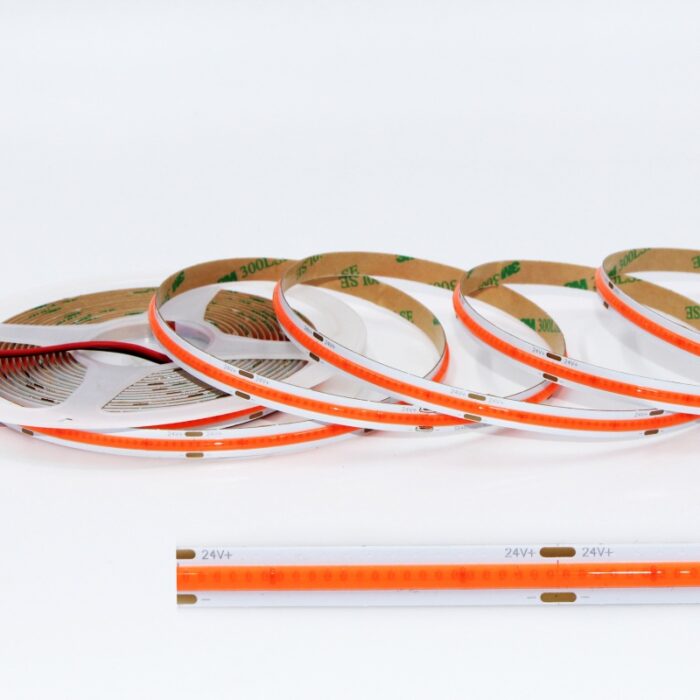
Voltage drop scales with current, and current halves when voltage doubles for the same wattage. That single relationship is why 24V strip lights have become the default for anything beyond short segments: the same run at 24V suffers roughly half the voltage drop of a 12V equivalent, allowing longer single-feed distances and thinner wiring. According to industry observation, most visible voltage-drop complaints on commercial projects trace back to 12V strip pushed into runs that should have been 24V — a specification decision, not a manufacturing fault. For new projects, the GPD COB 10mm 480D 24V strip illustrates the format: high density on a 24V platform built for extended runs.
Power Injection: How It Works and Where to Add It
When a single feed is not enough, power injection solves what voltage cannot: additional feeds deliver power at points along the run so no section sits too far from its supply. The practical patterns are feeding both ends of a run, or injecting at intervals from a central driver location. Two rules keep injection reliable: keep injection feeds short and adequately sized, and inject power only — the data line in addressable or controllable systems still needs its own clean routing. According to industry observation, most injection failures come from undersized injection wires or from connecting feeds with even slightly different voltages, which forces current between them instead of into the strip.
Specification and QC Checks for Long Runs
Voltage drop planning belongs in the specification, not just in the installer’s head. The requirements that prevent complaints: maximum run length per feed stated by the supplier, power-injection points marked on the layout, wire gauge for feeds and injections, and a verification method — measuring brightness at the far end before the profile is closed. Batch consistency matters too: reels from the same production window age and dim together, as covered in our color consistency guide. Importers sourcing for long-run projects should ask factories to confirm injection intervals and wire recommendations in writing. More selection background is available in our Technical Support knowledge base.
Frequently Asked Questions
How long can 24V strip run without power injection?
It depends on wattage per meter and trace design, so there is no universal number — ask the factory for the maximum run per feed for the exact model, and plan injection beyond that length rather than accepting a gradient.
Does voltage drop damage the strip?
No — the strip simply outputs less light toward the far end. The risk is aesthetic (visible gradients) and practical (rework after installation), not product damage.
Can 12V and 24V strips share one driver?
No. Voltage must match the strip exactly. Mixing 12V and 24V products on one output damages the 12V strip — a frequent finding according to industry observation when systems are expanded without a voltage plan.
Planning long-run strip lighting and need the injection details right? GPD Technology manufactures COB and SMD LED strip lights in Shenzhen with 24V long-run platforms, documented injection intervals, and specification support for importers, contractors, and distributors. Contact our team to review your run lengths before ordering.

3 thoughts on “LED Strip Voltage Drop: Planning Power Injection for Long Runs”